 Ferndale Siding
 Why We Only Install One Brand of Siding
Most siding contractors will sell you whatever product you point at. We don't work that way. After years of tear-offs, warranty claims, and callbacks across Whatcom County, we made a decision: James Hardie fiber cement is the only siding we install. Not because it's the cheapest option, and not because of a manufacturer incentive — because it's the only product we've found that consistently holds up to what Ferndale weather does to a house over 20, 30, and 40 years.
This page explains the reasoning in plain terms: what our climate actually does to exterior materials, what James Hardie is made of and why that matters, which product lines exist and what they're for, and what a correct installation involves. No hype, no invented numbers — just what we've learned from doing this work locally.
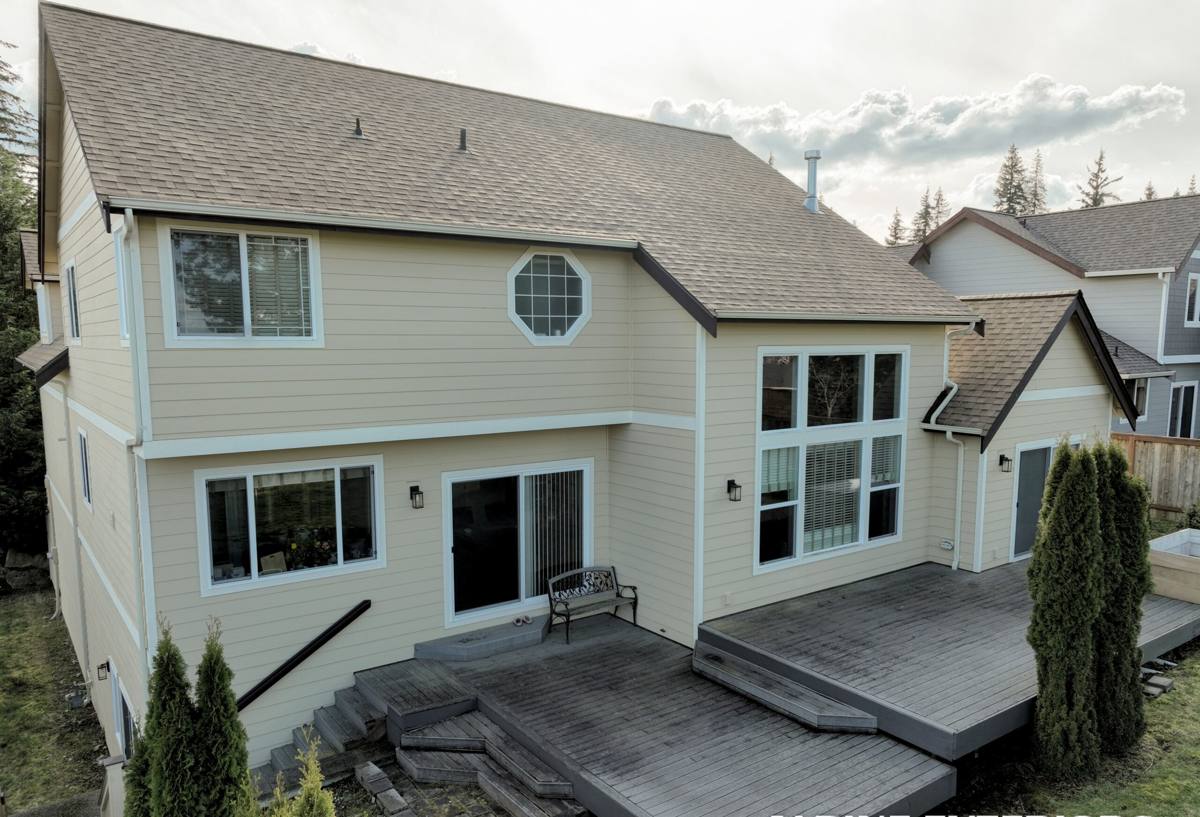
What Ferndale and Whatcom County Weather Does to a House
Ferndale sits close enough to Bellingham Bay and the Strait of Georgia that salt-laden air is a real factor on the west and north sides of most homes, especially anything within a few miles of the water. Add in the Pacific Northwest's driving, wind-pushed rain — not gentle vertical rainfall, but rain that gets pushed sideways into wall assemblies during winter storms — and you have two forces working against siding at the same time: moisture intrusion and corrosion.
Then there's moss. Whatcom County's shaded, damp conditions from late fall through spring create a long moss and algae season on north-facing walls, under eaves, and anywhere airflow is limited. Moss holds moisture against a surface for months at a time. On materials that aren't dimensionally stable or that rely on a field-applied paint film for protection, that sustained dampness is where rot, delamination, and coating failure start.
Any siding product can look fine on a sunny install day. The real test is what it looks like after ten Whatcom County winters.
The Three Things We're Actually Protecting Against
- Wind-driven rain forcing moisture behind and into the siding at laps, seams, and fastener points
- Sustained dampness from moss, shade, and short winter days that don't allow surfaces to dry out
- Salt air corrosion on fasteners, trim, and any exposed metal components near the water
What James Hardie Fiber Cement Actually Is
James Hardie siding is a fiber cement composite — a mix of Portland cement, sand, cellulose fiber, and water, cured and formed under controlled factory conditions into lap boards, panels, and trim. It is not a plastic composite, not a wood product, and not vinyl. That composition is the whole reason it performs differently than the alternatives.
Because it's cement-based, it doesn't absorb moisture the way wood-based siding does, it doesn't warp or cup the way vinyl can in temperature swings, and it's non-combustible — a genuine safety consideration, not a marketing line, since fiber cement doesn't contribute fuel to a fire the way wood-based products do. It also holds paint and factory finishes far better than wood substrates because it's dimensionally stable; it doesn't expand and contract with moisture the way wood fiber does, so the finish isn't constantly being stressed and cracked from underneath.
HZ5 Climate Engineering: Built for This Exact Region
James Hardie engineers several versions of its product for different climate zones across the country, and the Pacific Northwest falls under what Hardie calls its HZ5 engineering — formulated specifically for regions with high moisture exposure and freeze-thaw cycling. That's not a marketing tier; it changes the actual formulation and moisture-resistance performance of the board for our climate versus, say, the Southwest.
For a house in Ferndale, that means the siding is engineered around the same conditions we described above — sustained rain exposure, damp shaded areas, and the freeze-thaw swings that happen here in winter. It's one of the reasons we don't substitute a generic fiber cement product from another manufacturer: the climate-specific engineering is part of what you're actually buying.
ColorPlus Technology: Why Factory Finish Beats Field Paint
One of the most overlooked differences between siding products is how the color gets on the board. Many siding materials — primed wood, some fiber cement competitors — are painted after installation, in the field, exposed to whatever weather conditions exist that week. James Hardie's ColorPlus finish is baked on in a factory under controlled conditions, in multiple coats, with a finish that's engineered to resist fading and chipping.
The practical difference for a homeowner: a field-painted siding job is only as good as the weather, prep, and paint quality on the day it was applied, and it will need repainting on a cycle. A factory-finished ColorPlus board arrives with a consistent, cured finish and a paint warranty backed by the manufacturer — not a repaint schedule you have to manage yourself.
The James Hardie Product Lines
We install several Hardie product lines depending on the style of the home and what the homeowner is trying to achieve. Each has a different look and a different application.
| Product Line | What It Looks Like | Best Fit For |
|---|---|---|
| HardiePlank Lap Siding | Traditional horizontal lap boards | Most single-family homes; the most common choice |
| HardiePanel Vertical Siding | Large vertical sheets, often with battens | Modern/farmhouse styles, accent walls, gables |
| HardieShingle Siding | Staggered or straight-edge shingle look | Craftsman and cottage-style homes |
| HardieTrim Boards | Smooth or textured trim stock | Corner boards, window/door trim, fascia |
| HardieSoffit Panels | Vented or non-vented flat panels | Eaves and overhangs, moisture and pest resistance |
A well-designed Hardie exterior usually mixes two or three of these lines — lap siding for the field, a different texture or panel for an accent, and matching trim throughout — so the house has real dimension rather than one flat surface.
Why Installation Quality Matters as Much as the Product
Fiber cement is not a forgiving product to install incorrectly, and this is where a lot of siding jobs — with any brand — go wrong. James Hardie publishes detailed installation requirements around fastening patterns, clearances, flashing, and caulking, and those requirements exist because they directly determine whether water gets managed correctly at seams, penetrations, and the bottom edge of the wall.
A few installation details that matter more here than in drier climates:
- Proper clearance between the bottom of the siding and grade, decks, or roof lines so wind-driven rain doesn't wick up into the board
- Correct fastener type and placement — stainless or coated fasteners near the water to resist salt-air corrosion
- A weather-resistant barrier and rainscreen gap behind the siding so any moisture that does get in can drain and the wall can dry
- Factory-cut edges primed and sealed at every field cut, since an exposed raw edge is where moisture intrusion starts
- Correct caulking at butt joints and trim intersections — not gapped, not overfilled
This is also part of why we don't install competing products: a manufacturer's warranty is only as good as the installation behind it, and we'd rather stand fully behind one system we install correctly every time than spread our crews thin across five products with five different installation standards.
The Warranty, and What It Actually Covers
James Hardie backs its siding with a non-prorated limited warranty on the substrate, and ColorPlus finishes carry their own finish warranty covering fading, chipping, and cracking of the factory finish. Both are transferable to a subsequent homeowner within the warranty period, which matters for resale — a documented, transferable warranty is something a buyer's inspector and agent will both notice.
Warranty terms and exact coverage periods are set by James Hardie and can change, so we walk homeowners through the current warranty documentation for their specific product line at the time of installation rather than quoting numbers that may be outdated by the time the job is scheduled.
What This Costs, and What Drives the Number
We don't publish blanket per-square-foot pricing because it depends on too many project-specific factors, but these are the real cost drivers on a Whatcom County Hardie job:
| Factor | Why It Affects Cost |
|---|---|
| Tear-off vs. new construction | Removing and disposing of existing siding adds labor and dump fees |
| Substrate condition | Rotted sheathing found during tear-off needs repair before siding goes on |
| Product line mix | Lap-only jobs cost less than jobs mixing panel, shingle, and trim accents |
| Home complexity | Gables, dormers, and cut-up wall lines mean more trim and labor per square foot |
| Rainscreen/drainage system | A proper drainage gap adds material and labor but pays off in our wet climate |
Any quote we give walks through these line items specifically for your house rather than a flat number pulled from a rate sheet.
What to Expect and Ask For
Whether you hire us or another contractor, here's what a homeowner in this climate should expect from a legitimate Hardie installation:
- A written scope specifying which Hardie product lines are being used where
- Confirmation of HZ5-engineered product for this climate zone
- A stated rainscreen/drainage plan behind the siding
- Fastener specification (stainless or coated, appropriate for salt-air exposure)
- Proof of James Hardie Preferred Contractor or similar manufacturer credentialing
- Clear warranty documentation, including transferability, provided before work begins
If a contractor can't answer these specifics, that's worth noticing before you sign anything.
Get an Honest Look at Your Home
Every house in Ferndale carries the marks of our climate differently depending on exposure, shade, and age of the current siding. We're happy to come take a look, tell you honestly what condition your siding is in, and walk through what a James Hardie system would look like on your specific home — no pressure, no obligation. Reach out below for a free estimate.