 Ferndale Siding
 Bellingham's Weather Doesn't Give Siding a Break
Bellingham sits right on the water, and that proximity to Bellingham Bay and the Salish Sea shapes everything about how a home's exterior ages here. Salt-laden air drifts inland off the bay, prevailing wind-driven rain hits west- and south-facing walls hard for months at a stretch, and the long gray stretch from fall through spring keeps shaded siding damp far longer than homeowners in drier parts of the state ever have to think about. Add in the tree cover that so many Bellingham neighborhoods are known for — big firs and cedars that keep yards shaded and walls out of direct sun — and you get near-ideal conditions for moss, algae, and mildew to take hold on the north and east elevations of a house.
None of that is a knock on the area. It's part of why people live here. But it means the siding on a Bellingham home is doing more work than siding on a house in a drier inland climate, and it needs to be a material and an installation that's actually built for it, not just rated for it on paper.
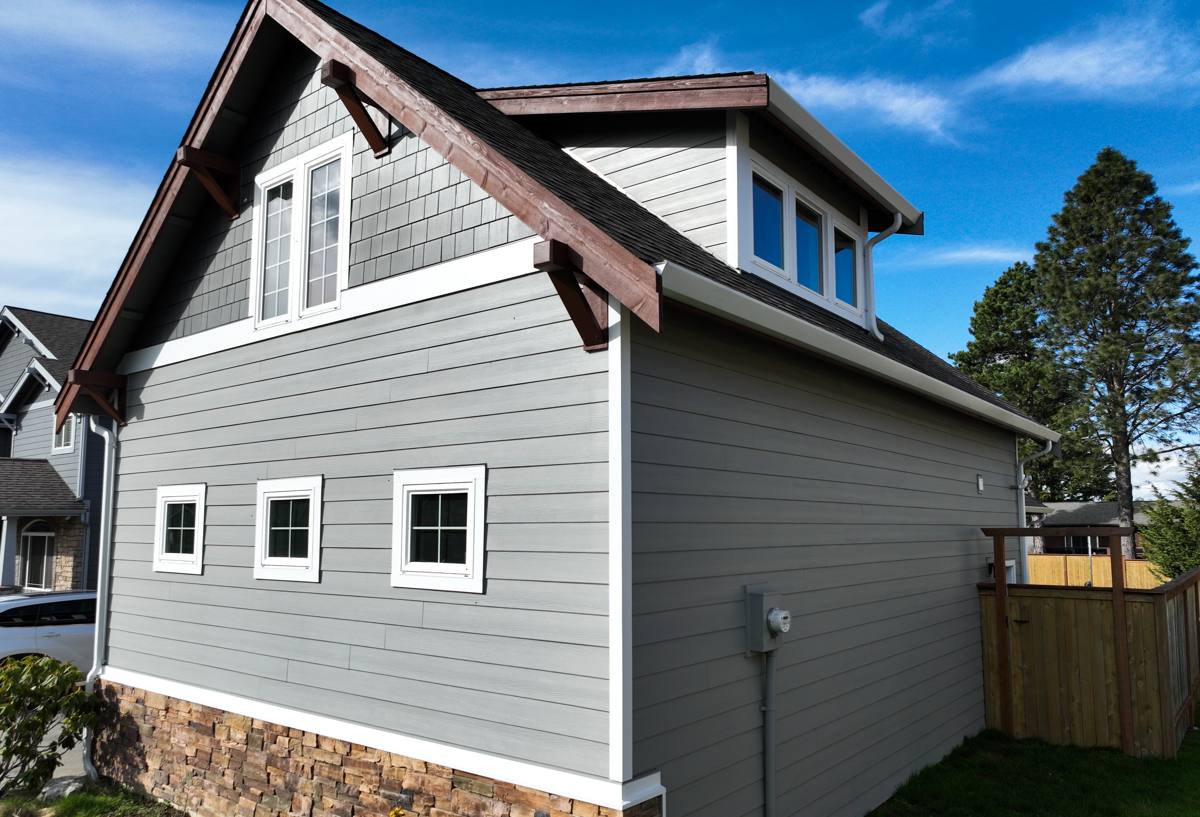
What We Actually See on Bellingham Homes
Working throughout Whatcom County, we see a fairly consistent pattern on older homes and on homes finished in the wrong material for this climate:
- Moss and algae staining that keeps coming back on shaded north walls, no matter how often it's pressure washed
- Paint failure and peeling on wood and engineered wood siding, especially at butt joints and lower courses close to grade or landscaping
- Soft or delaminating panels where moisture has been getting behind the siding for years, often discovered only during a remodel or a siding tear-off
- Caulk lines that have shrunk, cracked, or pulled away, letting wind-driven rain track behind trim and corner boards
- Corrosion or dulling on lower-quality metal fasteners and trim exposed to salt air near the water
A lot of this isn't really a "bad siding job" problem in isolation — it's a mismatch between the material and the climate, compounded over years. That's the core issue we try to solve for every Bellingham homeowner we work with.
Why We Install Only James Hardie Fiber Cement Siding
We get asked fairly often why we don't offer vinyl, LP SmartSide, or one of the other engineered wood or fiber cement alternatives on the market. The honest answer is that we made a standard, and we stuck to it, because the trade-offs on the alternatives don't hold up well in a climate like this one.
The trade-offs we weighed
| Material | What it does well | Why it's a tougher fit for Bellingham |
|---|---|---|
| Vinyl siding | Low upfront cost, low maintenance in mild, dry climates | Panels can warp or bow with temperature swings, seams and J-channels give moisture a path inward, and it's combustible plastic with no factory-baked finish |
| LP SmartSide (engineered wood) | Workable, budget-friendly, decent impact resistance | Wood strand core is more moisture-sensitive at cut edges and joints; in a wet, shaded climate that sensitivity gets tested constantly |
| Cedar / primed spruce | Classic look, renewable material | Needs ongoing refinishing, is a natural food source for moisture and insects, and demands more maintenance than most owners actually keep up with |
| James Hardie fiber cement | Non-combustible, factory ColorPlus finish, engineered for regional moisture exposure (HZ product line) | Higher upfront material and labor cost; must be installed to Hardie's spec to perform as designed |
Every one of those non-Hardie products has a legitimate place somewhere. We just don't think that place is a house that spends half the year damp, gets salt air off the bay, and sits in the shade of mature trees for most of the day. James Hardie's fiber cement is cement, sand, and cellulose fiber — it doesn't feed mold, it doesn't absorb water the way wood-based products do, and it's manufactured with regional exposure in mind through Hardie's HZ (HardieZone) system, which is specifically calibrated for climates like ours in western Washington.
ColorPlus and the finish that matters
The factory-applied ColorPlus finish is baked on under controlled conditions rather than field-painted on a ladder in whatever weather shows up that week. That matters in a place where you can lose good painting weather for stretches at a time. It also comes with its own finish warranty separate from the substrate warranty, backed by a large national manufacturer rather than resting entirely on a local contractor's word.
More Than Siding: The Whole Exterior Envelope
Siding doesn't fail in isolation. On most of the homes we look at in the Bellingham area, siding problems trace back to something else on the exterior — a roof detail that's letting water run behind the wall, a window that's not properly flashed, or a deck ledger board that's trapping moisture against the house. We handle roofing, windows, and decks alongside siding for that reason: an exterior envelope only works as a system. Replacing siding without checking the roof edge and window flashing above it is a good way to end up back at the same wall in five years.
How the pieces connect
- Roofing — drip edges, kick-out flashing, and gutter placement all determine how much water ends up running down your siding in the first place
- Windows — proper flashing and sealant at window openings is one of the most common failure points we find behind old siding
- Decks — ledger connections and any siding that meets a deck surface need careful flashing to keep water from wicking into the wall
What a Bellingham Siding Project Looks Like
We walk every project through the same basic sequence, adjusted for the specific house and lot:
- On-site assessment of the existing siding, trim, and any moisture damage found during removal
- Inspection and repair of the weather-resistive barrier and flashing details before any new siding goes up
- Installation of James Hardie panels or lap siding per manufacturer spec — correct fastener type and placement, proper clearances at grade and roof lines, and factory-mitered or properly caulked joints
- Trim, corner, and soffit detailing sized to shed water rather than trap it
- Final walkthrough covering warranty paperwork and basic care
The clearances and flashing details matter more here than they would in a drier climate. A siding installation that's technically "up to code" but skips the extra margin for standing water, splashback, and shaded drying time is setting up the next round of problems.
Choosing Colors and Product Lines for This Climate
James Hardie offers several product lines and a range of ColorPlus colors, and the right choice depends on the house, its exposure, and the look the owner wants. HardiePlank lap siding is the most common choice for traditional homes; HardiePanel works well for more modern or accent applications; HardieShingle suits homes going for a Craftsman or Cape Cod look. For a shaded, damp lot, we'll also talk through color choice, since darker colors show less moss staining between cleanings than very light ones, though no color is immune to it — periodic gentle washing is still part of ownership regardless of material or shade.
Cost Factors Worth Understanding
| Factor | Why it moves the price |
|---|---|
| Tear-off vs. new construction | Removing old siding and repairing any hidden damage adds labor beyond a straightforward install |
| Home size and wall complexity | More corners, dormers, and roof lines mean more cutting, trim work, and flashing detail |
| Product line and profile | Lap, panel, and shingle profiles carry different material and labor costs |
| Trim and accent work | Custom trim, board-and-batten accents, or shingle accent areas add time |
| Access and site conditions | Steep lots, tight setbacks, and mature landscaping common on Bellingham properties can affect staging and labor |
We give real, project-specific numbers after an on-site look rather than a phone estimate, because the flashing and repair work hiding behind old siding is often the biggest variable.
Why a Local Crew Matters Here
A crew that works Whatcom County regularly knows what a north-facing wall in Bellingham is going to face compared to a wall on the drier east side of the state, and installs accordingly — extra attention to flashing laps, fastener choice, and clearance details that matter more here than they would somewhere with less rain and less salt air. Being based in Ferndale also means we're a short drive away for follow-up questions or warranty service, not a crew that passed through once and moved on.
Signs it may be time to have your siding looked at
- Moss or algae staining that returns quickly after cleaning
- Peeling, bubbling, or chalky paint on wood or engineered wood siding
- Soft spots or visible gaps at panel seams and corners
- Visible warping, bowing, or cracking
- Rising heating bills that may point to compromised insulation behind failing siding
If you're in Bellingham or elsewhere in Whatcom County and want an honest look at your home's siding, roof, windows, or deck, we're happy to come out for a free, no-pressure estimate and walk you through exactly what we see and what your options are.