 Ferndale Siding
 Why This Decision Is Harder Than It Looks in Whatcom County
Every siding contractor gets some version of the same phone call: "Is this something you can patch, or do I need to replace the whole wall?" It's a fair question, and the honest answer is almost always "it depends" — but it depends on fewer things than most homeowners assume. What matters is the material, how far the damage has spread, what's happening behind the siding, and how much time is left on the material's useful life.
In Ferndale and the rest of Whatcom County, that calculation gets tilted earlier than it would in a drier climate. We sit close enough to Bellingham Bay and the Strait of Georgia that salt-laden air reaches exterior walls, especially on west- and southwest-facing elevations. Add driving rain that comes in sideways during winter storms, and a moss season that can run from October clear through May on shaded north walls, and you have a climate that is genuinely hard on siding. A repair-versus-replace decision made in Arizona or eastern Washington doesn't always translate here, because moisture — not sun — is what actually breaks siding down in this part of the state.
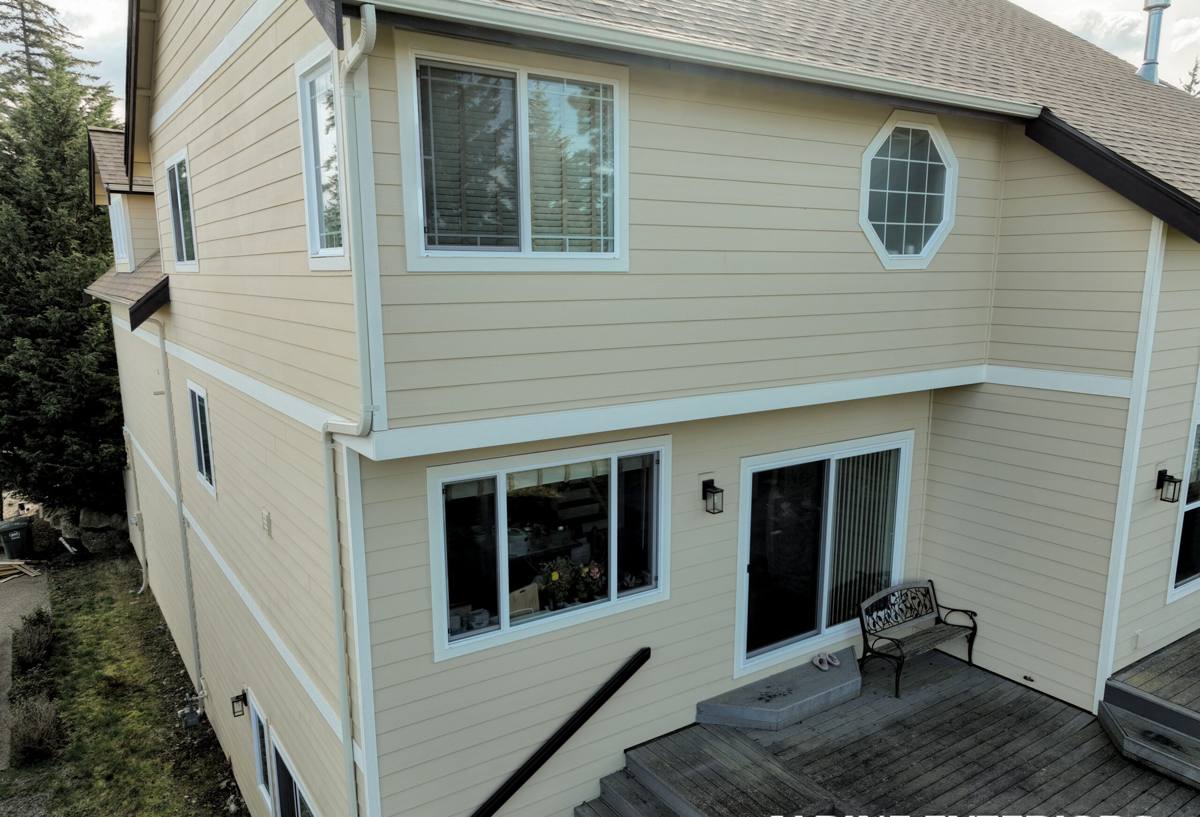
Start With What the Damage Is Actually Telling You
Damage That's Usually Fine to Repair
Not every problem means you're facing a full re-side. Some issues are isolated, mechanical, and don't indicate that the rest of the wall is compromised:
- A single cracked or dented board from an impact (a ladder, a falling branch, a stray baseball)
- Caulking that has failed at one or two joints while the rest of the seals are intact
- A small area of paint failure with no soft wood or swelling underneath
- Loose or missing fasteners on an otherwise sound section
- Moss or algae staining on the surface with no texture change to the siding itself
If a problem is contained to one area, the material underneath is still solid when you press on it, and the rest of the house shows no similar symptoms, a targeted repair is usually the right call — and the more honest one. There's no reason to sell a homeowner a full replacement for a problem that a few boards and a day of labor can fix.
Damage That Usually Means Replacement
The pattern changes once damage stops being an isolated event and starts being a symptom of the material or the installation failing more broadly:
- Soft, spongy, or crumbling wood siding — especially at butt joints and near the ground
- Widespread paint failure across multiple elevations, not just one hot spot
- Siding that's visibly warped, bowed, or separating from the wall
- Repeated moss and mildew return within a season or two of cleaning
- Interior signs — peeling paint, musty smell, or soft drywall near exterior walls
- Damage that shows up on more than one side of the house at once
That last one is the tell most homeowners miss. A single bad board is a repair. The same failure pattern showing up on the north wall, the west wall, and around the chimney flashing is not bad luck — it's the material or the original installation reaching the end of what it can handle in this climate.
The Hidden Cost of "Just Patching It Again"
Repair is almost always cheaper than replacement in the moment, which is exactly why it's tempting to keep choosing it. The problem is that repeated repairs on aging or moisture-compromised siding don't reset the clock — they just delay a replacement that's coming anyway, while you pay for labor and materials multiple times along the way.
| Scenario | Short-Term Cost | What Actually Happens |
|---|---|---|
| One-time repair of isolated damage | Low | Problem solved; siding continues its normal service life |
| Repeated repairs on the same wall over 2-3 years | Moderate, but adds up | Underlying moisture or material failure keeps resurfacing in new spots |
| Repair used to postpone a known material problem (rot, delamination) | Low now, high later | Sheathing and framing damage spreads under the surface, raising the eventual repair scope |
| Full replacement at the right time | Highest upfront | Resets the clock; one project instead of five |
The math tips toward replacement once you're patching the same wall for the second or third time in a few years. At that point you're not extending the siding's life — you're paying installation costs repeatedly for a problem that's structural, not cosmetic.
What's Behind the Siding Matters as Much as What's on It
Siding is a weather barrier, not a waterproof one — it's designed to shed the majority of water while a house wrap or building paper behind it manages what gets through. When siding fails and nobody addresses it for a while, water starts reaching the sheathing, the framing, and sometimes insulation. That's where a simple repair-or-replace decision turns into something bigger.
This is especially relevant in Ferndale because our wind-driven winter rain doesn't fall straight down — it hits walls at an angle and finds every gap, lapped joint, and failed caulk line. A siding product or installation that would hold up fine somewhere with calmer weather can show real problems here within a decade if water is getting behind it. Before recommending a repair, a contractor should actually pull a board or two in the affected area and look at the sheathing. If it's soft, discolored, or smells musty, the siding itself is the smaller problem.
How the Material You Have Changes the Answer
Not all siding ages the same way, and that changes how much sense repair makes as the years go on.
| Material | How It Typically Fails | Repair Outlook |
|---|---|---|
| Cedar | Rot, cupping, checking as finish wears through | Repairable early; refinishing needs get more frequent with age, especially in shaded, damp areas |
| Primed spruce / engineered wood (e.g. LP SmartSide) | Edge swelling, delamination at seams, moisture wicking | Individual boards replaceable, but swelling often signals the surrounding boards are absorbing water too |
| Vinyl | Cracking, warping, fading, panels popping loose in wind | Cheap to patch short-term; color-matching old panels gets harder every year as products change |
| Fiber cement (James Hardie) | Caulk and paint wear at joints; the board itself resists rot and moisture absorption | Long repair window because the substrate doesn't break down the way wood-based products do |
This is the core reason we standardized on James Hardie fiber cement and stopped installing wood-based and vinyl products: it's not that those materials can't be repaired, it's that the repair window on them is shorter and less predictable in a climate like ours. Fiber cement doesn't absorb water and swell, doesn't feed rot, and holds its factory-applied ColorPlus finish far longer than field-applied paint on wood. That means when we do get a repair call on a Hardie installation, it's usually a genuinely isolated issue — not the first sign of a wider material failure.
What a Proper Inspection Should Actually Check
A repair-or-replace recommendation is only as good as the inspection behind it. Before you accept either answer from a contractor, make sure the assessment actually covered these points:
- Moisture readings taken at multiple points, not just the visibly damaged spot
- At least one exploratory opening to check sheathing condition where damage is present
- A walk of all four elevations, since north and west walls in our area often fail years before the rest of the house
- Condition of flashing at windows, doors, and roof lines — a huge share of "siding" failures start as flashing failures
- Age and remaining expected life of the current material
- Whether the damage pattern is isolated or repeating across the house
If a contractor quotes a repair or a replacement without doing most of this, you're getting a guess dressed up as a diagnosis.
A Practical Way to Make the Call
When homeowners ask us for a rule of thumb, this is roughly how we walk through it:
- If the damage is isolated, the material underneath is sound, and the rest of the house looks healthy — repair it.
- If the same problem is showing up in multiple places, or you've repaired this wall more than once already — start pricing replacement.
- If the siding is wood-based or vinyl and is approaching or past 15-20 years old — replacement is worth strongly considering even if current damage looks minor, since the material's remaining life is short relative to the cost of another round of repairs.
- If moisture has reached the sheathing — that's a replacement conversation regardless of the siding material's age, because the repair scope now includes structural drying and rebuild, not just new boards.
None of this means every repair call ends in a sales pitch for a full re-side. Plenty of houses in Ferndale have siding that's doing fine and just needs a section fixed. The goal of an honest inspection is telling you which situation you're actually in, not defaulting to the bigger job.
When Replacement Is the Right Call, Here's What We Install
When a house does need full replacement, we install James Hardie fiber cement exclusively — HardiePlank lap siding, HardieShingle, and HardiePanel depending on the look and the wall assemblies involved, using the HZ10 product line engineered for our wetter Pacific Northwest exposure. It's non-combustible, resists moisture absorption far better than wood-based alternatives, and comes with a factory-baked ColorPlus finish backed by a real transferable warranty. For a climate that puts salt air, driving rain, and months of moss pressure on every wall in Whatcom County, it's the product we're willing to stand behind for the long haul — which is why it's the only siding we put on homes.
If you're staring at a damaged section of siding and can't tell whether it's a Saturday-afternoon fix or the first sign of something bigger, we're happy to take a look. We'll give you a straight answer about what we're seeing, what it means, and what your real options are — and if a full replacement isn't the right call yet, we'll tell you that too. Reach out for a free, no-pressure estimate using the form below.