 Ferndale Siding
 Bellingham sits close enough to the water that salt air, wind-driven rain, and a long wet season are just part of owning a home here. Windows take more abuse in this environment than most homeowners realize — not from any single storm, but from months of low-grade exposure that finds every weak seam in a frame, every gap in flashing, and every spot where a builder-grade unit was never sealed correctly in the first place. A window installation done right in Bellingham looks almost identical to one done anywhere else on the surface, but the details underneath — the flashing sequence, the sealants used, the hardware specified — are where the job either holds up for decades or starts failing in five years.
Why Bellingham's Climate Is Harder on Windows Than It Looks
Whatcom County's marine climate means windows here deal with three things at once: near-constant moisture, salt-laden air off Bellingham Bay and the Sound, and a moss and mildew season that can stretch from fall through spring. None of these are dramatic on their own, but together they punish any weak point in a window assembly.
Driving rain — rain pushed sideways by wind rather than falling straight down — is the big one. It doesn't just land on a window face, it gets forced up and under trim, into nail fin gaps, and behind siding that wasn't flashed to shed water outward. Salt air adds a slower, quieter problem: it accelerates corrosion in screws, hinges, balances, and cheaper aluminum components, which is why hardware that looks fine after year one can seize up or streak with rust by year five. And moss, which thrives in the shade and damp of a Northwest winter, holds moisture against sills and trim far longer than it would in a drier climate, keeping wood substrate wet enough to start rotting from the outside in.
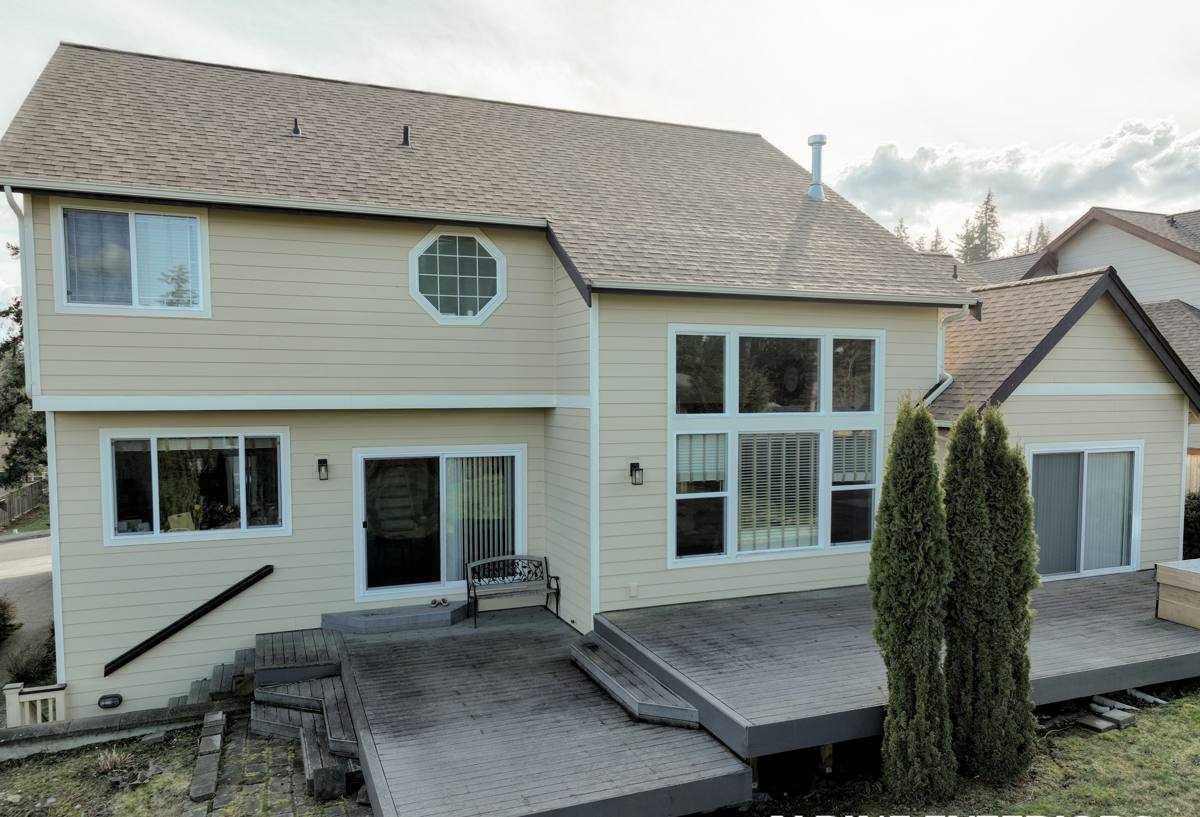
What a Correct Window Installation Actually Involves
A window installation is really a water management project that happens to include a window. The unit itself matters, but most failures we get called out to fix trace back to how the opening was prepped and flashed, not a defect in the window.
Flashing and Water Management
Every opening needs a sequenced flashing job: sill pan flashing first (so any water that does get past the window drains back outside instead of into the wall cavity), then side flashing, then head flashing that laps over the top in the correct shingle-style order. Skipping the sill pan is one of the most common shortcuts we see in older installs, and it's usually invisible until the wall cavity underneath is already damaged.
Integration With House Wrap and Siding
The window's flashing has to tie into the existing weather-resistive barrier correctly — lapped so water is always directed outward and downward, never trapped behind the siding. This is where a lot of retrofit jobs get tricky, because the surrounding siding and wrap were installed years earlier and need to be opened up carefully and re-integrated rather than just caulked over.
Insulation and Air Sealing
The gap between the window frame and the rough opening needs to be filled with a low-expansion foam or backer rod and sealant designed for window installation — not standard construction foam, which can bow frames out of square and cause operational problems. Done right, this gap also stops a major source of drafts and condensation around the frame interior.
Fasteners and Hardware
Given the salt air here, we favor corrosion-resistant fasteners and hardware over standard-grade options, especially on homes closer to the water. It's a small cost difference at install time that avoids stuck locks, streaking, and premature hardware failure later.
Signs Your Current Windows Are Past Their Service Life
Most homeowners don't replace windows because they want to — they replace them because the signs have become impossible to ignore. Worth checking for:
- Fog or moisture trapped between the panes of a double-pane window (a failed seal, not something that can be cleaned out)
- Soft or spongy trim, sill, or jamb wood when pressed
- Windows that are difficult to open, close, or lock, or that have visibly warped frames
- Visible daylight or a noticeable draft around the frame when the window is closed
- Moss or dark staining building up on the sill or exterior trim
- Condensation forming on the inside of the glass regularly during colder months
- A noticeable jump in heating costs without another clear explanation
Choosing Window Materials for a Marine Climate
There's no single "best" window material — it depends on budget, the home's age and style, and how much maintenance the homeowner wants to take on. Here's how the common options compare for a Bellingham-area home:
| Material | Moisture & Salt Air Performance | Maintenance | Typical Lifespan |
|---|---|---|---|
| Vinyl | Good — won't rot or corrode; seams are the main watch point | Low | 20–30 years |
| Fiberglass | Excellent — very stable in wet, temperature-swinging conditions | Low | 30+ years |
| Wood-clad | Good exterior protection from cladding, but exposed wood interior needs care | Moderate to high | 20–30 years with upkeep |
| Aluminum | Prone to corrosion and condensation in this climate unless thermally broken | Moderate | 15–25 years |
For most replacement projects in and around Bellingham, we steer homeowners toward vinyl or fiberglass because they handle sustained damp conditions and salt exposure with the least long-term maintenance. Wood-clad units can still be the right call on a home where matching an existing architectural style matters more than minimizing upkeep — that's a conversation we have honestly, based on trade-offs, not a sales pitch.
Single-Pane, Double-Pane, or Triple-Pane
Older Bellingham homes still commonly have original single-pane windows, which perform poorly for both energy efficiency and condensation control in this climate. Double-pane is the standard upgrade for most homes and does the job well. Triple-pane offers a further step up in insulation and sound dampening, which can be worth it on north-facing rooms or homes closer to busier roads, but it adds cost and weight that isn't always justified on every opening in a home.
New Construction Versus Replacement in Older Homes
New construction window installs are more straightforward — there's no existing siding or trim to work around, and flashing gets built in from scratch as part of the wall assembly. Replacement work in an established Bellingham home is a different job entirely. It usually means opening up trim or siding to inspect the sheathing and framing underneath for hidden rot before a new window ever goes in, since installing a new unit over damaged framing just locks in a bigger problem. We treat every replacement as an inspection first, installation second.
Our Process
- On-site assessment — we look at the existing windows, framing condition, and any signs of past water intrusion before recommending anything.
- Measurement and product selection — exact measurements are taken, and we walk through material, glass, and hardware options suited to the home and its exposure.
- Removal and opening prep — old units are removed and the opening is inspected and repaired as needed before anything new goes in.
- Flashing and installation — sill pan, side, and head flashing are installed in the correct sequence, the window is set plumb and level, and low-expansion foam or backer rod seals the gap.
- Exterior and interior finish — trim, caulking, and siding integration are completed to match the home's existing finish.
- Final walkthrough — every window is opened, closed, and locked to confirm smooth operation before we consider the job done.
Maintenance That Extends the Life of a New Installation
A properly installed window in this climate still benefits from basic upkeep:
- Clear moss and debris off sills and tracks before it holds moisture against the frame
- Check exterior caulk lines annually and touch up any cracking or separation
- Operate locks and hardware periodically so salt-air corrosion doesn't seize them unnoticed
- Keep gutters and downspouts clear so water isn't sheeting directly down over window heads
Why Hiring a Crew That Already Works in Bellingham Matters
Window installation isn't a one-size-fits-all trade. A crew that works regularly in Ferndale, Bellingham, and the surrounding Whatcom County area already knows what this specific climate does to a poorly flashed opening, has a track record with the local permitting process, and can respond quickly if something needs a follow-up visit. That local familiarity shows up in the small decisions — which sealant holds up through a wet winter, how much flashing overlap is enough, which hardware grade is worth the upgrade near the water — that a crew unfamiliar with the area might not think to prioritize.
If your windows are showing their age or you're planning ahead for a remodel, we're happy to take a look and give you a straightforward, no-pressure estimate. Use the form below to get started.