 Ferndale Siding
 Semiahmoo's Coastal Climate: What Your Exterior Is Really Up Against
Homes near Semiahmoo sit close enough to Drayton Harbor and the Strait of Georgia that the exterior of a house lives a different life than a house even a few miles inland. Salt-laden air moves off the water and settles on siding, trim, gutters, and roofing day after day. Add Whatcom County's long wet season — driving rain that comes in sideways off the water more often than it falls straight down — and you get an exterior that's under near-constant moisture and salt exposure for much of the year. Then comes moss season, which in this part of Washington isn't a once-a-year nuisance; it's a standing condition on north-facing roof slopes, shaded siding, and anywhere water sits a little too long before it can dry.
None of this means a home near Semiahmoo is doomed to constant repairs. It means the materials and installation details matter more here than they would in a drier, inland climate. A siding product, roof system, or window that performs fine forty miles from the coast can struggle noticeably closer to the water if it wasn't engineered — or installed — with that exposure in mind.
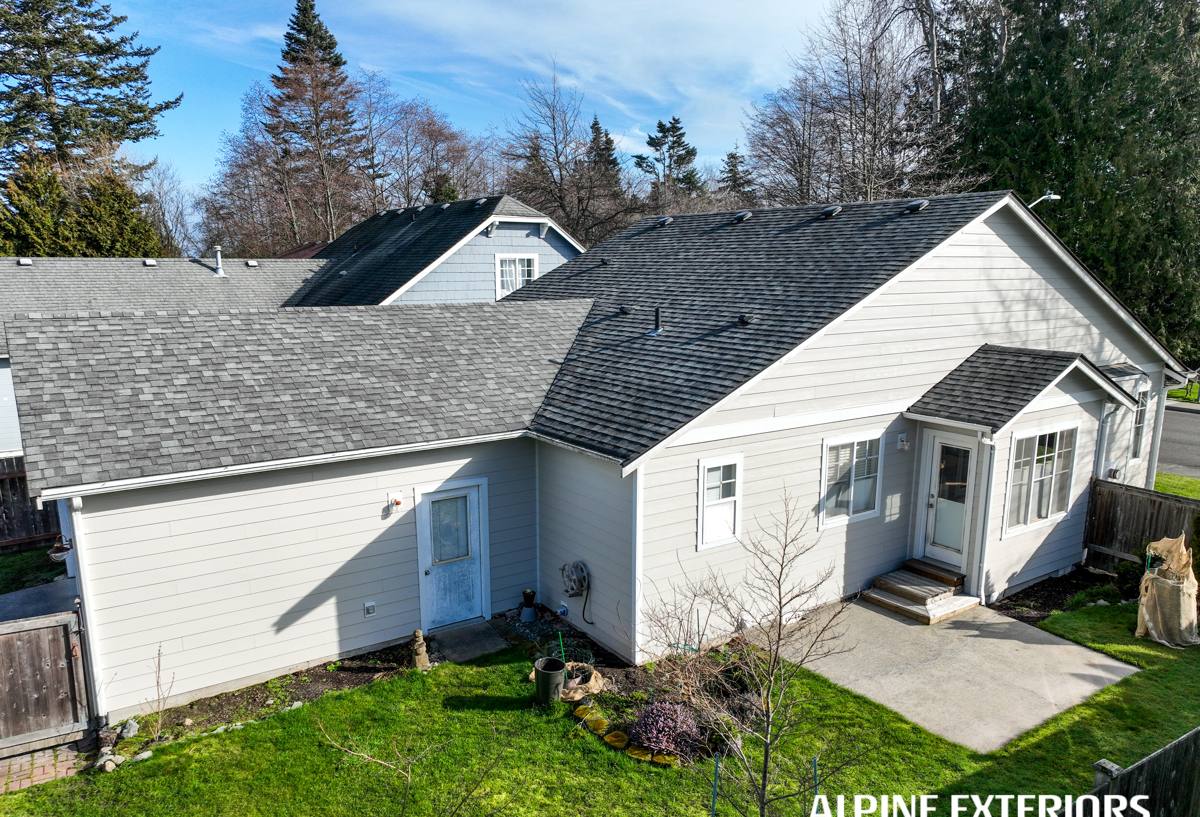
Salt Air and Siding: Why Material Choice Matters More Here
Salt air accelerates corrosion of exposed metal fasteners and hardware, and it's tough on any siding material that relies on paint film integrity to keep moisture out. Wood siding and trim in a coastal-influenced microclimate need more frequent recoating to stay ahead of failure. Vinyl siding can hold up structurally in salt air, but its factory color is more prone to fading and chalking under years of UV plus salt exposure, and it still relies on a separate weather-resistive barrier behind it doing all the real water-management work. Engineered wood products, including LP SmartSide, depend on an intact factory coating and correctly sealed edges to keep moisture out of the wood-based substrate — a coastal, high-moisture environment is exactly where any gap in that protection gets tested hardest and most often.
This is the core reason we standardized on James Hardie fiber cement siding for every home we work on, including the homes we serve in and around Semiahmoo. Fiber cement is non-combustible, doesn't rely on a wood substrate that can swell or rot if moisture gets behind it, and Hardie's ColorPlus factory finish is baked on and warranted against fading and peeling — which matters in an environment where sun, salt, and rain are all working on the paint film at once.
Why We Install Only James Hardie
We don't install vinyl, LP SmartSide, Cemplank, Allura, primed spruce, or cedar siding. That's a deliberate standard, not a lack of options. Every one of those products can be installed correctly and will perform for a while in the right circumstances — but each carries trade-offs in moisture behavior, maintenance burden, or long-term warranty structure that we're not willing to put our name behind, especially in a climate zone like Whatcom County's where coastal exposure adds an extra layer of stress to any exterior product.
James Hardie's HZ5 product line is engineered specifically for climates with freeze-thaw cycling and sustained moisture exposure — which describes the Pacific Northwest well. It resists moisture-driven damage far better than wood-based sidings, it doesn't require the recoating schedule that wood and some engineered products do, and it carries a strong transferable warranty when installed to Hardie's specifications. That last part matters as much as the product itself: fiber cement siding installed with the wrong fastener pattern, insufficient clearance, or poor flashing detail will still cause problems no matter how good the material is. We install to spec because that's the only way the warranty and the performance actually hold up.
Color and Style Options
Hardie's lap siding, panel siding, and shingle-style products come in a range of ColorPlus factory finishes as well as primed options for field painting. For a coastal property, we generally steer homeowners toward ColorPlus finishes — the factory-applied, baked-on color holds up better against the combination of UV and salt exposure than a field-applied paint job will over time, and it removes one more maintenance task from the homeowner's list.
Beyond Siding: Roofing, Windows, and Decks for Semiahmoo-Area Homes
Siding is only part of a home's defense against a coastal, wet climate. We handle roofing, windows, and decks as well, because an exterior only performs as a system — a new roof means little if flashing at the wall-to-roof transition isn't tied in correctly, and new siding won't stop moisture problems if window flashing behind it was never sealed properly to begin with.
Roofing and Moss
Roofs near Semiahmoo deal with moss pressure that's more persistent than most homeowners expect, particularly on shaded or north-facing slopes. Moss holds moisture against roofing material, works into shingle laps, and can shorten the effective life of a roof if it's left unmanaged. We look at ventilation, slope, and shading when we're on a roof in this area, not just the shingle or roofing material itself, because the moss problem is as much about airflow and sun exposure as it is about the roof surface.
Windows
Driving rain off the water puts real pressure on window flashing and sealant details, especially on walls that face open water or prevailing weather. We pay close attention to how new or replacement windows integrate with the weather-resistive barrier and siding around them — a well-built window installed with a poor flashing detail will leak eventually in this climate, and a modest window installed correctly will usually outperform it.
Decks
Outdoor living spaces near the water take a beating from salt, sun, and standing moisture. Fastener selection, board spacing for drainage, and ledger flashing all matter more for a deck close to Semiahmoo than they would inland, since the combination of salt air and sustained dampness accelerates corrosion and wood movement if those details are cut short.
Comparing Exterior Siding Options for a Coastal Whatcom County Home
| Material | Moisture Behavior | Maintenance in Salt Air | Typical Warranty Structure |
|---|---|---|---|
| James Hardie Fiber Cement | Non-combustible, doesn't rely on wood substrate; dimensionally stable when wet | Low — no recoating on ColorPlus finishes | Strong transferable product warranty when installed to spec |
| Vinyl | Sheds water but relies entirely on the barrier behind it; can warp under heat | Low upfront, but color fades and chalks over time near salt air | Varies widely by manufacturer and grade |
| Engineered Wood (LP SmartSide) | Wood-based substrate; vulnerable if factory coating or edge seal is compromised | Moderate — edge sealing and touch-up become important over time | Often includes moisture-related exclusions in fine print |
| Cedar / Primed Spruce | Natural wood; absorbs and releases moisture, prone to movement | High — regular recoating or staining needed to stay ahead of weathering | Typically product-only, limited |
This isn't a claim that the other materials fail outright — plenty of vinyl and engineered wood siding is out there performing adequately. It's a summary of why, when we weighed the trade-offs for the climate we work in, fiber cement was the product we were willing to stand behind on every job.
Choosing a Local Contractor Who Knows This Coastline
A contractor who mostly works inland won't automatically account for the extra flashing detail, fastener spec, or clearance a coastal property needs. Local experience with Whatcom County's specific mix of salt exposure, rainfall volume, and moss pressure is worth asking about directly.
- Ask whether the crew has worked on homes with direct or near-direct water exposure, not just general Whatcom County jobs
- Confirm they follow manufacturer fastener and clearance specifications for fiber cement siding — this is what protects the warranty
- Ask how they handle flashing at windows, doors, and roof-to-wall transitions, since that's where most moisture problems start
- Check that any roofing work includes a real look at ventilation and moss-prone slopes, not just a shingle swap
- Get a written scope that specifies the exact siding product and finish, not just "Hardie siding" as a generic line item
- Verify licensing, bonding, and insurance directly rather than taking it on faith
Timing a Project Around the Pacific Northwest Weather Window
Siding, roofing, and deck work all go better with a run of dry weather, and the Whatcom County coast has a narrower stretch of reliably dry days than places further inland. We plan installation schedules around realistic weather windows rather than rushing a job into a wet stretch, because moisture getting behind new siding or under new roofing during installation causes exactly the kind of problem the new material was supposed to prevent. Scheduling early in the season, before the fall rains set in, generally gives a project the best chance of a clean, unhurried installation.
What a Project Near Semiahmoo Typically Involves
Every home is different, but most exterior projects in this area follow a similar sequence: an on-site assessment of current siding, roofing, and window condition; identifying any moisture damage or ventilation issues before new material goes up rather than after; confirming product and color selections; and a realistic timeline that accounts for weather. For siding specifically, that assessment includes checking the condition of the sheathing and weather-resistive barrier underneath the existing siding, since covering up an existing moisture problem with new material never solves it.
We also talk through maintenance expectations up front. Fiber cement with a ColorPlus finish is genuinely low-maintenance, but "low-maintenance" doesn't mean "no maintenance" — periodic rinsing to keep salt residue from building up, and keeping gutters clear so water isn't running down the face of the siding, go a long way toward getting the full service life out of the material.
Get a Free, No-Pressure Estimate
If you're weighing a siding, roofing, window, or deck project on a home near Semiahmoo, we're happy to take a look and talk through what your specific property is dealing with — no pressure, no obligation. Use the form below to request a free estimate.