 Ferndale Siding
 Semiahmoo Sits Right Where Weather Meets Wood Siding
Homes along Semiahmoo don't face the same conditions as houses a few miles inland. Being close to open water means more exposure to wind-driven rain, salt-laden air, and the kind of persistent dampness that never fully dries out between storms. Add in the tree cover and shade common to Whatcom County properties, and you get long moss and algae seasons that most siding products simply weren't built to handle for decades on end. When we get called out to Semiahmoo for a repair, we're rarely looking at one isolated problem. We're usually looking at what years of coastal exposure have done to a specific material in a specific location on the house, and the fix has to account for that, not just patch over it.
This page is about siding repair specifically for Semiahmoo homes — what the local climate actually does to siding, what a correct repair looks like, and why the material we repair with (and the crew doing the work) matters more here than it might somewhere drier and more sheltered.
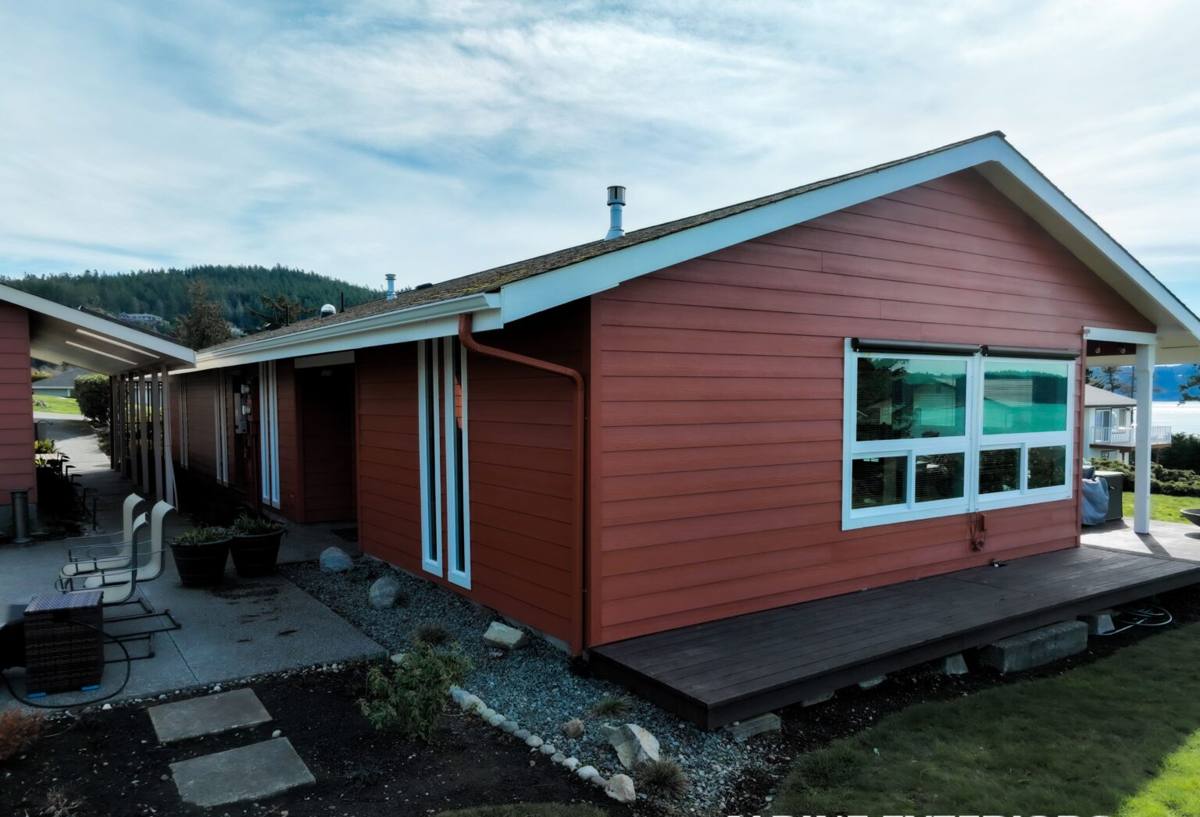
What Salt Air, Driving Rain, and Moss Actually Do to Siding
Salt Air
Airborne salt from nearby marine water accelerates corrosion on any exposed metal — fasteners, flashing, trim caps — and it also breaks down certain paint and coating systems faster than inland exposure does. Once a fastener starts to corrode, it can weep rust streaks down the face of the siding and lose its grip, which is often the first visible sign something is wrong even though the real problem is happening at the fastener, not the siding panel itself.
Driving Rain
Wind off the water doesn't just bring more rain, it pushes rain sideways and up under laps, trim, and butt joints that were designed for water running straight down. Siding systems depend on lapped, shingled installation to shed water downward. When wind forces water horizontally or upward, it can find its way behind panels through gaps that would never be a problem in calmer conditions. That's why so many Semiahmoo repair calls trace back to a joint, corner, or trim detail rather than the field of the siding itself.
Moss and Algae
Shade, moisture, and mild temperatures are exactly what moss and algae need to thrive, and a lot of Semiahmoo lots have all three in abundance. Moss holds moisture against the siding surface far longer than the material would otherwise stay wet, which softens caulk, degrades paint film, and — on materials that aren't dimensionally stable — can contribute to swelling, cupping, or delamination over time. Moss buildup at the bottom courses of a wall, around downspouts, and under overhangs is one of the most common early-warning signs we see on inspections here.
Signs a Semiahmoo Home Needs Siding Repair
Some damage is obvious. A lot of it isn't, especially from the ground. Here's what we tell homeowners to watch for between inspections:
- Rust streaking below fasteners, trim caps, or flashing
- Soft or spongy spots when you press on siding near the bottom courses or under windows
- Paint that's bubbling, peeling, or chalking heavily in one area but not others
- Visible gaps opening up at butt joints, corners, or where siding meets trim
- Persistent moss or algae growth that keeps returning after cleaning
- Warping, cupping, or bowing panels, especially on north- and west-facing walls
- Interior signs — musty smell, discoloration, or soft drywall on an exterior wall
- Caulk joints that have cracked, shrunk, or pulled away from the substrate
Any one of these on its own might be minor. Several showing up in the same area, especially near grade, under a downspout, or on the side of the house that takes the most wind and rain, usually means water has been getting behind the siding for a while.
What a Correct Repair Actually Involves
A repair that just replaces the visible damaged piece and stops there is a repair that's likely to fail again in the same spot. On a coastal property like this, we treat every repair as three separate questions:
1. What let water in?
Before anything gets replaced, we find the actual entry point — a failed caulk joint, a piece of flashing that was never installed correctly, a fastener that backed out, a butt joint with no gap for movement. Replacing siding without fixing the entry point just buys a few more years before the same repair comes back.
2. What's behind the siding?
Once panels come off, we check the water-resistive barrier, sheathing, and framing underneath. In a high-moisture area like Semiahmoo, it's common to find soft sheathing or moisture staining that extends beyond the visibly damaged siding. If the substrate is compromised, patching the siding without addressing what's under it isn't a real fix — it's a cosmetic one.
3. What's the right way to close it back up?
Correct flashing details, proper fastener placement and spacing, the right gap and sealant at joints, and matching factory-finished material so the repair doesn't stand out or become a weak point of its own. This is where the difference between a quick patch and a lasting repair really shows up.
Why James Hardie Fiber Cement Is What We Repair With
We install and repair with James Hardie fiber cement exclusively. It's not the only siding material on the market, but for a marine-influenced climate like Semiahmoo's, it's the one we're willing to put our name behind. Fiber cement is non-combustible, doesn't swell or rot when it takes on moisture the way wood-based products can, and Hardie's ColorPlus factory finish is baked on and warranted against fading and peeling — which matters a great deal on a wall that spends its life in salt air and driving rain. Hardie also builds climate-specific HZ product lines engineered for wetter regions like ours, which is a level of region-specific engineering most competing products don't offer.
When we repair a Hardie wall, we're matching into a system that was already built to handle this exposure. When we repair or replace a section of a different material with Hardie, we're not just fixing today's damage — we're changing what that section of wall has to survive going forward.
Repair Approach Comparison
| Approach | What It Addresses | Longevity in Coastal Conditions |
|---|---|---|
| Caulk-and-paint patch | Cosmetic surface only | Short — often fails within one or two wet seasons |
| Spot panel replacement, no root-cause check | Visible damage only | Moderate — same failure often returns nearby |
| Full diagnosis + flashing/fastener correction + matched Hardie replacement | Entry point, substrate, and finish material | Long — addresses why it failed, not just what failed |
Repair or Replace? What We Actually Weigh
Not every damaged section needs a full re-side, and not every home is a good candidate for spot repair alone. We walk homeowners through the same factors every time:
| Factor | Leans Toward Repair | Leans Toward Replacement |
|---|---|---|
| Extent of damage | Isolated to one or two areas | Recurring across multiple walls |
| Substrate condition | Sheathing and framing intact | Widespread rot or moisture damage found |
| Age and material of existing siding | Newer Hardie install, easy color/profile match | Old, discontinued, or non-Hardie product |
| Underlying cause | One identifiable failure point | Systemic issue — bad original install, poor drainage plane |
We'll always tell you honestly which side of that line your house falls on. Sometimes a targeted repair genuinely is the right call, and we'll say so even though a full re-side is a bigger job for us.
Our Process for a Semiahmoo Repair Call
Because water damage on a coastal property is rarely limited to exactly what's visible, we don't quote repairs sight unseen. Our process is:
- On-site inspection — we look at the damaged area, the surrounding wall, flashing, trim, and grade conditions, and we probe for soft spots you can't always see from the ground.
- Diagnosis before pricing — we tell you what we think caused the damage, not just what we're going to replace.
- Written scope — what's being removed, what's being inspected underneath, what gets replaced, and what happens if we find more damage once panels come off.
- Repair — correct flashing and fastening, matched James Hardie material, and joint detailing built for wind-driven rain, not just straight-down runoff.
- Walkthrough — we show you what we found and what we did about it before we consider the job done.
Why a Crew That Already Works Semiahmoo Matters
A contractor who mostly works drier, more sheltered neighborhoods can still do competent siding work in general — but they may not automatically know to check the fastener corrosion pattern that shows up on wind-exposed elevations here, or recognize how fast moss reestablishes itself on a shaded, moisture-holding wall near the water. A crew that regularly works this specific stretch of Whatcom County has already seen how salt air, sustained rain, and heavy moss seasons play out on real houses over real years. That experience changes what we look for during an inspection and what details we insist on getting right during a repair, because we've seen what happens when those details get skipped.
A Quick Homeowner Checklist
Between professional inspections, a short seasonal check can catch problems early:
- Walk the full perimeter and look for moss buildup, especially on shaded and north-facing walls
- Check under windows, at corners, and around downspouts for staining or soft siding
- Look at fastener heads and trim caps for rust streaking
- Press gently on siding near grade level to feel for sponginess
- Check caulk joints at trim and corners for cracking or gaps
- Note any musty smell or discoloration on interior walls that back up to exterior siding
If you find any of these, it's worth having someone look before the next wet season sets in — small entry points get bigger every time the wind pushes rain sideways into them.
If you're seeing any of these signs on a Semiahmoo home, we're happy to take a look and give you an honest read on what's actually going on — no pressure, no obligation. Use the form below to request a free estimate.