 Ferndale Siding
 Why Moisture Is the Real Threat to Your Siding
Most siding doesn't fail because it wears out. It fails because water got behind it and nobody found out until the damage was structural. In Ferndale and the rest of Whatcom County, that risk is higher than in drier parts of the state. Between the marine air off Bellingham Bay, the driving rain that comes sideways off Georgia Strait storms, and a moss and algae season that can run eight or nine months out of the year, siding here spends most of its life damp. The material on the outside matters, but what happens to the moisture that inevitably gets past it matters more.
This page walks through how water actually gets behind siding, what it does once it's trapped, how to spot early warning signs, and what separates a siding system that sheds and dries water from one that quietly rots a wall from the inside out.
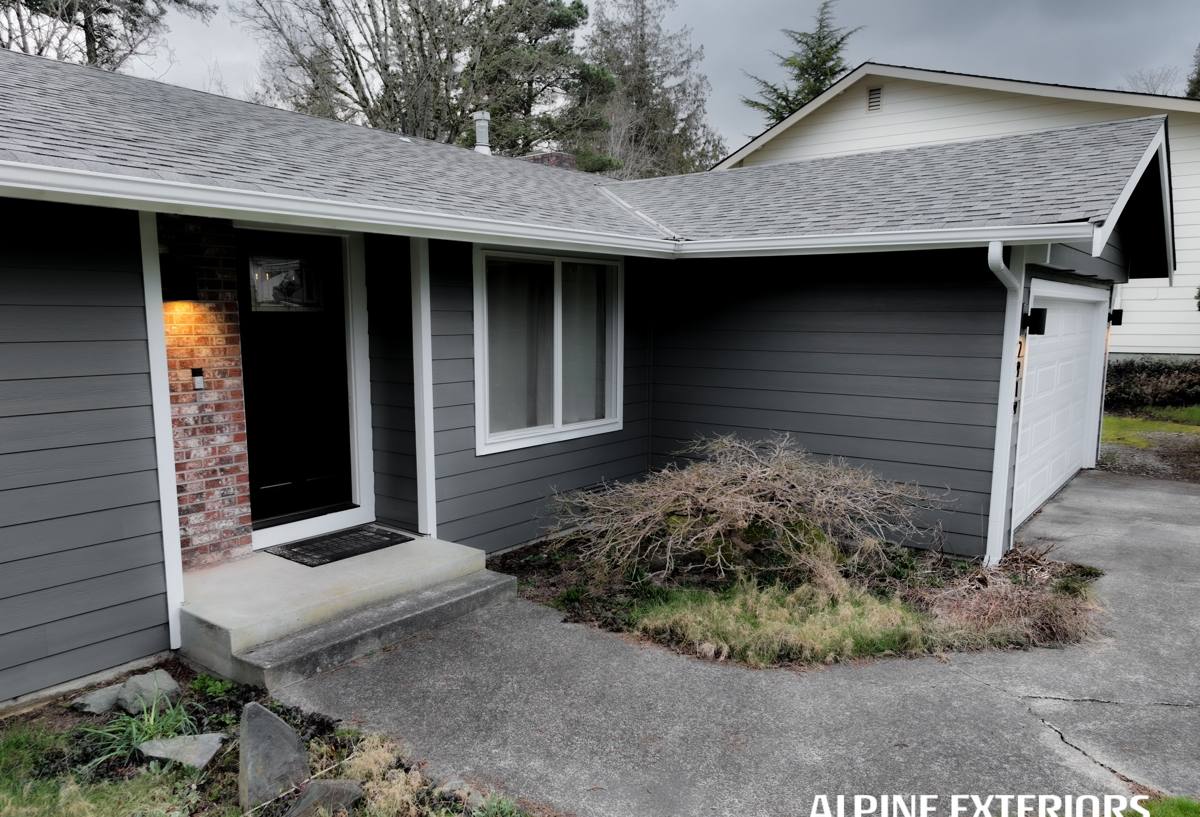
How Water Actually Gets Behind Siding
Homeowners often picture rot starting from a leaky roof or an obvious crack. In practice, most moisture intrusion happens through small, unremarkable gaps that nobody notices during a casual walk around the house.
Common entry points
- Nail holes and fastener penetrations that were never sealed or that work loose over time
- Butt joints between siding pieces that weren't flashed or caulked correctly
- Window and door trim where caulk has shrunk, cracked, or was never applied to a proper joint
- Missing or poorly lapped flashing above windows, doors, and horizontal trim boards
- Siding installed tight to the ground or to a deck, holding splashback moisture against the bottom edge
- Kick-out flashing missing where a roofline meets a sidewall, dumping roof runoff straight down the wall
None of these look dramatic. That's the problem. Water doesn't need a big opening — it needs time, and Whatcom County gives it plenty of that.
What Happens Once Moisture Gets Trapped
Wood-framed walls are built to get wet occasionally and dry out. The whole system falls apart when water gets in faster than it can leave, or when there's no path for it to leave at all. That's when you get rot: fungi that feed on wood fiber, break down its structure, and eventually turn solid framing into something you can push a screwdriver through.
Rot doesn't need standing water. It needs sustained moisture content above roughly 20%, combined with the mild, humid temperatures that describe a typical Ferndale winter and spring almost perfectly. Sheathing, wall studs, window bucks, and the back side of the siding itself are all vulnerable. Because the damage happens on the hidden side of the wall, it's often years before it shows up on the surface — and by then it's usually more than a cosmetic fix.
Signs You May Already Have Hidden Rot
You don't need a moisture meter to catch most problems early. A slow walk around the exterior once or twice a year, especially after a hard winter, will surface most of the warning signs.
- Siding that feels soft, spongy, or flexes when you press on it
- Paint or finish that's peeling, bubbling, or discoloring in one specific spot rather than evenly across a wall
- Dark staining or streaking below window sills, trim boards, or seams
- A musty smell near an exterior wall on the inside of the house
- Visible gaps, warping, or separation at butt joints and corners
- Swelling or crumbling at the bottom few inches of siding near grade or a deck ledger
- Interior drywall cracking, staining, or a soft spot near an exterior wall
Any one of these on its own isn't necessarily an emergency. Several of them together, or any of them near a known trouble spot like a window head or roof-to-wall intersection, are worth having looked at before the next wet season.
How Different Siding Materials Handle Moisture
The material you choose changes how forgiving your wall is when water inevitably finds its way behind it. Some materials rot on contact with sustained moisture. Others don't rot themselves but do a poor job stopping bulk water, or trap it against the sheathing behind them. Here's how the common options compare.
| Material | Absorbs water | Rots if kept wet | Install sensitivity |
|---|---|---|---|
| Cedar / primed wood siding | Yes, readily | Yes — the material itself decays | High — needs consistent maintenance and back-priming |
| OSB-based engineered wood (e.g. LP SmartSide) | At cut edges and gaps | Yes, at exposed or unsealed edges | High — every cut edge must be sealed per spec |
| Vinyl siding | No | No, but doesn't stop water from reaching the wall behind it | Moderate — relies entirely on the barrier behind it |
| Fiber cement (James Hardie) | Minimal, engineered to resist | No — it's cement and cellulose fiber, not organic wood | Moderate — correct clearances and fastening still matter |
The takeaway isn't that any one material makes a wall waterproof — nothing does. It's that the material's own resistance to rot is one layer of protection, and the barrier system behind it is the layer that does most of the real work.
The Weather-Resistive Barrier and Rainscreen Gap Do the Heavy Lifting
Behind every properly built wall is a weather-resistive barrier (WRB) — often a housewrap or building paper — whose job is to stop bulk water that gets past the siding from reaching the sheathing. Where the WRB is torn, poorly lapped, or improperly flashed around penetrations, it fails at exactly the moment it's needed.
A rainscreen gap — a small air space between the back of the siding and the WRB, usually created with vertical furring strips — gives any water that does get through a path to drain and a way to dry out with airflow instead of sitting against the sheathing. On a coastal, high-rainfall site like Ferndale, that gap is the difference between water that passes through harmlessly and water that sits for weeks. It's a detail that costs a little more labor and materials up front and saves a wall assembly for decades.
Where installation quality changes the outcome
Two houses can have identical siding and wildly different long-term outcomes based on installation alone. Flashing sequencing, fastener placement, caulk selection at trim joints, and clearance at grade all matter more than most homeowners realize when they're comparing bids on price alone.
Moss, Algae, and Whatcom County's Long Wet Season
Ferndale's combination of marine humidity, shade from mature trees, and a wet season that stretches from fall through late spring creates ideal conditions for moss and algae growth on north-facing and shaded walls. Beyond the cosmetic green or black staining, a moss mat holds moisture directly against the siding surface for extended periods, which accelerates whatever underlying vulnerability the material or the installation already has. Salt-laden air off the bay adds another layer, gradually breaking down caulk, fasteners, and unprotected finishes faster than it would inland.
Regular gentle cleaning, keeping vegetation trimmed back from walls, and choosing a finish that resists mildew growth all help — but they're maintenance items, not substitutes for a wall system that's built to drain and dry in the first place.
A Homeowner's Moisture Walk-Around Checklist
Use this once or twice a year, ideally after a stretch of hard rain, to catch problems while they're still cheap to fix.
- Press on siding near the bottom edge, around windows, and at corners — it should feel solid, not soft
- Check caulk lines at trim and window edges for cracking, gaps, or shrinkage
- Look for staining or dark streaks below joints, sills, and horizontal trim
- Confirm siding isn't in direct contact with soil, mulch, or a deck surface
- Look up at roof-to-wall intersections for missing or rusted kick-out flashing
- Note any moss or algae buildup on shaded or north-facing walls
- Check inside, along exterior walls, for musty odors, staining, or soft drywall
Why We Install Only James Hardie Fiber Cement
We standardized on James Hardie for the same reason this page exists: moisture in this climate is relentless, and it doesn't forgive weak points in a material or a wall system. Fiber cement doesn't rot the way wood-based products can, holds a factory-applied ColorPlus finish that resists the caulk and paint failures that let water in around trim, and is engineered in HZ product lines specifically for high-moisture, marine climates like ours. Combined with a properly detailed WRB, flashing, and rainscreen behind it, it gives a wall assembly the best realistic chance of staying dry where it matters — on the sheathing and framing you can't see.
If you're noticing any of the signs above, or you just want an honest look at how your current siding and wall assembly are holding up against a Ferndale winter, we're happy to take a look. Request a free, no-pressure estimate using the form below and we'll walk the exterior with you and tell you plainly what we find.