 Ferndale Siding
 Sandy Point's Exterior Is Working Harder Than Most
Sandy Point sits right up against the water north of Ferndale, and that location comes with a trade-off. The views are worth it, but the exterior of a Sandy Point home takes on a combination of stresses that inland Whatcom County houses simply don't deal with in the same combination: salt-laden air moving off the Strait of Georgia, sustained wind exposure with few windbreaks, driving rain that hits siding at an angle instead of falling straight down, and a moss and mildew season that runs long even by Pacific Northwest standards. None of these on their own is unusual for this part of Washington. Together, and applied to a home sitting close to open water, they add up to an exterior that ages faster than the same materials would twenty minutes inland.
We work on homes throughout Ferndale and greater Whatcom County, and Sandy Point is one of the areas where we pay the closest attention to material choice and installation detail, because the margin for error is smaller here.
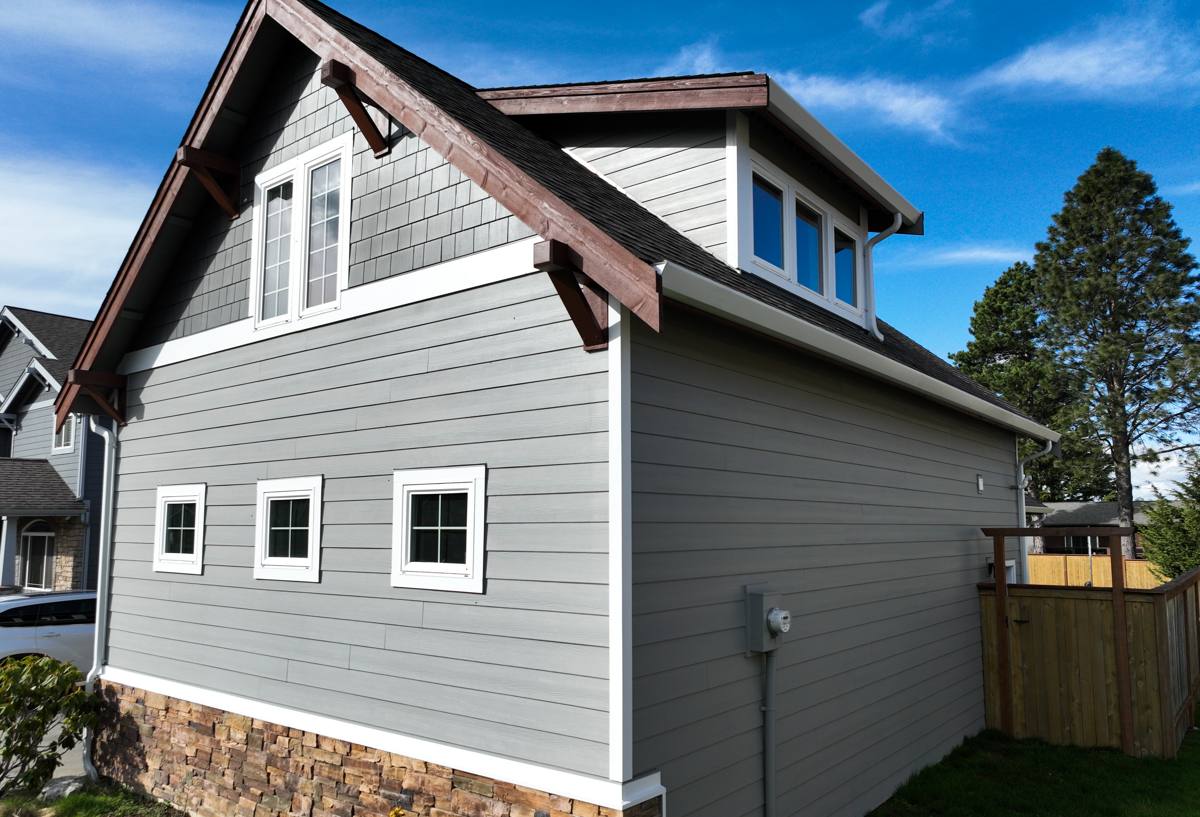
What Salt Air Actually Does to a Building
Salt air isn't just a smell — it's airborne moisture carrying dissolved salts that land on every exterior surface of a house and stay there until rain or a hose washes them off. On siding, that salt residue does a few things over time. It accelerates corrosion on any exposed metal fasteners, flashing, and trim that isn't rated for coastal exposure. It draws additional moisture to the surface of the siding through hygroscopic action (salt attracts water from the air), which keeps the material's surface damp longer after a rain event than it would be in a non-coastal setting. And on materials that aren't dimensionally stable, the repeated wet-dry cycling that follows speeds up swelling, checking, and paint failure.
This is why coastal construction in general uses corrosion-resistant fasteners and flashing, and why the siding material itself matters more here than it might on a home a few miles inland.
Wind Load and Rain Intrusion
Sandy Point's open exposure means wind-driven rain is a regular event, not an occasional storm condition. Wind-driven rain doesn't behave like ordinary rainfall — it gets pushed sideways and even upward into laps, seams, and any gap in flashing or trim. A siding system that's fine in a sheltered yard can leak at Sandy Point if the water-resistive barrier, flashing details, and siding overlaps aren't installed with coastal wind in mind. This is an installation issue as much as a material issue, which is part of why we treat the install process itself as seriously as the product spec.
The Long Moss Season
Whatcom County's wet season runs long, and homes near the water tend to stay in that damp window even longer because of onshore humidity and reduced direct sun on north- and west-facing walls. Moss, algae, and mildew need sustained moisture and shade to establish, and Sandy Point homes — especially ones tucked among trees or facing away from the sun — provide exactly that. Once organic growth gets a foothold on a siding surface, it holds moisture against that surface, which speeds up any underlying problem, whether that's paint failure, wood rot, or fastener corrosion. Growth is manageable with regular cleaning on the right material, but it becomes a much bigger deal on a surface that can't tolerate repeated pressure washing or moisture exposure without degrading.
Why Material Choice Matters More Here Than Elsewhere
We install only James Hardie fiber cement siding, and we don't install vinyl, LP SmartSide, cedar, primed spruce, Cemplank, or Allura. That's a standard we hold everywhere we work, but it matters even more directly in a setting like Sandy Point, where the climate is actively testing every weak point in a siding system.
Fiber cement is dimensionally stable — it doesn't expand and contract with moisture the way wood-based products do, which matters when a wall is cycling between wet and dry conditions constantly rather than occasionally. It's also non-combustible, which is a separate consideration from moisture but still relevant to long-term home protection. Hardie's ColorPlus factory finish is baked on and cured under controlled conditions before the boards ever leave the plant, so the finish itself isn't relying on field-applied paint holding up against salt air and UV from day one.
We're not going to tell you every other product on the market fails at the coast — plenty of coastal homes have wood or vinyl siding that's been maintained carefully for years. What we will say is that the maintenance burden and the margin for error go up with those products in an environment like Sandy Point's, and after years of doing this work in Whatcom County, fiber cement is what we're willing to put our name behind and warranty.
Hardie's HZ5 Engineering
James Hardie engineers its siding lines by climate zone, and the Pacific Northwest falls under the HZ5 category, built specifically to handle high-moisture, temperate-wet conditions rather than a one-size-fits-all product. That's a meaningful distinction for a coastal property — it means the product formulation is already accounting for the kind of sustained damp exposure Sandy Point sees, rather than being adapted from a product built for a drier climate.
What Correct Installation Looks Like at Sandy Point
A good siding product installed poorly will still fail at the coast, and a lot of the failures we see on older homes here trace back to installation shortcuts rather than the material itself. The details we pay particular attention to on Sandy Point projects include:
- Stainless steel or hot-dip galvanized fasteners rated for coastal/corrosive exposure — not standard interior-grade fasteners
- Correct flashing at every window, door, and penetration, lapped to shed water downward and outward even under wind-driven conditions
- Proper drainage plane and water-resistive barrier behind the siding, so any moisture that does get past the surface has somewhere to go
- Manufacturer-specified gaps and clearances at butt joints, trim, and ground contact points, so the material can perform as engineered
- Field-cut edges properly sealed or primed per Hardie's installation instructions, since an unsealed cut edge is a weak point regardless of how good the factory finish is
These aren't exotic requirements — they're standard best practice for fiber cement installation. But they get skipped more often than homeowners realize, especially on faster or lower-bid jobs, and skipping them shows up as problems years down the road rather than immediately.
Beyond Siding: The Rest of the Exterior Envelope
Siding doesn't work in isolation — it's one piece of an exterior envelope that also includes the roof, windows, and any attached structures like decks. On a Sandy Point property, all four of those systems are dealing with the same salt air, wind, and moisture exposure, and problems in one often show up as damage in another. A roof with failing flashing can send water down behind siding. Windows with degraded seals let moisture into wall cavities. A deck that isn't properly ledger-flashed against the house can rot the band board it's attached to and take the adjacent siding with it.
We handle siding, roofing, windows, and decks, which means we look at a Sandy Point home's exterior as one connected system rather than a set of unrelated projects. That matters practically — flashing at a roof-to-wall intersection or a deck ledger needs to tie into the siding installation correctly, and having one crew responsible for that whole boundary avoids the finger-pointing that happens when three different contractors each did their piece in isolation.
Comparing Common Siding Choices in a Coastal Setting
| Material | Moisture Behavior | Maintenance in Salt Air | Typical Longevity Here |
|---|---|---|---|
| James Hardie fiber cement | Dimensionally stable, doesn't swell/rot | Periodic rinse; factory finish resists fading | Long-term with correct install; strong transferable warranty |
| Vinyl | Doesn't rot but can warp/crack under UV and temperature swings | Low, but seams and fasteners are still exposed | Variable; appearance and rigidity degrade over time |
| Cedar / wood-based | Absorbs moisture; prone to swelling, checking, rot | Regular refinishing/sealing required, more often near salt air | Shorter without diligent, ongoing upkeep |
| LP SmartSide (engineered wood) | Wood-based core; sensitive to sustained moisture at edges/cuts | Edge sealing and maintenance is installation-critical | Depends heavily on install quality and moisture exposure |
This isn't a claim that every non-Hardie product fails at the coast — it's a summary of the trade-offs that led us to standardize on one product line rather than offer several.
Signs a Sandy Point Exterior Needs a Closer Look
A lot of exterior problems near the water are gradual, and homeowners often don't notice until something's visibly wrong. Worth checking periodically:
- Persistent moss or dark streaking on north- or west-facing walls that comes back quickly after cleaning
- Soft spots, visible swelling, or separated seams in siding, especially near the ground or at trim boards
- Rust staining running down from fasteners, flashing, or hardware
- Paint that's chalking, peeling, or has lost adhesion faster than expected
- Water stains or musty smells on interior walls that back onto exterior siding
- Visible gaps or missing sealant around windows, doors, or deck ledgers
Any one of these on its own may be minor. Several together, or anything paired with an interior sign of moisture, is worth a professional look before it becomes a bigger repair.
Why a Local Crew Matters at Sandy Point
We're based in Ferndale and work throughout Whatcom County, which means Sandy Point's specific conditions aren't an abstraction to us — we've seen how homes here age compared to homes a few miles inland, and we plan material choices, fastener specs, and flashing details accordingly rather than defaulting to a generic install approach. A crew that hasn't worked coastal Whatcom properties before may not think to upgrade fastener corrosion resistance or pay extra attention to wind-driven rain details, because those aren't universal requirements — they're specific to conditions like the ones Sandy Point sees. Local experience also means faster response if something needs a look after a storm, and a crew that's still around and reachable years after the original install, which matters for warranty follow-through.
Cost Factors Worth Understanding Upfront
Every home is different, so we won't quote a number here, but a few factors specific to coastal work tend to affect the estimate more than they would on an inland project: the amount of existing damage or rot to address before new siding goes on, the complexity of flashing at windows, rooflines, and any deck attachment points, the total wall area and trim detail, and whether corrosion-resistant fastener and flashing upgrades are needed beyond standard spec. We walk through all of this during an on-site estimate so there aren't surprises once work starts.
If you own a home in Sandy Point and want an honest look at how it's holding up against the salt air, wind, and moisture out there, we're happy to come take a look. Reach out for a free, no-pressure estimate — no obligation, just a straight assessment of where things stand and what your options are.