 Ferndale Siding
 New-Construction Windows for Semiahmoo Homes
Building on the Semiahmoo peninsula puts a house closer to open water than almost anywhere else in Whatcom County. That location is the whole draw of the area, and it's also exactly why the window installation on a new build here has to be done differently than it would inland. Salt-laden air off the Strait of Georgia, wind-driven rain that comes in sideways during winter storms, and a long, damp moss season that keeps exterior surfaces wet for months at a stretch all put real stress on a window opening. Ferndale Siding Company installs new-construction windows for builders and homeowners working in and around Semiahmoo, and we approach every opening with that exposure in mind from the first layer of flashing tape to the final bead of sealant.
"New-construction" installation is a different job than a replacement window. On a new build, the window goes in before the siding, and the flashing and weather barrier details around that opening become part of the wall's drainage plane for the life of the house. Get that sequence wrong and you don't find out for years — usually not until there's rot in the sheathing or stains showing up on interior trim. Get it right, and the window opening becomes one of the most durable parts of the building envelope.
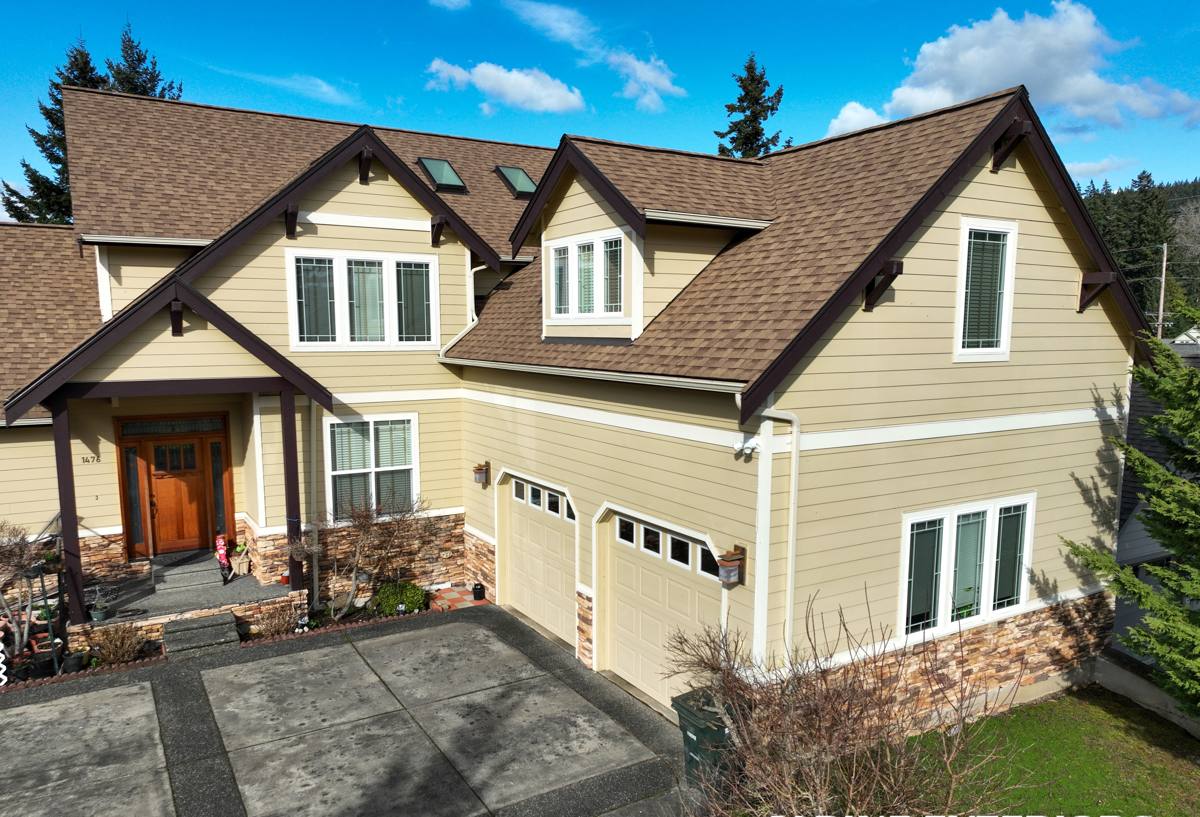
Why Semiahmoo's Climate Changes the Job
A lot of window installation guidance is written for a generic climate. Semiahmoo isn't generic. A few conditions specific to this stretch of Whatcom County shape how we detail every opening:
- Salt air corrosion: Homes close to the water see accelerated corrosion on exposed fasteners, hinges, and hardware. We spec corrosion-resistant fastening at the window frame and flashing attachment points rather than standard interior-grade hardware.
- Wind-driven rain: Storms coming off the water don't just fall — they push. Rain gets forced sideways and upward under trim and siding laps that would shed water fine in a calmer climate. Flashing has to be lapped and sealed to handle water moving against gravity, not just running down.
- Persistent moisture and moss season: Whatcom County's wet season runs long, and shaded or north-facing walls near Semiahmoo can stay damp for weeks without a real drying window. Any gap in the water-resistive barrier around a window opening becomes a standing invitation for moisture to work its way into the wall assembly.
- Temperature swings between marine air and clear nights: Coastal night cooling causes condensation on and around glass and frames more often than it would further inland, which is a performance issue but also a clue — the wrong glass package or a poorly sealed frame will show it early.
None of this means new-construction windows near Semiahmoo require exotic materials. It means ordinary materials have to be installed with more discipline than they would need in a drier, calmer location.
What a Correct New-Construction Window Install Involves
Rough Opening and Flashing
The rough opening gets checked for square, level, and correct dimension before anything goes in. Sill flashing is installed with a slight outward slope so any water that reaches the sill drains back out rather than pooling against the frame. Side flashing (jambs) and head flashing are lapped in the correct shingle-style order — bottom pieces overlapped by the ones above — so water sheds downward and outward at every layer, never into the wall.
Weather-Resistive Barrier Integration
The window flange has to tie into the house wrap or weather-resistive barrier as a continuous system, not as two separate materials that happen to touch. We integrate the flashing with the WRB in the correct sequence so the drainage plane behind the future siding stays unbroken around the entire opening. This is the step that matters most in a wind-driven-rain climate and the one most often rushed on a tight build schedule.
Setting the Window
The unit is set plumb, level, and square, then fastened per the manufacturer's schedule — not just "enough screws to hold it." Shimming is done at load-bearing points to prevent frame distortion, which matters for long-term operation of the sash and for keeping weatherstripping compressed evenly.
Sealing and Backer Rod
Exterior sealant is applied over backer rod at the correct joint width, using a sealant rated for the substrate and for sustained UV and moisture exposure — not a general-purpose caulk that will chalk and crack within a couple of seasons in coastal conditions. Interior air-sealing at the frame is handled separately, since interior air sealing and exterior water sealing serve different purposes and shouldn't be treated as the same step.
Final Check
Every window gets operated, checked for square reveal on all four sides, and inspected for flashing lap direction before we sign off. On a new build, this is also the point where we flag anything upstream — sheathing gaps, WRB tears, framing that's out of tolerance — before siding closes it all in.
Choosing the Right Window for a Semiahmoo Build
Frame material and glass package both affect how a window holds up this close to the water. There's no single "best" choice for every project — it depends on budget, architectural style, and how exposed the specific elevation is.
| Frame Material | Coastal Performance | Maintenance | Typical Fit |
|---|---|---|---|
| Vinyl | Good corrosion resistance; consistent performance in salt air | Low — no painting, periodic cleaning | Cost-conscious builds, most elevations |
| Fiberglass | Excellent — very stable, resists warping from moisture and temperature swings | Low | High-exposure walls, larger units |
| Wood (clad exterior) | Good if exterior cladding is fully intact; interior wood needs a controlled environment | Higher — clad exterior helps, but seams and joints need periodic inspection | Traditional or custom architectural styles |
| Aluminum (uncoated) | Weakest in salt air without a marine-grade finish; prone to corrosion at fasteners | Higher — finish and hardware need monitoring | Not our default recommendation for direct water-facing elevations |
We're glad to walk through options with a builder or homeowner directly rather than push one line — the right call often changes elevation by elevation on the same house, depending on how much weather that particular wall actually takes.
Glass Packages and Condensation
Because of the marine air and cooler nights common around Semiahmoo, we typically steer new-construction clients toward dual- or triple-pane units with a warm-edge spacer system rather than the cheapest available glass package. It's not about chasing a marketing number — it's that a poorly performing spacer or single-pane unit is the first thing to show condensation and fogging in this kind of climate, and that's a problem that shows up inside the finished home, not something we can fix after drywall.
Our Process for New-Construction Projects
- Plan review: We look at window schedules and elevations before framing is finalized, so any conflicts between window sizing, header height, or flashing details get caught early.
- Coordination with the builder's schedule: New-construction windows go in at a specific point in the build sequence — after weather barrier, before siding. We work within the general contractor's timeline rather than forcing our own.
- Flashing and installation: Performed to the standards described above, on every opening, regardless of whether it's a highly visible front elevation or a less-seen side wall.
- Documentation: We note flashing details and any site conditions worth flagging, which is useful for the builder's own records and for warranty purposes down the line.
- Final walkthrough: Every window is checked for operation, seal, and reveal before we consider the opening complete.
Common New-Construction Mistakes We Watch For
- Flashing lapped in the wrong order, so water runs behind a layer instead of over it
- Window flanges taped over the WRB instead of properly integrated into it, leaving a hidden seam
- Sills without a drainage slope, allowing water to sit against the frame
- Fasteners driven through flashing without sealant at the penetration
- Sealant applied without backer rod, leading to premature cracking under coastal UV and moisture cycling
- Shimming only at the sides, leaving the header unsupported and prone to sag over time
Most of these mistakes are invisible once siding goes on. They tend to surface as a stain, a soft spot in trim, or a drafty window years into the life of the house — long after it would be simple to fix. Catching them at the framing stage is the entire point of a careful new-construction process.
Why Local Experience on Semiahmoo Specifically Matters
A crew that mostly works drier, more sheltered parts of Whatcom County can do competent work and still under-detail a window opening on a site this exposed to open water. Semiahmoo conditions call for treating every opening like it's on the most exposed wall of the house, because on a peninsula, a surprising number of walls qualify. We've built our flashing and sealing approach around this specific stretch of coastline, not adapted a generic inland process after the fact. That local calibration is the difference between windows that need attention again in five years and windows that quietly do their job for decades.
Get a Local Estimate
If you're building on the Semiahmoo peninsula or elsewhere near Ferndale and want new-construction windows installed by a crew that details every opening for this coastline's salt air, wind-driven rain, and long wet season, we're happy to take a look at your plans and talk through it. Reach out for a free, no-pressure estimate using the form below.