 Ferndale Siding
 Blaine sits right on the water in northern Whatcom County, a few minutes up the road from Ferndale, and its siding takes a different kind of beating than a home fifteen miles inland. Homes here deal with salt-laden air off the water, driving rain that comes in sideways during winter storms, and a moss season that can run most of the year in the shaded, damp spots on a house. When siding starts failing in Blaine, it's rarely one single cause — it's usually a combination of these factors working on the same wall for years before anyone notices.
This page covers what siding repair actually looks like for homes in the Blaine area: what the local climate does to different siding materials, how to tell a real repair need from a cosmetic issue, what a correct repair job involves, and why the material you repair with matters as much as the repair itself.
Why Blaine's Climate Is Hard on Siding
Coastal Whatcom County isn't just "rainy Pacific Northwest" — it's a specific combination of conditions that stresses siding faster than a drier or more sheltered location would.
Salt Air and Moisture
Homes close to the water pick up airborne salt that settles on exterior surfaces. On its own, salt residue isn't dramatic, but combined with the region's near-constant humidity, it accelerates corrosion of exposed fasteners, trim flashing, and any metal components in the siding system. It also holds moisture against the wall surface longer than dry air would, which matters a lot for wood-based and engineered-wood products.
Driving Rain
Storms coming off the Strait push rain sideways, not just straight down. That means water gets forced into laps, seams, butt joints, and anywhere caulk or flashing has started to fail — areas that a purely vertical rain would never reach. Siding systems that rely on face-sealed joints or unprotected seams are especially vulnerable in this kind of weather.
A Long Moss and Mildew Season
Shaded north and east walls, tree-lined lots, and the general dampness of a Whatcom County winter add up to a moss and mildew season that can stretch from fall through spring. Moss holds water against siding, and where it's allowed to establish itself in seams or behind trim, it keeps that section of the wall wet far longer than the rest of the house.
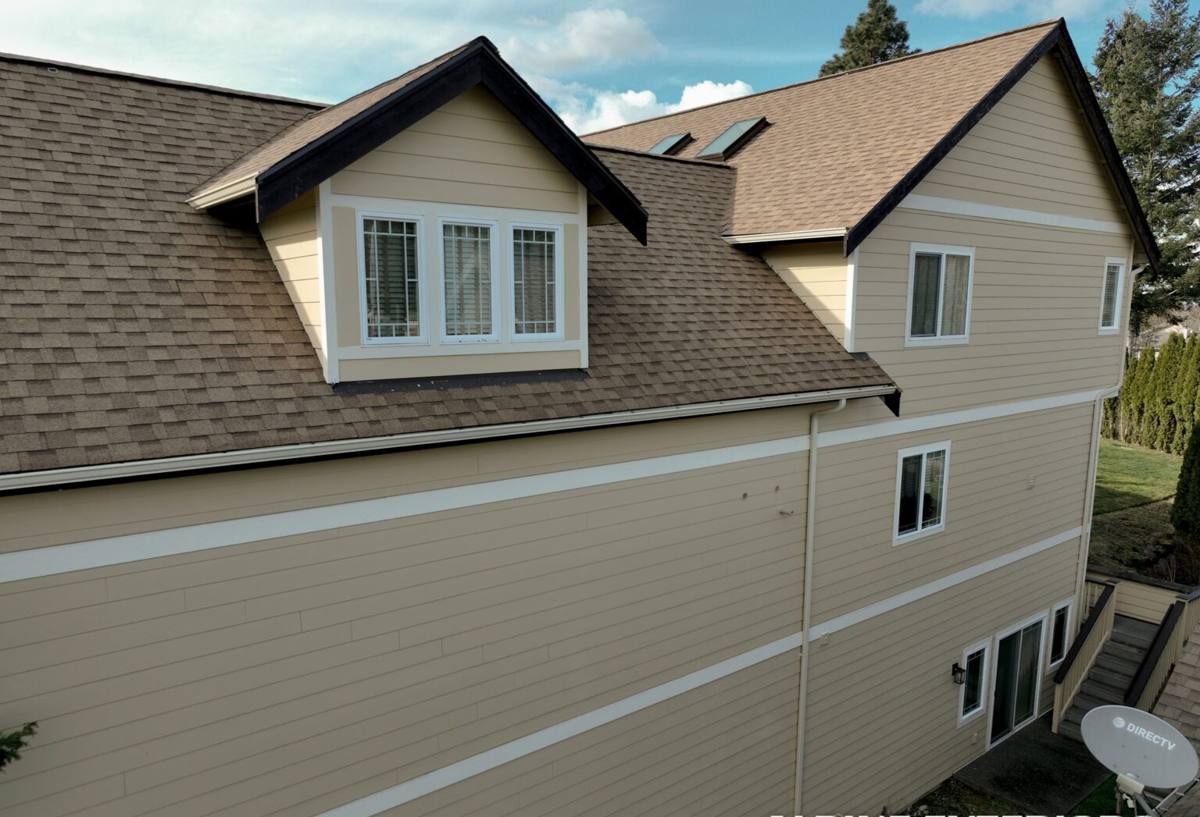
Signs a Blaine Home Needs Siding Repair
Most siding problems give some warning before they turn into something expensive. Homeowners in this area should watch for:
- Soft or spongy spots when you press on the siding, especially near the bottom courses or under windows
- Visible gaps, cracks, or separation at butt joints and corners
- Paint that's peeling, bubbling, or failing in one specific area rather than evenly across the house
- Moss or dark streaking concentrated on shaded walls or behind trim boards
- Warping, buckling, or waviness in a section of siding
- Rust streaks below fasteners or trim
- Interior signs — a musty smell, a soft spot on interior drywall, or a stain near an exterior wall
Any one of these on its own might be minor. Several together, or any sign near a window, door, or roofline transition, usually means water has already gotten past the surface and into the wall assembly.
What a Correct Siding Repair Actually Involves
A repair that just replaces the damaged board and stops isn't a real repair — it's a temporary cover-up. Water damage rarely stays contained to exactly the piece that looks bad.
Find the Real Cause, Not Just the Symptom
Before anything gets cut out or replaced, the underlying cause needs to be identified: failed caulking, a flashing gap, a clogged gutter dumping water onto a wall, grade or landscaping pushing moisture up against the siding, or simple wear at the end of a product's service life. Replacing a board without fixing the cause just buys a year or two before the same spot fails again.
Check What's Behind the Siding
Once siding is pulled back, the house wrap, sheathing, and framing underneath need to be inspected. If moisture has been getting in for a while, there can be soft sheathing or early rot that has to be addressed before new siding goes back on — patching over compromised structure is how small problems become expensive ones.
Match the System, Not Just the Color
Siding isn't just a decorative skin — it's a system of overlapping pieces, flashing, and fasteners designed to work together. A repair needs to integrate correctly with the existing lap pattern, joint spacing, and flashing details, not just look close enough from the street.
Repair or Replace? What Actually Drives That Decision
| Factor | Leans Toward Repair | Leans Toward Replacement |
|---|---|---|
| Extent of damage | Isolated to one wall or a few boards | Recurring issues across multiple walls |
| Cause | Identifiable, fixable source (flashing, caulk, gutter) | Widespread material failure or age-related breakdown |
| What's behind the siding | Sheathing and framing are sound | Rot or moisture damage found in multiple areas |
| Age and material | Newer siding, material still performing well | Original siding near or past its expected service life |
| Overall condition | Rest of the siding is in good shape | Fading, cracking, or wear showing house-wide |
We'll always tell you honestly which side of that table your house falls on. A targeted repair is the right call more often than not — but when the damage points to a system-wide problem, patching one section just delays a bigger job.
Why We Repair Using James Hardie Fiber Cement
We install and repair with James Hardie fiber cement siding exclusively. We don't install vinyl, LP SmartSide, Cemplank, Allura, primed spruce, or cedar, and that standard applies to repair work too.
Why Material Consistency Matters for a Repair
When a home already has Hardie siding, repairing it with matching Hardie product is straightforward — the same HZ5 engineered formulation and ColorPlus factory finish that make the rest of the house durable in this climate extend to the repaired section, with a color match that won't visibly age differently over time.
When the Existing Siding Isn't Hardie
If your home currently has vinyl, engineered wood, or another material, our approach depends on the scope of the damage. Small, isolated repairs may be workable with compatible materials. But where the damage reflects a broader material or moisture problem — which is common with wood-based products in a wet, salt-air environment — we'll be upfront that the better long-term fix is transitioning the affected section, or eventually the whole house, to fiber cement rather than continuing to patch a product that struggles with this climate.
What Fiber Cement Handles Better Here
Fiber cement doesn't absorb and swell with moisture the way wood-based siding can, and it isn't vulnerable to the softening and impact damage that affects some engineered wood products in a wet climate. It's also non-combustible, which matters independent of the coastal weather. That combination is why we standardized on it rather than offering multiple product lines.
How We Approach a Siding Repair Call in Blaine
1. Inspection First
We start by looking at the damaged area and the rest of the exterior — a full walk-around, not just a glance at the spot you called about. Since problems in this climate often show up in more than one place at once, we check shaded walls, corners, and anywhere water tends to collect.
2. Honest Diagnosis
We'll tell you plainly whether this is a contained repair, a repair plus some preventive work (gutter fix, flashing correction, grading), or something bigger. No inflating a small job, and no downplaying a real one.
3. Correct Repair Work
Damaged material comes out, anything compromised underneath gets addressed, and new material goes in matched to the existing lap lines, joints, and finish — installed to the flashing and clearance details that keep water moving out and away from the wall, not trapped behind it.
4. Walkthrough Before We Leave
We show you what was found, what was done, and what to keep an eye on going forward, especially if the repair pointed to a wider issue worth planning for.
Why a Crew That Already Works This Area Matters
Siding repair in a coastal Whatcom County town isn't the same job as siding repair in a dry inland climate, and a crew that mostly works elsewhere doesn't always account for that. A contractor familiar with Blaine and Ferndale conditions knows to expect moss buildup in shaded areas, understands how driving rain off the water finds its way into weak joints, and won't be surprised by salt-related fastener corrosion that a drier-climate crew might not think to check for. That local pattern recognition is part of what makes a repair actually hold up rather than needing to be redone in a couple of years.
It also means faster, more accurate estimates — we're not guessing at how this climate behaves, we're working with what we see on homes in this area regularly.
Cost Factors for Blaine Siding Repairs
We don't publish fixed repair pricing because the range is genuinely wide — a single-board fix and a multi-wall repair with underlying rot are very different jobs. The factors that drive cost include:
- How much siding needs to come off and how much new material goes back on
- Whether sheathing or framing repair is needed underneath
- Accessibility — height, roof lines, and obstructions around the damaged area
- Whether flashing, caulking, or gutter corrections are needed alongside the siding work
- Color and profile matching to existing siding
We give you real numbers after we've actually looked at the damage, not a phone estimate based on guesswork.
If you're seeing soft spots, gaps, moss buildup, or paint failure on your Blaine or Ferndale home, it's worth having someone look at it before the next round of winter storms. We offer free, no-pressure estimates — use the form below to get one scheduled.