 Ferndale Siding
 Why Fairhaven's Coastal Exposure Is Hard on Siding
Homes near the water in the Fairhaven area deal with a different set of conditions than siding was designed for a century ago. Salt-laden air off the water works its way into seams, fasteners, and any exposed wood grain, accelerating corrosion and finish breakdown in ways inland homes never experience. Add in driving, wind-pushed rain that hits walls at an angle instead of falling straight down, and siding here has to shed water horizontally, not just vertically — a detail a lot of standard installations get wrong.
Then there's the moss and algae. Whatcom County's long wet season, combined with mature tree cover and shaded north- and west-facing walls common around Fairhaven, creates months of near-constant surface moisture. That's exactly what moss, algae, and mildew need to take hold. On siding that isn't properly primed, sealed, and finished, that green-black staining isn't just cosmetic — it holds moisture against the substrate and speeds up rot underneath.
None of this means siding is doomed in a coastal climate. It means the product, the prep work, and the installation details all have to be matched to what the area actually throws at a house — which is the whole reason this page exists.
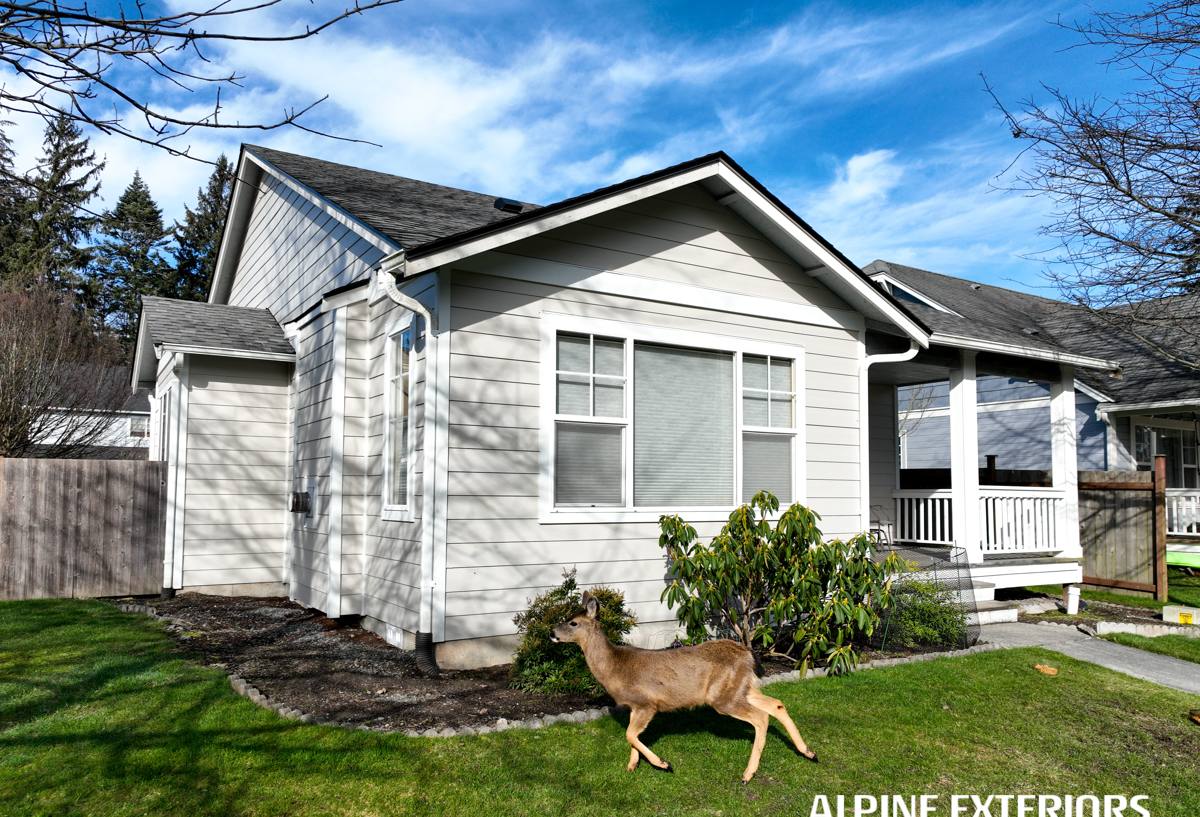
What "Correct" Siding Replacement Actually Involves
Siding replacement isn't just stripping off the old boards and nailing up new ones. Done right, it's really a wall system upgrade, and skipping steps is exactly how a brand-new-looking job fails again in five to ten years. A correct replacement includes:
- Full tear-off — old siding removed completely so the sheathing and framing underneath can actually be inspected, not just guessed at.
- Sheathing evaluation and repair — any soft, rotted, or delaminated sheathing gets found and replaced before anything new goes up. Covering over hidden rot is the single most common shortcut that causes callbacks.
- A properly lapped weather-resistant barrier (WRB) — the housewrap or building paper behind the siding, installed and taped so water that gets past the siding drains out instead of soaking in.
- Correct flashing at every penetration — windows, doors, hose bibs, vents, and deck ledgers are where the vast majority of moisture intrusion actually starts, not the open field of the wall.
- Manufacturer-spec fastening and clearances — proper nail placement, board gaps, and ground/roof clearances, following James Hardie's published installation instructions rather than "how we've always done it."
Every one of these steps matters more in a wet coastal climate than it would in a dry one, because there's simply less margin for error before trapped moisture becomes a real problem.
Choosing a Product Built for This Environment
Why We Only Install James Hardie
We install James Hardie fiber cement siding exclusively. We don't offer vinyl, LP SmartSide, Cemplank, Allura, primed spruce, or cedar as alternatives — not because those products can't be installed correctly, but because we'd rather stand behind one system we know performs in this specific climate than stock multiple product lines with different long-term track records and maintenance demands. Hardie's fiber cement is non-combustible, dimensionally stable in wet-dry cycling, and comes with a factory-applied ColorPlus finish that's baked on rather than field-painted, which matters a lot in an area where UV exposure, salt, and moisture all attack a painted surface at once.
| Factor | Fiber Cement (Hardie) | Vinyl | Engineered Wood (LP SmartSide) | Cedar / Untreated Wood |
|---|---|---|---|---|
| Moisture & rot resistance | High — cement-based, doesn't rot | High, but seams can trap moisture | Moderate — wood-based core is moisture-sensitive if compromised | Low without diligent upkeep |
| Salt air / corrosion behavior | Stable, resists degradation | Can become brittle over time | Edge swelling risk if coating fails | Weathers and grays quickly near salt air |
| Moss & algae resistance | Good with factory finish | Prone to surface algae film | Moderate, coating-dependent | Low — porous surface favors growth |
| Fire rating | Non-combustible | Combustible | Combustible | Combustible |
| Ongoing maintenance | Low — occasional rinse, repaint on a long cycle | Low, but cracks/fades and isn't repairable in sections | Moderate — coating needs monitoring | High — regular sealing, staining, repair |
Vinyl handles moisture reasonably well but expands, contracts, and can become brittle with age and UV exposure, and it isn't a repairable product — a damaged section usually means a full panel replacement, and matching faded color years later is difficult. Engineered wood products perform well when the factory coating stays intact, but any breach in that coating exposes a wood-based core that doesn't forgive sustained moisture. Cedar and other untreated wood siding look great initially but demand the most ongoing attention — regular sealing, staining, and moss removal — to hold up in a climate this wet. Hardie's HZ5 formulation, engineered for climates like this one, is what we've found gives homeowners the best combination of low maintenance and long-term performance without asking them to babysit their siding.
Our Process for a Fairhaven Siding Replacement
Every project follows the same sequence, whether it's a small single-story home or a larger two-story property closer to the water:
- On-site assessment — we walk the exterior, check for soft spots, moisture staining, and existing damage, and look at how the home is currently oriented to prevailing wind and rain.
- Scope and product selection — we confirm the right Hardie profile (lap siding, shingle-style panels, or a trim/board combination) and color for the home.
- Tear-off and sheathing inspection — old siding comes off entirely; any compromised sheathing is documented and replaced before moving forward.
- WRB and flashing installation — a new weather barrier goes on correctly lapped, with flashing detailed at every window, door, and penetration.
- Hardie installation to manufacturer spec — correct fastener type, spacing, and clearances, following James Hardie's published installation guidelines rather than a generic approach.
- Caulking, touch-up, and finish check — factory-finished ColorPlus edges are sealed and touched up per Hardie's specifications so the warranty stays intact.
- Cleanup and walkthrough — job site cleared, and we walk the finished exterior with the homeowner before calling it done.
Signs Your Fairhaven Home May Be Ready for Replacement
Some of these show up gradually, which is why a lot of homeowners don't act until the damage is more extensive than it needed to be. Watch for:
- Siding that feels soft, spongy, or gives slightly when pressed
- Paint that's peeling, bubbling, or won't hold a fresh coat
- Persistent moss, algae, or dark staining that returns soon after cleaning
- Visible cracking, warping, or boards separating from the wall
- Gaps opening up around trim, windows, or corners
- A musty smell near exterior walls inside the home
- Noticeably higher heating bills, which can point to moisture-compromised insulation behind old siding
Any one of these on its own might just need a repair. Several at once, especially on walls facing prevailing wind and rain, usually means the siding system as a whole has reached the end of its useful life.
What Drives the Cost of a Project Like This
We don't quote pricing without seeing the home, because the variables genuinely change the number. What we can tell you is what those variables are, so an estimate makes sense when you get one:
| Factor | Why It Matters |
|---|---|
| Home size and wall complexity | More square footage and more corners, dormers, or gables mean more material and labor |
| Condition of existing sheathing | Hidden rot found during tear-off adds repair scope that can't be quoted until walls are opened up |
| Siding profile and trim detail | Simple lap siding is more straightforward than a mix of shingle-style accents, board-and-batten, and custom trim |
| Color and finish choice | Factory ColorPlus finishes are typically more efficient to install than field-painting after installation |
| Site access and exposure | Two-story walls, steep grades, or waterfront wind exposure can affect staging, safety measures, and timeline |
Most full siding replacements represent a significant investment, which is exactly why we walk every home in person before putting a number in writing — a phone estimate on a project like this isn't a real one.
Why Hiring a Crew That Already Works in Fairhaven Matters
A contractor who mostly works drier, inland jobs can still do competent work, but they're often applying general installation practices to a coastal wall that needs more attention to flashing, drainage, and product selection. A crew that regularly works homes in and around Fairhaven and the broader Ferndale area already understands how salt air and driving rain behave against different wall orientations, which sides of a home tend to hold moss longest, and how to detail a wall so it sheds wind-driven rain instead of fighting it.
There's also the practical side: familiarity with Ferndale and Whatcom County permitting requirements, realistic scheduling around the region's wet-season stretches, and knowing which Hardie profiles and colors have actually held up well on homes with this kind of exposure. That local track record is hard to substitute with generic experience from a different climate.
Caring for New Siding in a Coastal Environment
James Hardie siding is low-maintenance, not zero-maintenance, and a little attention goes a long way in this climate:
- Rinse the exterior periodically to clear salt residue and airborne grime before it builds up
- Keep shrubs and tree branches trimmed back from walls to reduce shade and improve airflow, which cuts down on moss and algae
- Check caulking at trim, windows, and joints annually and touch up any that's cracked or pulled away
- Address any impact damage or chipped finish promptly rather than letting it sit through a wet season
Keeping up with these basics is also what keeps the manufacturer's warranty coverage valid, so it's worth the small amount of time it takes.
If your Fairhaven home's siding is showing its age, we're happy to take a look and walk you through what's actually going on — no pressure, no obligation. Fill out the form below to schedule a free estimate.