 Ferndale Siding
 Why Bellingham Decks Wear Out Faster Than the Brochure Says
A deck in Bellingham lives a harder life than the same deck would inland. You're close enough to the water that salt-laden air reaches fasteners, flashing, and any exposed metal, and Whatcom County's long wet season means a deck can stay damp for days at a time between dry spells. Add a shade tree or a north-facing exposure, and you get moss and algae that hold moisture against the boards long after the rain stops. None of this means a deck is doomed — it means a deck built or repaired for this climate needs different details than one built somewhere dry.
Most of the repair calls we get in and around Bellingham aren't from one dramatic failure. They're from years of small moisture exposures — a fastener that started to corrode, a board that never quite dried between rains, a ledger connection that was never properly flashed — finally adding up to something you can see or feel underfoot.
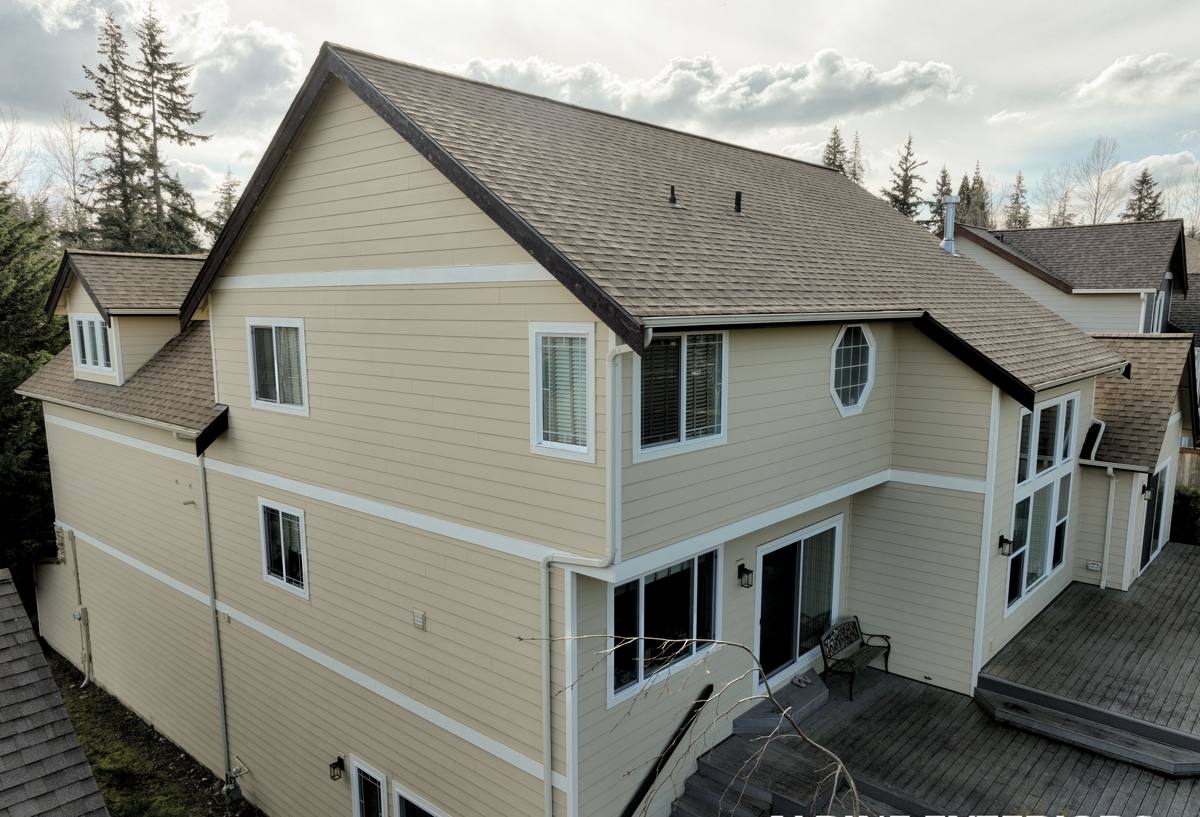
Signs a Deck Needs Repair — And Signs It Needs More Than That
Homeowners usually call us about one of two things: the deck looks bad, or the deck feels wrong to walk on. The second one matters more. Cosmetic wear — graying wood, surface moss, a little cupping — is often just maintenance. Structural symptoms are a different conversation.
- Boards that flex, bounce, or feel spongy underfoot
- Visible gaps or movement where the deck attaches to the house (the ledger board)
- Rust streaks running down from screws or nail heads
- Cracked, split, or soft wood you can press a screwdriver into
- Railings that wiggle at the post connection
- Persistent moss or dark staining in the same spots every year
- Stairs that feel uneven or have started to separate from stringers
If you're only seeing surface graying and light moss, that's usually cleaning and refinishing territory. If you're seeing any of the structural signs above, that's a repair — and it's worth having someone look at the framing underneath, not just the decking on top, before it gets worse.
Why the Ledger Board Deserves Extra Attention Here
The ledger board — the piece that bolts the deck to the house — is the single most common source of serious deck failures nationally, and it's a particular concern in a climate that stays wet as long as ours does. If flashing behind the ledger was installed poorly, or is missing altogether, water works its way behind the board and rots both the ledger and the rim joist it's attached to, often invisibly, for years. We check this connection on every repair call, even when it isn't the reason someone called us.
What a Correct Deck Repair Actually Involves
A repair that only replaces what's visible from the top often misses what's failing underneath. A repair done right starts with the structure and works outward:
1. Structural Inspection First
Before we touch a single board, we get underneath the deck and check the framing: joists, beams, posts, footings, and the ledger connection. This is where rot actually starts in our climate, and it's almost always hidden from a homeowner's normal view of the deck.
2. Fastener and Connector Condition
Salt air and constant moisture are hard on metal. We look at joist hangers, structural screws, and any exposed hardware for corrosion — not just rust stains on the surface, but the kind of pitting that weakens a connection without looking dramatic.
3. Drainage and Flashing
Water needs somewhere to go. If a deck holds standing water against the house, against a post base, or in a low spot in the decking itself, that's a design problem, not a wear problem, and patching the symptom without correcting the drainage means you'll be back here in a few years.
4. Board-by-Board Assessment
Only after the structure and drainage are confirmed sound do we get into which individual boards, balusters, or stair treads need replacing versus which can be cleaned, sanded, and refinished.
Problem Areas We See Most Often on Bellingham Decks
| Problem | What Causes It Here | What We Check |
|---|---|---|
| Soft or spongy decking | Prolonged moisture retention under moss or debris | Board core condition, joist tops underneath |
| Rusting fasteners | Salt air combined with high humidity | Fastener type, hidden corrosion at hanger connections |
| Ledger separation | Missing or failed flashing, moisture trapped against the house | Flashing detail, rim joist condition behind the ledger |
| Wobbly railings/posts | Loosened post-to-frame connections from seasonal wood movement | Post base hardware, blocking, lag bolt tightness |
| Persistent moss/algae | Shade, north exposure, long wet season | Surface prep needs, board spacing, drainage slope |
Repair or Replace? An Honest Way to Decide
Not every deck problem needs a full rebuild, and not every deck problem should be patched. We walk homeowners through this rather than defaulting to whichever job is bigger.
| Factor | Leans Toward Repair | Leans Toward Replacement |
|---|---|---|
| Framing condition | Joists and beams are solid, problems are isolated | Rot or corrosion is widespread through the structure |
| Ledger connection | Sound, properly flashed | Compromised, poorly flashed, or original construction was substandard |
| Age of the deck | Under 15-20 years, built to a reasonable standard | Older deck nearing the end of its practical service life |
| Extent of damage | Confined to specific boards, railings, or stairs | Damage recurring across multiple sections year after year |
| Your plans for the space | You're happy with the current layout and size | You want a different footprint, size, or added features |
When the framing is sound, a repair is usually the more cost-effective and faster path, and there's nothing wrong with choosing it. We'll tell you plainly when we think a repair is a temporary fix rather than a real solution — that's a judgment call we take seriously, because a deck is a safety structure, not just a place to put patio furniture.
How We Handle a Deck Repair Project
- On-site assessment. We inspect the deck top to bottom, including underneath, and give you a straight answer on scope.
- Written estimate. You get a clear breakdown of what's being repaired, replaced, or refinished, and why — no vague line items.
- Structural work first. Any framing, ledger, or connector repairs happen before cosmetic work, so nothing gets covered up before it's fixed.
- Board and hardware replacement. Damaged decking, railings, or stair components are replaced with materials matched to your existing deck where possible.
- Fastener upgrade where needed. If the original hardware wasn't suited to a coastal-influenced climate, we address that as part of the repair, not as an upsell afterthought.
- Final walkthrough. We check the repair with you, including how it drains, before we call the job done.
Materials and Fasteners: Why the Details Matter More Here
Two decks can look identical from the driveway and age completely differently depending on what's holding them together. In a climate with salt air and long stretches of wet weather, we favor corrosion-resistant fasteners and connectors over standard-grade hardware, even when it costs a little more up front. The reasoning is simple: the hardware fails first, and when it fails, it fails invisibly, inside the structure, before you ever see it from the top.
Where wood is being replaced, we discuss options honestly — cedar, treated lumber, or composite decking each have real trade-offs in cost, maintenance, and how they handle sustained moisture. We won't push a product because it's easier for us to install; we'll tell you what fits your deck, your budget, and how much upkeep you actually want to do.
Deck Maintenance That Actually Extends Repair Life
A good repair lasts a lot longer with a little seasonal attention. This isn't a sales pitch for ongoing service — it's the short list that makes the biggest difference in our climate:
- Sweep leaves and debris off the deck regularly, especially in fall
- Clean moss and algae off boards before it builds up a thick layer
- Keep gutters and downspouts clear so runoff isn't landing on the deck
- Check railings and stair connections once a year for looseness
- Reseal or refinish wood decking on the schedule your finish product recommends
- Watch for standing water after heavy rain — it shouldn't pool anywhere on the surface
Why a Crew That Already Works Bellingham Makes a Difference
Deck repair isn't exotic work, but doing it right in this specific climate means knowing what actually fails here versus what a general contractor guide assumes. A crew that regularly works Whatcom County properties has already seen how salt air treats hardware over a decade, how a shaded, north-facing deck holds moss differently than a sun-exposed one, and which ledger and flashing details hold up through our wet season and which ones quietly fail behind the scenes. That local pattern recognition is the difference between a repair that solves the actual problem and one that just replaces the boards you can see.
If your deck is showing wear, feeling soft in spots, or you're just not sure whether it needs a repair or something bigger, we're happy to take a look and give you a straight, no-pressure assessment — reach out below for a free estimate.