 Ferndale Siding
 Decks in Cordata Face a Different Kind of Wear
Cordata sits in that stretch of Whatcom County where marine air off the Salish Sea meets a landscape of mature evergreens, which means decks here deal with more than just rain. You get driving rain that comes in sideways during winter storms, humidity that lingers under tree canopy long after the sun's out, and a moss season that can stretch from October well into spring. None of that is exotic — it's just the Pacific Northwest doing what it does — but it adds up fast on a structure that's exposed to the weather year-round.
A deck built the same way you'd build one in a dry inland climate will show problems within a few seasons: soft spots in the decking, black streaking on fascia boards, fasteners that bleed rust, and a green film on anything shaded. None of that means the wood or composite is bad. It usually means the deck wasn't detailed for this climate in the first place.
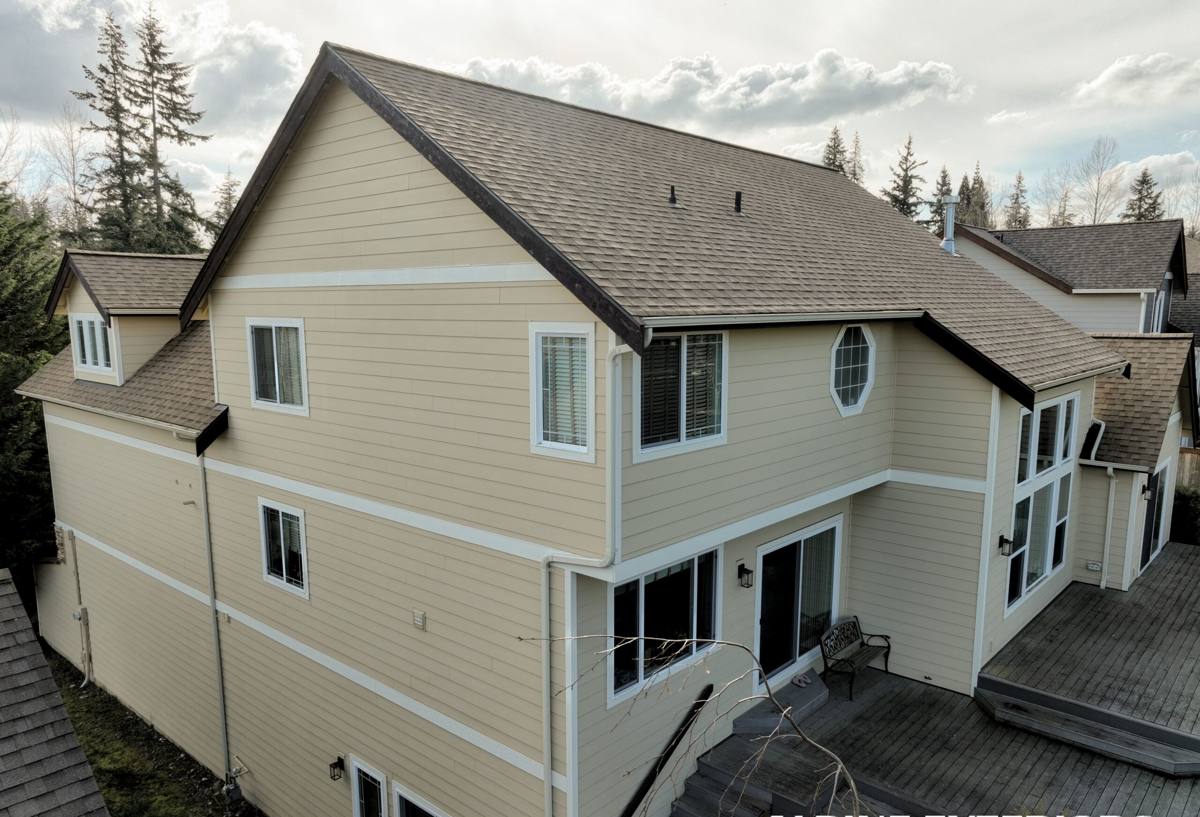
What Cordata Homes Actually Need From a Deck
The goal isn't to fight the climate — it's to build in a way that sheds water fast, dries out between storms, and doesn't trap moisture anywhere. That shows up in a handful of concrete details:
- Decking gaps sized correctly so boards can drain and dry, not just look tight on installation day
- Ledger board flashing that actually directs water away from the house rim joist, not just a bead of caulk
- Joist tape or a moisture barrier on top of every joist, so the framing under the decking isn't sitting in standing water
- Stainless or coated fasteners rated for treated lumber and coastal humidity, not standard exterior screws
- Footings set below frost depth and sized for our soil, with proper drainage around the post base
- A layout that accounts for shade from surrounding trees, since shaded sections of a deck stay damp far longer than sun-exposed ones
Skip any one of these and the deck will still look fine at the walkthrough. The problems show up two or three winters later, which is exactly why they're easy for an unfamiliar crew to overlook.
Salt Air and Metal Fasteners
Whatcom County isn't oceanfront everywhere, but the marine air reaches well inland, and it's harder on unprotected metal than most homeowners expect. Standard zinc-coated screws and brackets can start showing surface rust within a season or two, which then bleeds into the wood around them. We spec stainless steel or heavy hot-dip galvanized hardware for structural connections and fasteners, which costs a bit more up front and saves you from staining and hardware replacement down the line.
Choosing Decking Material for This Climate
There's no single "best" decking material — there's a best fit for your budget, your maintenance appetite, and how much sun versus shade your particular yard gets. Here's how the common options actually compare once you factor in our weather:
| Material | Upfront Cost | Moisture & Moss Resistance | Maintenance | Typical Lifespan |
|---|---|---|---|---|
| Pressure-treated wood | Lowest | Fair — needs sealing to perform | Annual cleaning and re-sealing | 10-15 years |
| Cedar | Moderate | Good natural resistance, but surface still needs care | Periodic cleaning and oil/stain | 15-20 years |
| Capped composite | Higher | Very good — capped shell resists moisture absorption | Occasional washing, no sealing | 25-30 years |
| PVC | Highest | Excellent — doesn't absorb moisture at all | Occasional washing | 30+ years |
In a lot of shaded Cordata yards, we lean homeowners toward capped composite or PVC on sections that don't get much direct sun, simply because bare wood in constant shade is where moss and mildew take hold fastest. On open, sun-exposed decks, a well-maintained cedar or treated wood deck can perform just fine for years. It really comes down to your specific lot.
Why We're Careful With Uncapped Composite
Older-generation uncapped composite decking has a real weak spot in wet climates: without a protective shell, the wood-fiber core can absorb moisture at the board ends and around fastener holes, which is exactly where mold and mildew show up first. That's not a knock on composite as a category — capped composite and PVC solve this by design. It's why, as a matter of our own standard, we default to capped or fully synthetic products for decking in damp, shaded conditions and explain the trade-off if a customer specifically wants an older-style uncapped product.
The Structure Underneath — What You Don't See
Most of what determines whether a deck lasts 10 years or 30 is invisible once it's built. Framing lumber should be rated for ground contact where it's close to grade, joist spacing should account for the decking material's actual span rating (composite and PVC often need tighter spacing than wood), and every ledger connection needs proper flashing integrated with your home's existing siding and weather barrier — not just sealant applied after the fact. Post bases should sit on top of the concrete footing, never buried in it, so water has somewhere to go besides straight into the end grain.
This is also where corners get cut on lower-cost bids. A deck that looks identical from the yard can have completely different fastener grades, flashing details, and footing depths underneath. Those differences don't matter until year three or four — right when they suddenly matter a lot.
Moss, Drainage, and Long-Term Upkeep
Moss doesn't grow because a deck was built wrong — it grows because Whatcom County has the moisture and shade moss needs, full stop. What building "right" does is control where it shows up and how bad it gets. Proper board gapping lets water drain through instead of pooling on the surface. Keeping the deck surface a few inches below any door threshold and sloping it slightly away from the house keeps water moving off the deck instead of sitting against it. And leaving air space between the decking and any skirting or under-deck storage keeps that space ventilated instead of turning into a damp, moss-friendly pocket.
Once it's built right, the maintenance homeowners actually need to do is straightforward:
- Sweep debris and needles off the deck surface regularly, especially in fall — trapped organic matter is moss's favorite starting point
- Rinse or lightly scrub the surface once or twice a year, more often in heavily shaded areas
- Check and clear gutter downspouts that drain near or onto the deck footprint
- Re-seal wood decking on the schedule the product actually calls for, not just when it starts looking gray
- Look underneath once a year for any signs of standing water, soft framing, or fastener corrosion
Our Process for a Cordata Deck Build
- On-site walkthrough — we look at sun exposure, tree cover, drainage patterns, and how the deck ties into your home before we talk materials or price
- Design and material selection — we walk through the material comparison honestly, based on your specific site conditions and budget, not a one-size-fits-all recommendation
- Permitting — we handle the permit application and inspections through the local jurisdiction so you don't have to chase paperwork
- Footings and framing — built to span and load requirements for your decking choice, with flashing and moisture barriers detailed for our climate
- Decking, railing, and finish work — installed with correct gapping and fastening for long-term drainage
- Final walkthrough — we go over the finished deck and what maintenance it actually needs, in plain terms
Permits and Local Requirements
New decks in and around Ferndale typically require a building permit, with specifics depending on deck height, size, and attachment to the house — the local building department is the authority on what applies to your project. We handle that application and inspection process as part of the job, which also means the work is documented and up to code if you ever sell the home.
Why a Crew That Already Works in Cordata Matters
A contractor who builds regularly in this part of Whatcom County isn't guessing about how much shade a north-facing yard gets in January, or how fast moss takes hold under mature trees, or which fastener grades hold up against the marine air moving inland from the coast. That familiarity shows up in the details — flashing choices, material recommendations, drainage planning — that separate a deck built for the Pacific Northwest from one that just happens to be sitting in it. It also means we're not learning on your project; we've already seen how these choices play out on decks a few years down the road.
Signs a Deck Was Built for This Climate
If you're comparing bids or evaluating an existing deck, these are the things worth checking:
- Visible flashing at the ledger board connection to the house, not just caulk
- Consistent, deliberate gaps between decking boards
- Stainless or coated fasteners, not fasteners already showing rust streaks
- A slight slope away from the house across the deck surface
- Ventilation gaps under the deck and around any skirting
- A written scope that specifies fastener and hardware grade, not just "decking and framing"
If you're planning a new deck in Cordata or want an honest read on an existing one, we're happy to come take a look. The estimate is free, there's no pressure, and you'll get a straight answer about what your specific yard and home actually need — just fill out the form below to get started.