 Ferndale Siding
 What Sumas Siding Has to Deal With
Sumas sits in farm country near the Canadian border, in a stretch of Whatcom County where the weather doesn't do siding any favors. Marine-influenced storms roll through with driving, sideways rain instead of gentle drizzle. Humidity stays high for long stretches of the year, and that combination of moisture and shade along tree lines and north-facing walls means moss and algae get a real head start — often six months or more of active growing season. Add in UV exposure during the drier summer stretch and freeze-thaw cycling in winter, and you've got a climate that stresses siding from every direction at once.
Most siding materials are not built for that combination. Vinyl expands and contracts with temperature swings and can warp or crack at the fasteners over time. Wood-based products like primed spruce or engineered wood siding rely on their paint film and edge sealant staying perfect for years — one missed touch-up and moisture finds a way into the substrate. In a climate like this one, the margin for error is small, and the siding on a Sumas home needs to be able to handle repeated wetting and drying without falling apart.
Why We Only Install James Hardie Here
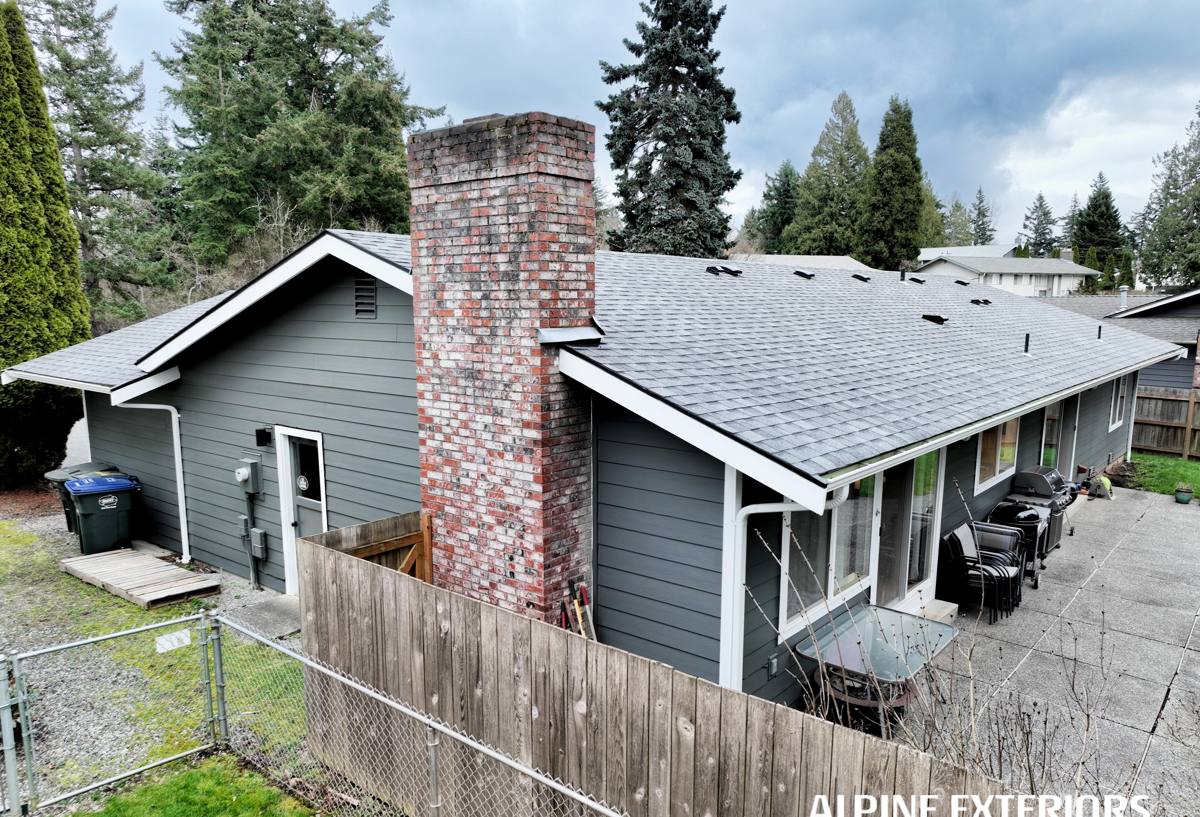
Ferndale Siding Company installs James Hardie fiber cement siding exclusively. We don't offer vinyl, LP SmartSide, Cemplank, Allura, primed spruce, or cedar, and that's a deliberate call based on what actually holds up in this part of Whatcom County — not a sales pitch.
It Doesn't Feed Moisture Damage
Fiber cement is made from cement, sand, and cellulose fiber, so it doesn't rot, delaminate, or feed fungal growth the way wood-based siding can. In a climate with a long wet season, that matters more than almost anything else on the spec sheet.
It's Non-Combustible
James Hardie siding is non-combustible, which matters for wildfire ember exposure and simply for long-term peace of mind on a home that's meant to last decades.
The Finish Resists What This Climate Throws at It
Hardie's ColorPlus factory finish is baked on in a controlled environment, not brushed on at the jobsite, so it holds color and resists the fading, chalking, and moss staining that plague field-painted siding here. That's a direct answer to the driving rain and long moss season this region deals with — a finish that's cured properly before it ever goes on the wall stands up better than one that has to cure outdoors between rainstorms.
What a Correct James Hardie Installation Involves
The material is only half the equation. A huge share of the siding failures we get called out to inspect aren't material failures at all — they're installation shortcuts. Hardie's own installation instructions are specific, and skipping steps is exactly how moisture gets behind even the best siding.
Clearances and Flashing
Hardie siding needs proper clearance from the ground, roof lines, decks, and any other siding material — typically 6 inches from grade or hard surfaces and 1/4 inch from roofing and other flashing details. Every window, door, and penetration needs correctly lapped flashing so water is directed out and down, not trapped behind the board.
The Weather-Resistive Barrier
Underneath the siding, a properly lapped weather-resistive barrier is what actually keeps bulk water out of the wall assembly. Fiber cement is durable, but it's still a rain-screen system working with a barrier behind it, not a standalone waterproof shell.
Fastening and Joints
Nails have to be set at the right depth and location — over-driven or under-driven fasteners are one of the most common causes of cracking and popped boards. Butt joints get treated with the sealant and technique Hardie specifies, not just caulked over generically.
HardieZone Product Selection
James Hardie engineers its products by climate zone. Homes in our part of Washington fall under the HZ10 system, which is formulated for wetter, more moderate climates as opposed to the HZ5 line built for hot, dry regions. Installing the wrong zone product is a mistake we simply don't make, because it defeats part of the reason to choose Hardie in the first place.
Choosing the Right Hardie Profile for a Sumas Home
James Hardie makes several distinct product lines, and the right mix usually comes down to the home's style and which walls take the worst weather exposure.
| Product | Best Use | Why It Fits This Climate |
|---|---|---|
| HardiePlank lap siding | Full exterior, most home styles | Traditional layered profile sheds driving rain effectively |
| HardiePlank with ColorPlus finish | Homes prioritizing low maintenance | Factory-cured finish resists moss staining and fading |
| HardiePanel vertical siding | Gables, modern facades, accent walls | Clean lines and strong water-shedding on steep faces |
| HardieShingle | Dormers, accent sections | Cedar-shake look without wood's moisture upkeep |
| HardieTrim boards | Window and door trim, fascia, corners | Won't absorb water or rot like wood trim in constant damp |
Most Sumas jobs use HardiePlank as the primary field material with HardieTrim around openings and corners, sometimes with a panel or shingle accent on a gable or entry feature. We'll walk through what fits your specific home during the estimate rather than pushing a one-size answer.
Our Process
Every job follows the same core sequence, adjusted for the condition of what's already on the wall:
- On-site assessment of the existing siding, sheathing, and any signs of trapped moisture or rot
- Removal of old siding and inspection of the sheathing underneath before anything new goes up
- Repair of any damaged sheathing or framing found during tear-off — this gets flagged and priced honestly, not buried in a change order surprise
- Installation of a new weather-resistive barrier, correctly lapped from the bottom up
- Flashing at every window, door, and penetration
- Installation of James Hardie siding, trim, and accents to manufacturer spec
- Final caulking, touch-up, and a walk-through with the homeowner
We don't skip the tear-off inspection step even when it slows the schedule down. Covering existing moisture damage with new siding just hides the problem for a few more years — it doesn't fix it.
Why Hiring a Crew That Already Works This Area Matters
A crew that regularly works Sumas and the surrounding Whatcom County towns has already seen how this climate behaves against different wall orientations, roof lines, and older building styles common to the area. That experience shows up in small decisions — where extra flashing attention pays off, which walls need the most moss-resistant finish, how to sequence a job around the wetter months so materials aren't sitting exposed. It also means a shorter response time if something needs a warranty check or a follow-up visit down the road, instead of waiting on a crew based hours away.
What Affects the Cost of a Hardie Installation
Every home is different, but the same handful of factors drive most of the variation in price:
| Factor | Why It Matters |
|---|---|
| Home size and number of stories | More square footage and taller walls mean more material and labor time |
| Condition of the existing siding and sheathing | Rot or moisture damage found during tear-off requires repair before new siding goes on |
| Product line and profile chosen | Lap, panel, and shingle profiles differ in material and install labor |
| Trim and accent detail | Complex trim work, corner detailing, and accent walls add labor |
| Finish choice | Factory ColorPlus finish versus field-applied paint affects material cost and long-term upkeep |
We give a firm, itemized number after seeing the home in person — not a phone estimate — because the sheathing condition underneath the old siding is often the biggest variable of all.
What to Expect From a Correctly Installed Job
Whether you're evaluating our work or a bid from anyone else, here's what a properly done James Hardie install should include:
- Correct 6-inch clearance from grade and hard surfaces, 1/4-inch clearance from roofing and flashing
- Weather-resistive barrier installed and lapped correctly before siding goes up
- Flashing at every window, door, and wall penetration
- Fasteners set flush, not over-driven or under-driven
- Butt joints and seams treated per Hardie's specified method, not just caulked over
- The correct HardieZone (HZ10) product for our climate
- A factory ColorPlus finish or a proper field-primed and painted finish, matched consistently across the job
If a bid skips any of these, it's worth asking why before signing.
If you're weighing a siding project on a Sumas home, we're glad to come take a look and give you a straightforward, no-pressure estimate — including an honest read on what's driving the cost and what condition your walls are actually in underneath the old siding. Use the form below to get started.