 Ferndale Siding
 Decking on Lummi Island Is a Different Job Than Decking Inland
Lummi Island sits out in the Salish Sea, and that location changes what a deck goes through every year. Homes here take on salt-laden air coming off the water, wind-driven rain that gets pushed sideways under eaves and railings, and a wet season that runs long enough for moss and algae to get a real foothold on any horizontal surface that doesn't drain and dry quickly. A deck built to a generic spec sheet, without accounting for those conditions, tends to show problems early — fastener corrosion, board staining, slick spots in the shade, and substructure rot that isn't visible until it's advanced.
We work throughout Whatcom County, and island and near-water properties like Lummi Island get a different set of decisions from us than a deck three miles inland in Ferndale. This page covers what those decisions are and why they matter.
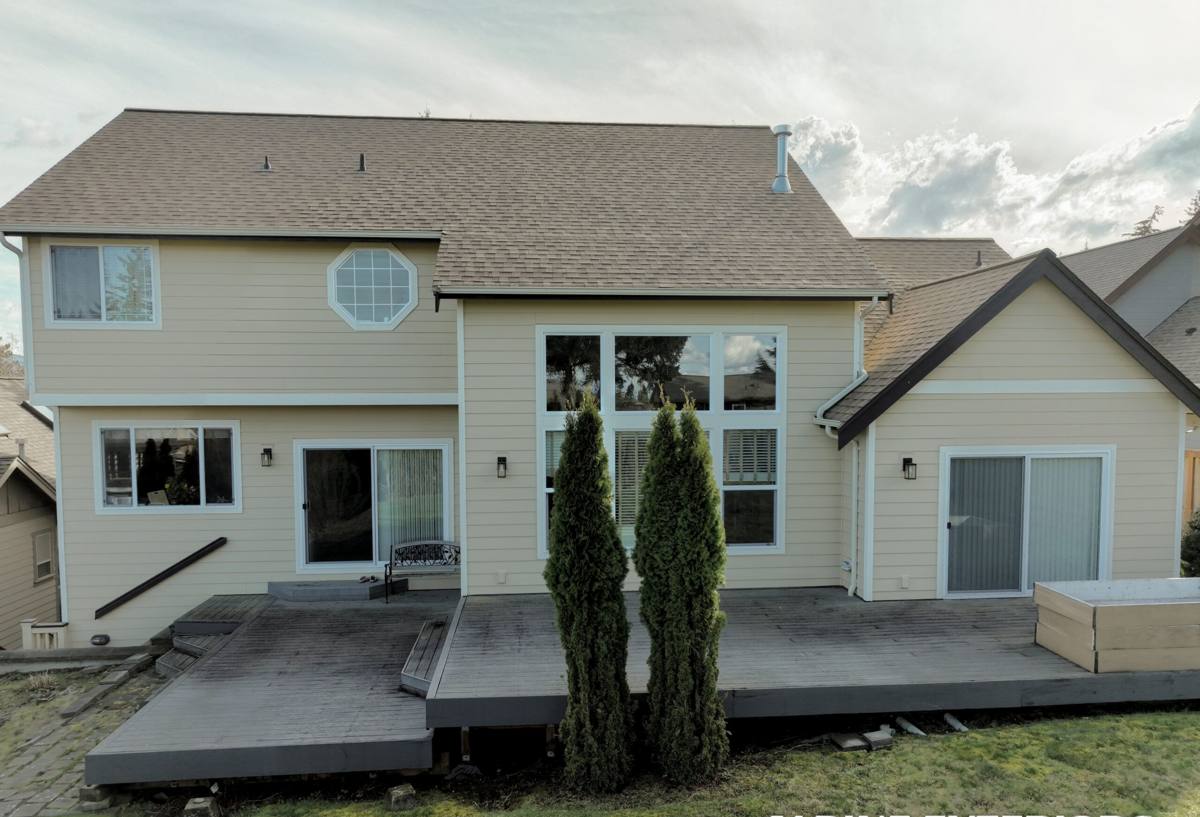
What Salt Air and Driving Rain Actually Do to a Deck
Salt Air
Airborne salt doesn't just affect boats and metal railings. It accelerates corrosion in any exposed fastener, bracket, or ledger connector, and it can dull or discolor certain composite finishes faster than the same product would age further inland. The fix isn't avoiding decks near the water — it's choosing hardware and board finishes rated for coastal exposure and keeping metal connections properly coated or stainless from the start.
Driving Rain
Storms off the water rarely fall straight down. Wind pushes rain sideways and up under rail caps, into board end grain, and behind fascia where it can sit against wood framing far longer than a homeowner would guess just by looking at the surface. Framing that isn't flashed and vented correctly stays damp long after the rain stops, which is where rot actually starts — underneath, not on top.
Moss and Algae Season
Whatcom County's wet season is long, and shaded or low-airflow deck areas — under overhangs, near fences, close to landscaping — stay damp for weeks at a time. Composite decking resists rot, but it isn't immune to surface growth. Boards with a textured or capped surface and a deck built with real airflow underneath will stay noticeably cleaner and less slick than one that traps moisture against the ground.
Why Composite Makes Sense Here — With Honest Caveats
Composite decking is a good fit for this climate because it doesn't absorb water the way real wood does, it doesn't need annual staining, and quality capped boards resist the graying and splintering that salt air and UV speed up in untreated lumber. That said, composite isn't maintenance-free, and it isn't automatically the right call for every budget or every homeowner's priorities. We'll tell you plainly where it outperforms wood and where it doesn't, rather than oversell it.
| Factor | Composite Decking | Pressure-Treated Wood | PVC Decking |
|---|---|---|---|
| Moisture resistance | Very good — capped boards shed water, resist rot | Fair — needs sealing to hold up in wet climates | Excellent — fully synthetic, no wood fiber to absorb water |
| Salt air performance | Good with coastal-rated finishes | Poor without frequent maintenance | Very good |
| Surface grip / moss resistance | Good with textured cap; still needs airflow underneath | Poor once weathered — gets slick | Good |
| Upfront cost | Mid-range | Lowest | Highest |
| Ongoing maintenance | Occasional washing | Annual sealing/staining | Occasional washing |
| Typical lifespan | 25–30+ years | 10–15 years before major repair | 25–30+ years |
We don't push one product on every homeowner. If budget is the priority and someone is committed to yearly maintenance, treated wood is still a legitimate choice. If low upkeep matters more than upfront cost, composite or PVC earns that price difference over the life of the deck — especially in a climate that's hard on untreated wood.
What a Correct Composite Deck Build Includes Out Here
Substructure First
The framing underneath a composite deck matters as much as the boards on top, arguably more on a property exposed to wind-driven rain. That means treated or naturally durable framing lumber, joist tape or a comparable protective barrier on top of joists to keep fasteners from creating a path for water into the wood, and ledger flashing detailed so water is directed away from the house rather than behind the siding.
Fastening and Hardware
Hidden fastener systems and structural screws should be stainless steel or coated specifically for coastal/marine exposure — not a generic exterior-rated fastener that's fine three miles from the water but corrodes faster right on it.
Drainage and Airflow
Board spacing, joist height off grade, and skirting design all affect how fast a deck dries out after a storm. On a moss-prone site, we pay particular attention to any low-airflow zones — under stairs, along the house wall, behind built-in benches — since those are where growth shows up first.
Railings and Edge Details
Rail post connections are a common weak point because they're structural, exposed, and hard to inspect once covered. We detail post bases so water sheds away from the connection instead of pooling at the base of the post.
Our Process
- On-site assessment. We look at sun and wind exposure, existing framing condition if this is a replacement, drainage slope, and how close the site is to the water.
- Material selection. We walk through board and hardware options suited to a marine-influenced climate, with real pricing and trade-offs — not just the top of a catalog.
- Substructure work. Framing repair or build-out, ledger flashing, and joist protection happen before a single deck board goes down.
- Installation. Boards, hidden fasteners, and railings installed to the manufacturer's coastal-exposure specifications where applicable.
- Final walkthrough. We go over basic care — cleaning schedule, what to watch for near shaded or low-airflow areas — so the deck stays in the condition it was built in.
What to Ask Before Hiring Anyone for This Job
A deck built without accounting for salt air, driving rain, and moss season will look fine for a year or two and then show its shortcuts. Before hiring a crew for a Lummi Island or other near-water property, it's worth asking:
- What fastener and hardware grade will be used, and is it rated for coastal exposure?
- Will joists be protected with tape or an equivalent barrier before boards go on?
- How is the ledger flashed where the deck meets the house?
- What's the plan for airflow under low-clearance or shaded sections of the deck?
- Does the crew have experience with island or waterfront logistics — ferry scheduling, material delivery, access constraints?
- What does the manufacturer's warranty actually cover in a marine environment, and does the installer follow those specs?
Maintaining a Composite Deck in This Climate
Composite decking cuts down on maintenance, but "low maintenance" isn't "no maintenance," especially with a long wet season. A periodic wash with a soft brush and mild cleaner keeps pollen, salt residue, and early moss growth from building up, and it's worth doing shaded or low-airflow areas more often than sun-exposed ones. Clearing debris out of gaps between boards keeps drainage working the way it was designed to. None of this is heavy work — it's closer to the occasional upkeep a homeowner would do for siding or gutters than the annual sanding and staining a wood deck demands.
Why Local Experience on Lummi Island Matters
Working on the island isn't the same as working a standard Ferndale lot. Ferry scheduling affects delivery windows and crew timing, access can be tighter depending on the property, and material has to be planned for in advance rather than picked up same-day from a supply yard. A crew that's already worked island jobs in Whatcom County plans around those realities instead of discovering them mid-project — which keeps the timeline honest and avoids the delays that come from underestimating logistics.
Local experience also means we've seen how decks in this specific environment actually age — which framing details hold up, which hardware corrodes early, and which shaded corners of a deck need extra attention. That's knowledge you only get from working the area, not from a spec sheet.
Get a Straight Answer for Your Property
Every deck on Lummi Island faces a slightly different mix of sun, wind, and shade depending on the lot. If you're planning a new composite deck or replacing one that's showing its age, we're happy to take a look and give you a straightforward assessment — what your site actually needs, realistic material options, and a clear estimate with no pressure attached. The form below is the easiest way to get started.