 Ferndale Siding
 Why Lynden Roofs Wear Differently Than the National Average
A roofing guide written for the national market assumes dry summers, a handful of hard freezes, and rain that mostly falls straight down. That is not what a roof in Lynden deals with. Whatcom County sits under a marine weather system that pushes wind-driven rain sideways into fascia and soffits, keeps humidity high for months at a stretch, and rarely gives a roof a real chance to dry out between storms. Add the salt-tinged air that moves inland off the Sound and the Strait, and you have a climate that is harder on fasteners, flashing, and shingle granules than most manufacturers' warranty testing accounts for.
The result is a long moss season that can run from fall through late spring, gutters that clog faster than homeowners expect, and roofs that show granule loss and flashing failure years before their rated lifespan would suggest. None of this means Lynden homes need exotic materials or oversized systems. It means the details that a lot of roofers treat as optional — proper underlayment, real ventilation, correctly lapped flashing — are not optional here. They are the difference between a roof that makes it to 25 years and one that starts leaking at 12.
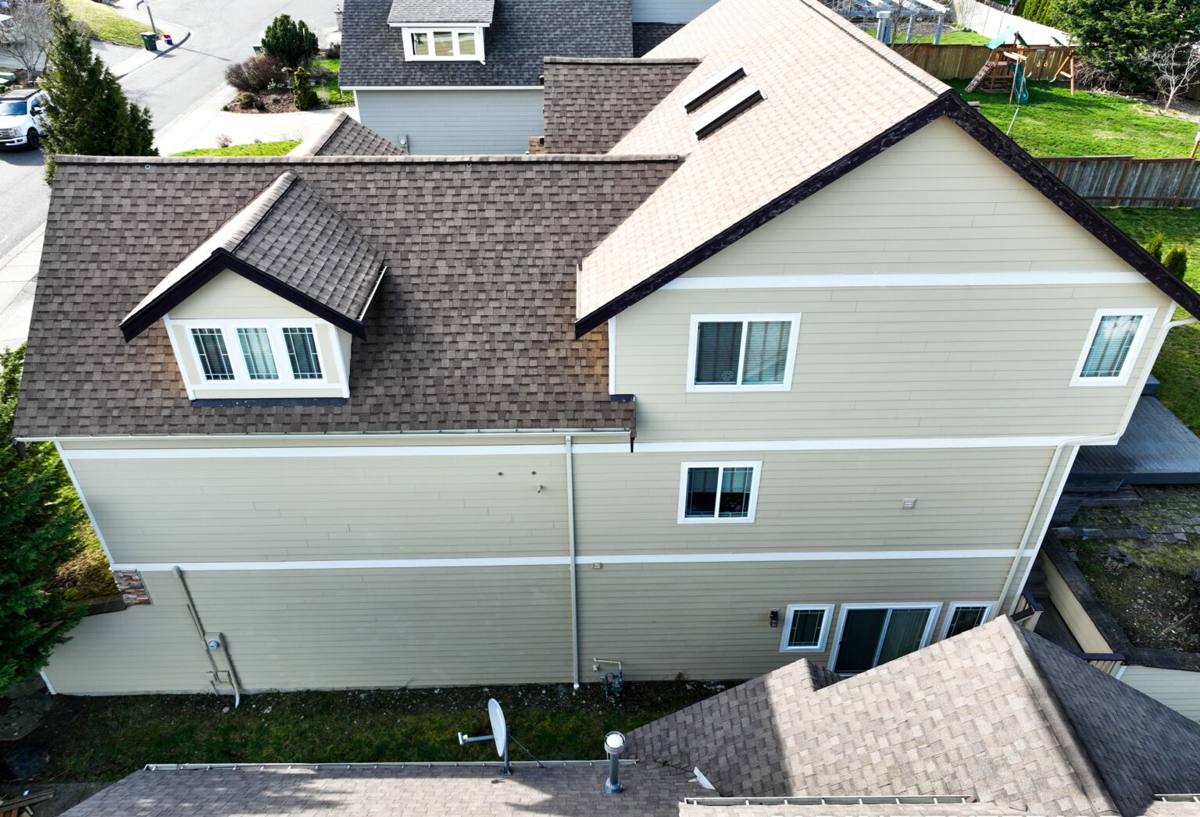
Signs a Lynden Roof Needs Replacement, Not Another Repair
Repairs make sense when a roof has isolated damage and years of usable life left. Replacement makes sense when the underlying materials are worn out everywhere, not just at the spot that happens to be leaking today. The signs below are what we actually look for on inspections in this area, not a generic checklist.
- Granules collecting in gutters or downspout splash zones, which signals the asphalt mat underneath is losing its UV and weather protection
- Shingles that look cupped, curled, or brittle when you press on them, especially on south- and west-facing slopes that take the most sun and wind
- Moss or algae streaking that keeps coming back within a season or two of cleaning, which usually means moisture is staying trapped under the shingle tabs
- Soft or spongy decking felt underfoot during inspection, a sign that water has been getting past the roofing layer for a while
- Daylight visible through the roof deck from the attic, or insulation that's damp, matted, or discolored
- Flashing around chimneys, skylights, and roof-to-wall transitions that's rusted, lifted, or was never properly stepped and counter-flashed in the first place
- A roof approaching or past 20 years old with multiple prior repairs — at that point, patching individual failures usually costs more over a few years than one correct replacement
What a Correct Roof Replacement Actually Includes
"Replace the roof" sounds simple, but the quality of a roofing job is decided almost entirely by layers homeowners never see once the new shingles are down. Skipping or shortcutting any of these is how a roof that looks fine on installation day starts failing in year three.
Tear-Off and Deck Inspection
We remove the old roofing down to the deck rather than layering over it. That lets us actually see the plywood or plank sheathing underneath and replace any sections that are soft, delaminated, or water-damaged — problems a layover job would just bury and let keep spreading.
Underlayment and Ice/Water Protection
Given how much wind-driven rain Whatcom County sees, we treat synthetic underlayment as standard, not an upgrade, and we run self-adhering ice-and-water barrier along eaves, valleys, and roof penetrations — the spots where wind-blown rain is most likely to work its way backward under a standard shingle course.
Ventilation
A roof deck that can't breathe traps moisture from the inside of the house, which accelerates rot and voids most shingle warranties outright. Balanced intake at the eaves and exhaust at the ridge keeps the attic space closer to outdoor temperature and humidity, which also helps prevent the ice-damming and condensation issues that show up in a wet, mild climate like this one.
Flashing
Flashing failure is the single most common cause of "mystery leaks" on roofs that otherwise look fine. Correct work means new step flashing at wall intersections, new counter-flashing at chimneys, and properly lapped valley metal or woven valleys, installed in the right sequence with the underlayment rather than caulked on as an afterthought.
Fasteners and Wind Resistance
We nail to the manufacturer's specified pattern and fastener count, not the minimum that will pass a quick glance. Given the storm winds this area sees seasonally, under-fastened shingles are one of the most common causes of early failure and warranty denial.
Roofing Materials That Make Sense for Whatcom County Weather
There is no single "best" roofing material — there's a best fit for a given home's roof pitch, budget, and how much long-term maintenance the owner wants to take on. Here's how the common options actually compare under this region's rain-and-moss conditions.
| Material | How It Handles Local Climate | Maintenance Reality | Typical Lifespan |
|---|---|---|---|
| Architectural asphalt shingle | Good performance when installed with proper underlayment and ventilation; algae-resistant (AR) shingle lines resist streaking better than standard | Periodic moss and debris removal; most homeowners' default choice | 20–30 years |
| Standing seam metal | Sheds rain and moss growth very well due to smooth, steep-draining surface; handles wind-driven rain with fewer seams to fail | Low; occasional gutter and fastener check | 40–50+ years |
| Cedar shake | Traditional look, but wood is naturally more vulnerable to sustained moisture and moss colonization in this climate | High; regular treatment and moss control needed to avoid premature rot | 20–30 years with diligent upkeep |
| Synthetic composite shake/slate | Mimics wood or slate appearance without wood's moisture sensitivity; performs well in wet, mossy conditions | Low to moderate | 30–50 years |
We'll walk through these trade-offs against your actual roof rather than pushing one product line. If we steer a homeowner away from a material — cedar shake is the most common example — it's because of the maintenance burden and moisture sensitivity in this specific climate, not because the product is bad in general.
Our Roof Replacement Process, Start to Finish
- On-site inspection. We walk the roof and the attic, not just look from the ground, and document deck condition, flashing points, and ventilation before quoting anything.
- Written estimate. You get a clear scope of work — materials, underlayment spec, flashing plan, and price — so there's no ambiguity about what "the roof replacement" includes.
- Material selection. We help you weigh options against your budget and how the roof is exposed to weather and tree cover, without pressuring toward the most expensive line.
- Scheduling around weather. Because a tear-off leaves a home exposed, we plan installation days around the forecast and keep the work area tarped and protected if conditions turn.
- Tear-off and deck repair. Old roofing comes off, the deck gets inspected, and any damaged sheathing is replaced before anything new goes down.
- Underlayment, flashing, and ventilation installation. This is the stage that determines whether the roof lasts 15 years or 30, and it's where we spend the most care.
- Final roofing material installation. Shingles, panels, or shakes go on to manufacturer spec, with correct fastening and exposure.
- Cleanup and magnetic nail sweep. We clear debris and run a sweep for stray fasteners so your yard and driveway are left clean.
- Final walkthrough. We review the finished roof with you and go over warranty paperwork before calling the job complete.
Cost Factors for a Lynden Roof Replacement
Every roof is priced individually, but the variables that actually move the number are consistent. Rather than quote a figure that won't match your specific roof, here's what drives cost up or down.
| Factor | Why It Matters |
|---|---|
| Roof size and number of planes | More square footage and more valleys, hips, and dormers all mean more material and labor time |
| Roof pitch | Steep roofs require more safety equipment and slower, more careful work than a low-slope roof |
| Deck condition | Rotted or delaminated sheathing found during tear-off adds material and labor that can't be known until the old roof is off |
| Material choice | Asphalt shingle, metal, and synthetic composite carry very different material costs, as shown in the comparison above |
| Layers being removed | A roof with an existing layover adds tear-off time and disposal cost versus a single-layer roof |
| Access and roof height | Multi-story homes or roofs with limited ground access require more setup time for safe staging |
As a broad range, a straightforward asphalt shingle replacement on an average single-family roof in this area typically falls in the low-to-mid five figures, with metal and premium synthetic materials running higher. The only way to get an accurate number is a real inspection — square footage from a satellite estimate alone misses deck condition, pitch complexity, and flashing scope.
Moss, Debris, and Roof Care After Replacement
A new roof still needs seasonal attention in this climate — the difference is that a correctly installed roof can shed moss and shrug off wind-driven rain far more effectively than one with weak underlayment or clogged ventilation. A little regular upkeep protects that investment.
- Keep gutters and downspouts clear, especially heading into fall, so water isn't backing up under the shingle edge
- Trim back overhanging branches to reduce shade, debris buildup, and the moss growth that thrives in damp, shaded spots
- Have moss treated or gently removed before it establishes a heavy mat rather than after — thick moss holds moisture against the roofing surface
- Avoid pressure washing shingles directly; it strips protective granules and can force water under the roofing layer
- Schedule a roof check after major windstorms to catch lifted flashing or displaced shingles early
- Have your attic ventilation checked periodically, since blocked soffit vents are a common and easy-to-miss cause of trapped moisture
Why Hiring a Crew That Already Works in Lynden Matters
Roofing crews that mostly work drier climates tend to under-spec underlayment, skip ice-and-water membrane in valleys, or treat ventilation as optional because it's rarely the thing that fails fast in their home region. In Whatcom County, those same shortcuts show up as leaks, rot, and moss within a handful of years. A crew that regularly works Lynden and the surrounding area already knows which roof details matter most here — where wind-driven rain tends to find weak points, how aggressively moss establishes on shaded north slopes, and which flashing details fail first on local roof styles.
Local, familiar work also means faster response if something does come up after installation. You're not waiting on a crew that has to travel in from outside the region to honor a workmanship warranty or check on a storm-related concern.
Permits, Warranties, and What a Reputable Contractor Should Provide
Roof replacement in unincorporated Whatcom County and surrounding municipalities generally requires a building permit, and a legitimate contractor should handle that as part of the job rather than leaving it to you or skipping it. Beyond the permit, a proper roofing job should come with two separate types of protection: a manufacturer's warranty covering the material itself, and a workmanship warranty from the installing contractor covering the labor and installation. Ask any contractor you're considering to explain both clearly, including what voids each one — improper ventilation and under-fastening are common ways a manufacturer warranty gets denied, regardless of who installed the roof.
If you're weighing a roof replacement for a Lynden home, we're happy to take a look, walk you through what your roof actually needs, and give you a straightforward, no-pressure estimate. Use the form below to get started.