 Ferndale Siding
 Why Marietta's Climate Is Hard on Siding
Marietta sits close to the water in one of the wetter, damper corners of Whatcom County, and that location shapes everything about how siding ages here. Homes in this part of Ferndale deal with a combination most inland neighborhoods never see at the same intensity: salt-laden air off the bay, wind-driven rain that hits walls sideways instead of falling straight down, and a moss season that can stretch for most of the year on shaded, north-facing walls. Any one of those factors will shorten the life of the wrong siding material. Together, they make material choice one of the most important decisions a Marietta homeowner makes on an exterior project.
Salt Air and Coastal Moisture
Airborne salt is corrosive to metal fasteners and trim, and it also holds moisture against exterior surfaces longer than dry inland air does. Siding that isn't engineered for a marine-influenced environment can show fastener corrosion, finish breakdown, and swelling at the edges years before it would in a drier part of the county.
Driving Rain and Wind-Driven Water
Storms coming off the water don't just drop rain straight down — they push it horizontally into walls, corners, and anywhere a seam or penetration isn't sealed correctly. This is where installation quality matters as much as the product itself. Water finds the weak point, and on a water-exposed property that weak point gets tested far more often than it would elsewhere.
Moss, Shade, and Extended Wet Season
Between tree cover and the marine layer, many Marietta lots stay damp longer into the season than properties just a few miles inland. Moss and algae take hold fastest on porous or wood-based materials that hold moisture at the surface. Siding that resists water absorption at the material level, not just at the paint layer, holds up dramatically better here.
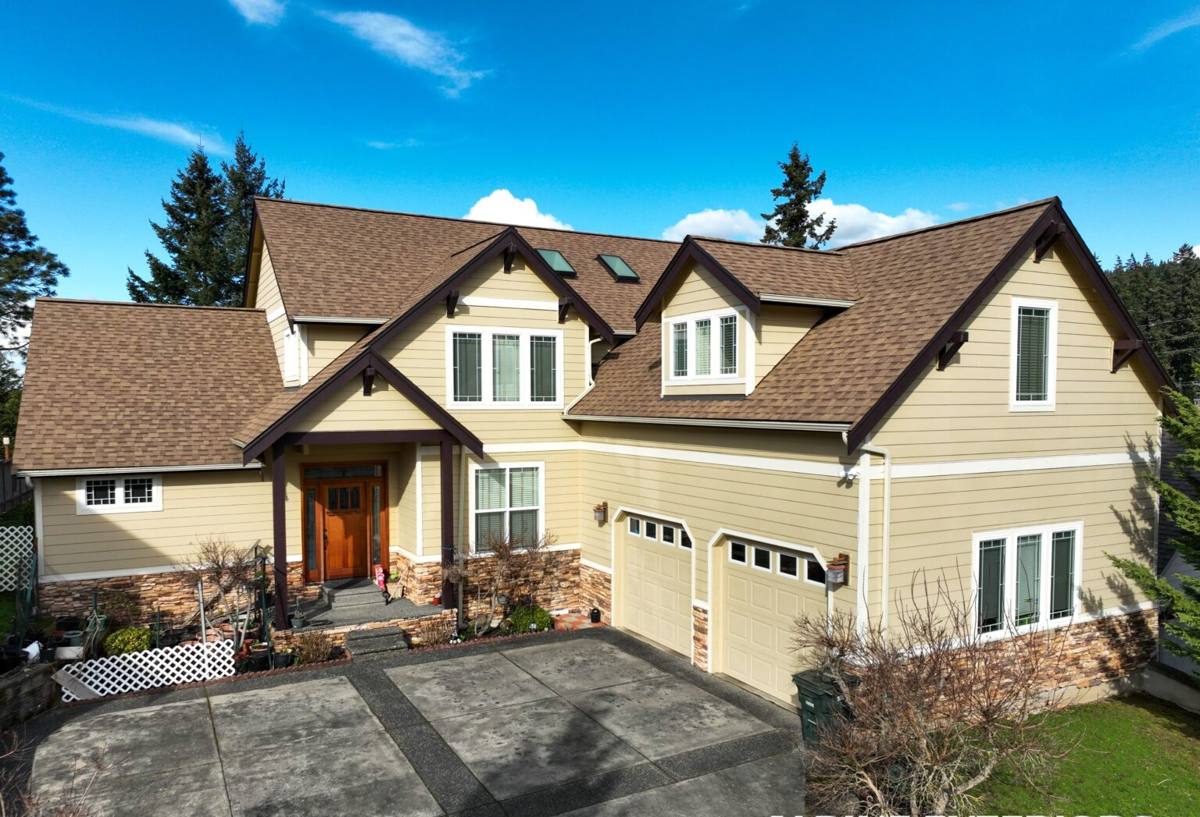
Why James Hardie Fits Marietta Homes
We install James Hardie fiber cement siding exclusively, and in a climate like Marietta's the reasoning is straightforward. Fiber cement doesn't rot, doesn't provide a food source for moss and mildew the way wood does, and doesn't swell or delaminate under repeated wetting and drying cycles the way some engineered wood products can. It's also non-combustible, which matters as regional wildfire smoke seasons have become a more regular late-summer reality across Western Washington.
James Hardie's ColorPlus finish is baked on at the factory under controlled conditions, rather than field-applied on site. That matters in a wet climate because factory-cured finishes adhere more consistently and resist the fading and chalking that field-applied paint can show within a few years of coastal sun and salt exposure.
| Factor | James Hardie Fiber Cement | Wood / Engineered Wood | Vinyl |
|---|---|---|---|
| Moisture absorption | Very low, engineered for wet climates | Moderate to high, prone to swelling | Low, but seams can trap moisture |
| Moss/algae resistance | High — less porous surface | Lower — organic material feeds growth | Moderate — surface can still host growth in shade |
| Salt air / coastal durability | Engineered for marine exposure | Can degrade faster near salt air | Can become brittle over time |
| Fire resistance | Non-combustible | Combustible | Can soften/deform under heat |
| Finish longevity | Factory-cured ColorPlus, long warranty | Field-applied paint, shorter repaint cycle | Color molded in, can fade and chalk |
What a Correct Marietta Installation Involves
The siding product is only part of the equation. In a high-moisture, wind-exposed area, the details behind the boards matter just as much as the boards themselves. A correct James Hardie install here follows the manufacturer's wet-climate specifications closely, not just the minimum building code.
Weather-Resistive Barrier and Flashing Details
Every wall gets a properly lapped weather-resistive barrier behind the siding, with flashing integrated at windows, doors, and any roof-to-wall intersections so water is directed out and away from the structure rather than trapped behind the cladding. This is the layer that does the real work during a wind-driven storm.
Proper Fastening and Clearances
James Hardie specifies exact fastener types, spacing, and clearances above grade, decks, and roof lines. In a salt-air environment, using the correct corrosion-resistant fasteners — and installing them at the right depth and spacing — is the difference between trim that stays tight for decades and trim that starts showing streaking and loosening within a few years.
- Weather-resistive barrier installed and lapped correctly at every seam
- Flashing integrated at all windows, doors, and roof intersections
- Correct minimum clearance maintained above roof lines, decks, and grade
- Manufacturer-specified, corrosion-resistant fasteners used throughout
- Proper gapping and caulking at butt joints per Hardie's fastening requirements
- Factory-cut and factory-primed edges kept intact wherever possible to preserve warranty coverage
- Ventilation behind the cladding maintained so trapped moisture can escape
Choosing the Right Hardie Product Line and Color for This Area
James Hardie makes climate-engineered product lines (HZ5, HZ10) matched to different regions of the country, and the Pacific Northwest's wet, moderate climate calls for the version formulated for consistent moisture exposure rather than freeze-thaw or extreme heat. We spec the line built for this region as the default for Marietta projects.
Color choice matters too. ColorPlus finishes come in a range of factory-applied colors engineered to resist fading, and darker, low-maintenance tones tend to show less streaking from airborne salt and organic buildup between cleanings than very light, flat finishes exposed to constant shade and moisture. We walk homeowners through the tradeoffs for their specific lot — sun exposure, tree cover, and proximity to the water all factor in.
Our Process, From Estimate to Finished Job
We keep the process straightforward because most homeowners are dealing with a big decision and don't need it complicated further.
- On-site assessment — we look at your home's current siding, moisture exposure, sun/shade pattern, and any signs of existing water intrusion or rot before recommending anything.
- Product and color selection — we walk through the right Hardie line and ColorPlus color options for your specific exposure, not just what looks good in a sample book.
- Written estimate — a clear scope of work and price, with no pressure to sign on the spot.
- Prep and installation — removal of old siding where needed, correction of any water-damaged sheathing found underneath, proper barrier and flashing installation, then the Hardie siding itself.
- Final walkthrough — we go over the finished work with you before calling the job done.
Cost Factors for James Hardie Siding in Marietta
Every home is different, so we don't quote pricing without seeing the property, but the factors that most often move the number are consistent from job to job.
| Factor | Why It Affects Cost |
|---|---|
| Condition of existing sheathing | Water-damaged sheathing found during tear-off has to be repaired or replaced before new siding goes on |
| Home size and wall complexity | More corners, gables, and trim detail mean more labor and cut waste |
| Product line and profile | Lap width, panel style, and trim options carry different material costs |
| Story height and access | Multi-story sections and difficult access require more scaffolding and labor time |
| Existing siding removal | Full tear-off of old wood or vinyl adds labor compared to installing over a properly prepped surface |
Why a Crew That Already Works in Marietta Matters
Installation quality is the single biggest variable in how long siding lasts, and that quality depends heavily on whether the crew understands the specific conditions of the site they're working on. A crew that regularly works waterfront and near-waterfront properties in this part of Whatcom County already knows where wind-driven rain tends to hit hardest, how much clearance a given lot's moss and shade pattern really needs, and which flashing details matter most on homes exposed to the bay. That's knowledge that shows up in the finished product years later, not on install day.
Maintenance in a Salt Air, Moss-Prone Environment
James Hardie siding is low-maintenance compared to wood, but "low-maintenance" doesn't mean "no maintenance," especially this close to the water. A periodic rinse to clear salt residue and organic buildup, prompt attention to any caulking that starts to separate at trim joints, and keeping gutters clear so water isn't overflowing onto wall sections all go a long way toward getting the full lifespan out of the material. None of this requires repainting on the schedule wood or engineered wood siding would demand — that's a large part of why we recommend it here.
If you're weighing siding options for a home in Marietta, we're happy to take a look and give you a straightforward, no-pressure estimate — just fill out the form below to get started.