 Ferndale Siding
 New Roof Installation in Everson: Why Local Knowledge Matters
Everson sits inland from Ferndale along the Nooksack River corridor, in a part of Whatcom County that's quieter, more rural, and surrounded by farmland and tree cover. That setting changes how a roof ages here compared to a house closer to the water or tucked into a dense subdivision. Long stretches of shade from mature trees, ongoing moisture off the river valley, and the general wet-side-of-the-Cascades climate all put steady pressure on roofing materials year after year. A roof that's installed correctly for this environment will hold up. One that isn't will show problems early, usually starting with moss, soft spots, and slow leaks that don't show themselves until they're already inside the attic.
This page is about one job, done right, in one place: full new roof installation for homes in and around Everson. Not a general overview of roofing everywhere — the specific decisions that matter for a house sitting in this part of Whatcom County.
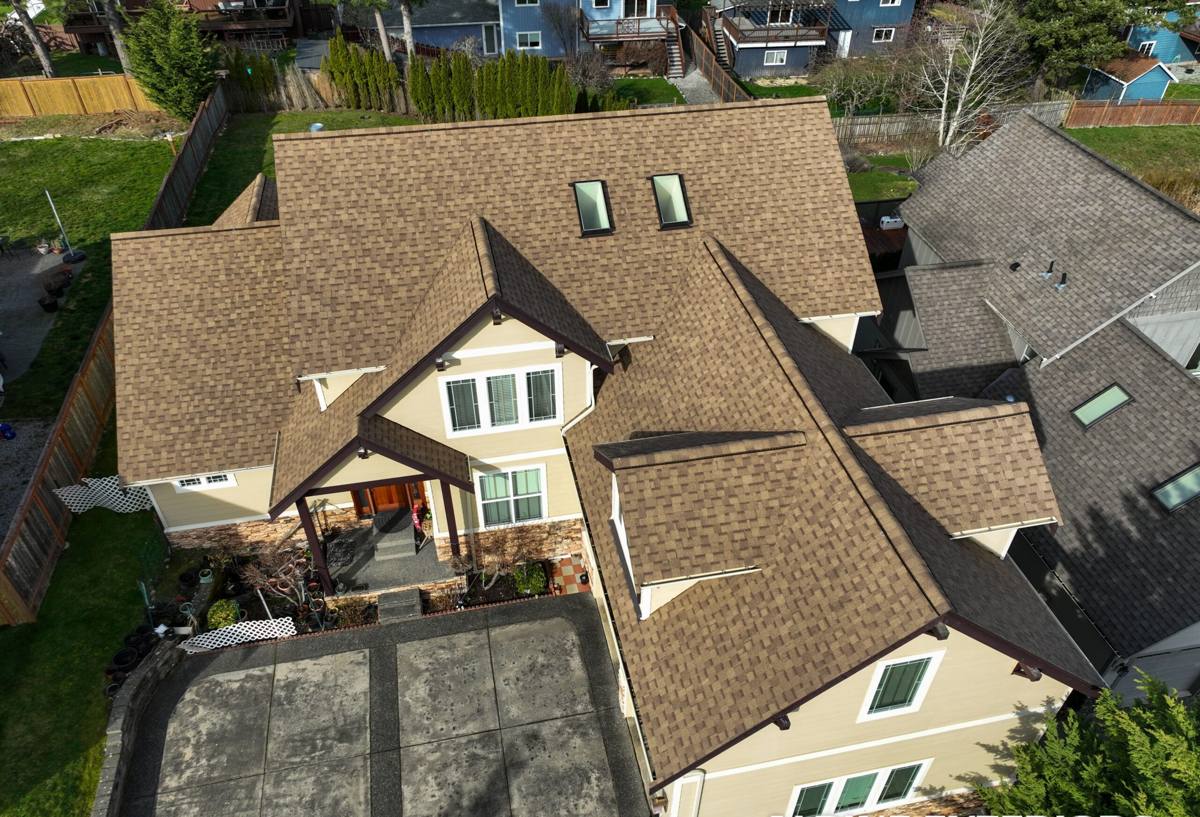
What Whatcom County Weather Does to an Aging Roof
Every roof in this region deals with the same basic conditions: driving rain that comes in sideways during winter storms, a long stretch of the year where surfaces rarely fully dry out, and a moss season that can run from fall through spring. Homes with heavy tree cover, like many in and around Everson's rural lots, get an extra dose of shade, falling debris, and standing moisture that speeds up wear on a roof surface.
Moss and Organic Growth
Moss doesn't just sit on top of shingles looking bad. It holds moisture against the roofing surface, works its way under shingle tabs and edges, and gradually lifts material away from the deck. On a shaded, tree-lined lot, moss can establish itself within a couple of years of a roof going on if the installation didn't account for airflow and drainage. Once it's under the shingles rather than on top of them, cleaning won't fix the underlying problem — the material is already compromised.
Wind-Driven Rain and Flashing Wear
Rain that comes in at an angle finds every weak point in a roof system — valleys, chimney flashing, skylight curbs, and the transitions where a roof meets a wall or dormer. These are the areas that fail first on an aging or poorly detailed roof, well before the shingle field itself gives out. A correct installation treats these transition points as the most important part of the job, not an afterthought.
Signs You're Looking at Replacement, Not Repair
Not every roof problem means a full replacement. But for homeowners in Everson, these are the signs that patching is no longer the honest answer:
- Granules collecting in gutters or at the base of downspouts in noticeable amounts
- Shingles that are curling, cupping, or cracking across large sections rather than one isolated spot
- Moss or dark streaking that returns quickly after cleaning
- Soft or spongy spots when walking the roof, which usually mean the decking underneath has taken on water
- Daylight visible through the attic sheathing, or damp insulation after a storm
- A roof that's already had two or more rounds of repairs in the last several years
- Age alone — most asphalt roofing in this climate is nearing the end of its realistic service life by 20-25 years, sooner if ventilation was ever inadequate
What a Correct New Roof Installation Actually Involves
Tear-Off and Deck Inspection
We remove the old roofing down to the deck rather than layering over it. That's the only way to actually see the plywood or plank sheathing underneath, catch any soft or delaminated sections, and replace them before anything new goes on. Covering over a bad deck just hides the problem under a new roof.
Underlayment and Water Protection
A synthetic underlayment goes down across the full deck as the primary water barrier beneath the shingles. In vulnerable areas — eaves, valleys, and low-slope transitions — we add self-adhering ice-and-water membrane, which matters in this climate because those are exactly the spots where wind-driven rain and slow-draining moisture cause the most damage over time.
Flashing Details
New metal flashing at valleys, chimneys, sidewalls, and any roof penetrations — not a reuse of old, bent, or rusted flashing. This is where most leaks actually originate on an older roof, and it's the part of the job that's easiest to shortcut and hardest to fix later without tearing into finished work.
Ventilation
Proper intake and exhaust ventilation keeps the attic space close to outside temperature and moisture levels. Without it, warm moist air gets trapped, condenses on the underside of the deck, and creates the exact damp conditions that shorten a roof's life and feed moss growth from underneath. We check existing ventilation on every job and correct it as part of the installation, not as a separate upsell.
Roofing Material Options for Everson Homes
Material choice matters, but it matters less than correct installation. Still, here's an honest comparison of the common options we install:
| Material | Typical Lifespan | How It Handles Moss & Moisture | Best Fit |
|---|---|---|---|
| 3-tab asphalt shingle | 15-20 years | Lower moisture resistance; thinner profile sheds debris less effectively under tree cover | Budget-conscious projects, lower-slope sections |
| Architectural (laminate) shingle | 25-30 years | Thicker, better shed of standing moisture; still needs good ventilation to resist moss | Most Everson homes — the standard we recommend for shaded, rural lots |
| Standing seam metal | 40-50+ years | Sheds water and moss very effectively due to slick, continuous surface | Homeowners planning to stay long-term or wanting minimal moss maintenance |
| Synthetic composite (slate/shake look) | 30-50 years | Good moisture resistance; performance varies by manufacturer | Homes wanting a specific look with lower upkeep than natural wood |
We don't install cedar shake roofing as a standard offering. It can look great, but it demands regular maintenance and treatment to resist rot and moss in a climate this wet, and the upkeep burden is significant for most homeowners. If that's a look you want, we'll talk through it honestly rather than just saying yes.
Our Installation Process
- On-site inspection and honest assessment of whether you need replacement or repair
- Written estimate covering material options, ventilation needs, and any deck repair likely to come up
- Scheduling built around Whatcom County's weather patterns — we plan tear-off days when we have a real dry window, not just an open slot on the calendar
- Tear-off and deck inspection, with any damaged sheathing replaced before anything new goes down
- Underlayment, ice-and-water membrane, and new flashing installed at every valley and penetration
- Shingle or metal installation per manufacturer specifications, including proper nailing patterns and exposure
- Ventilation correction or upgrade as needed
- Full site cleanup, including a magnetic sweep for nails and debris
- Final walkthrough and warranty paperwork before we consider the job done
Cost Factors to Expect
| Factor | Why It Moves the Price |
|---|---|
| Roof size and pitch | More square footage and steeper pitches mean more material and more labor time |
| Number of layers to remove | Tearing off two layers of old roofing costs more than one |
| Deck repair | Rotted or soft sheathing found during tear-off has to be replaced before installation continues |
| Material choice | 3-tab, architectural, and metal roofing carry different material costs per square |
| Ventilation upgrades | Adding proper intake/exhaust venting where none exists is worth the cost long-term but adds to the job |
| Roof complexity | Multiple valleys, dormers, and penetrations take more flashing work and more time than a simple gable roof |
| Site access | Rural properties with long driveways or difficult staging areas can affect setup and material handling |
We give real numbers on-site after seeing the roof, not a vague range over the phone. Every estimate lays out what's driving the cost so you know exactly what you're paying for.
Why a Crew That Already Works Everson Matters
A roofing crew that regularly works Whatcom County knows how to read this area's weather windows, understands the permitting process locally, and isn't guessing at how rural properties around Everson are laid out for material delivery and staging. That familiarity shows up in small but real ways — showing up when a dry stretch actually opens up rather than gambling on a forecast, knowing what inspectors here are looking for, and not treating a rural driveway or a tree-shaded lot as a surprise on install day. It also means we're not disappearing after the job is done. If a question comes up two years down the road, we're still working in this area and easy to reach.
After Your New Roof Goes On
A correctly installed roof still needs basic upkeep, especially given how long moss season runs here. A few habits go a long way toward getting the full lifespan out of your investment:
- Clear gutters and downspouts at least twice a year, more often if you're under heavy tree cover
- Have moss growth treated before it spreads, rather than waiting until it's visible from the street
- Walk the roofline visually after major windstorms to check for lifted shingles or displaced flashing
- Keep overhanging branches trimmed back to reduce shade, debris, and physical abrasion on the roof surface
- Check attic ventilation isn't blocked by insulation or debris, especially after any attic work
If you're in Everson and dealing with an aging roof, moss that keeps coming back, or you just want an honest opinion on whether repair or replacement makes sense, we're happy to come take a look. The estimate is free, there's no pressure, and you'll get a straight answer either way — just fill out the form below to get started.