 Ferndale Siding
 Point Roberts is its own kind of place. It's a small peninsula hanging off the bottom of the Tsawwassen area, cut off from the rest of Whatcom County by water and by the Canadian border — the only way in by land is through Canada. That isolation shapes everything about how homes are built and maintained out there, and roofs take the worst of it. Salt-laden wind off the Strait of Georgia and Boundary Bay, rain that comes in sideways instead of straight down, and a damp, shaded climate that keeps moss growing nearly year-round all add up to a roof that ages faster than one twenty miles inland. This page is about what roof repair actually involves for a Point Roberts home — what wears out first, what a correct fix looks like, and why the logistics of this particular community matter as much as the workmanship.
Why Point Roberts Roofs Take a Different Kind of Beating
Every roof in western Whatcom County deals with rain. Point Roberts roofs deal with rain plus salt air plus near-constant exposure on a piece of land with water on three sides. That combination shows up in specific, predictable failure patterns.
Salt Air and Metal Fatigue
Salt in the air accelerates corrosion on anything metal — flashing, fasteners, gutter hangers, vent caps. A nail or flashing piece that would hold up for thirty years in a drier, inland setting can start rusting and losing its seal in a fraction of that time this close to open water. Once a fastener corrodes and loosens, or flashing pits and thins, water finds a way in long before the shingles themselves are worn out.
Wind-Driven Rain and Flashing Failure
Rain that falls straight down mostly runs off a roof the way it's supposed to. Rain driven sideways by wind off the water gets pushed up under shingle edges, around chimney and skylight flashing, and into any gap that a calmer climate would never test. Most of the leaks we find on coastal Whatcom County homes aren't from worn-out shingle field — they're from flashing details that were fine for years until one storm found the weak point.
A Moss Season That Barely Ends
Cool temperatures, shade from mature trees, and near-constant moisture give moss a long growing window here — often most of the year, with only a short dry stretch in summer where growth really slows. Moss holds water against the roof surface, works its way under shingle tabs as it spreads, and can lift shingles enough to break their seal even before the shingle material itself has failed.
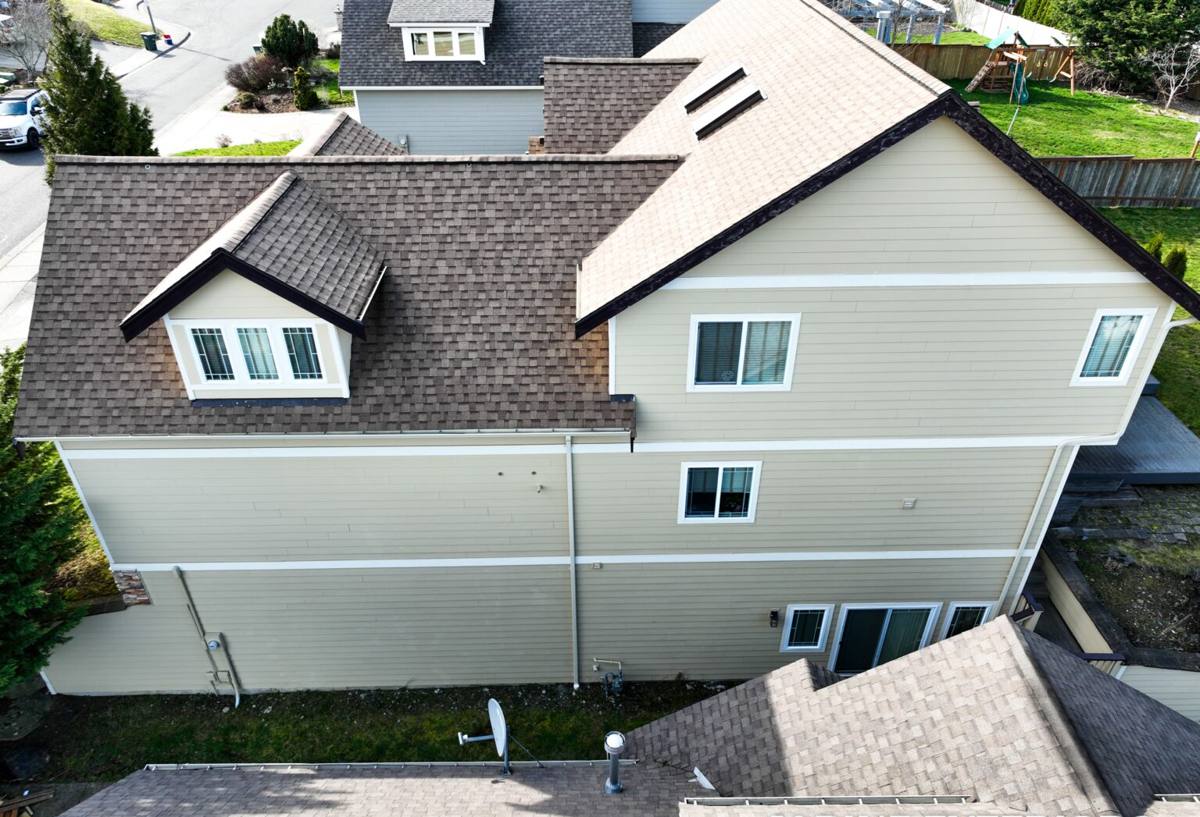
Signs Your Point Roberts Roof Needs Repair
Most roof problems give warning signs well before they become a full leak. Homeowners who catch these early usually end up with a smaller, cheaper repair instead of interior damage.
- Moss buildup along the shaded, north-facing slopes or anywhere tree cover keeps the roof damp
- Granules collecting in gutters or at downspout outlets — a sign the shingle surface is wearing thin
- Rust streaks below metal flashing, vent boots, or gutter hardware
- Curling, cupping, or lifted shingle edges, especially on slopes that face the open water and prevailing wind
- Soft or discolored ceiling patches, especially near chimneys, skylights, or where two roof planes meet
- Daylight visible through the attic roof deck, or damp insulation on inspection
- Cracked or missing caulking and sealant around penetrations — pipe boots, vents, and flashing seams
- Shingles that feel spongy or granule-bare when walked, or visible bare fiberglass mat
What a Correct Repair Involves
A roof repair that actually holds up in this environment takes more than swapping a few shingles. It means finding the real source of the problem and fixing it in a way that accounts for salt exposure and wind-driven rain, not just patching the visible symptom.
Diagnosing the Actual Problem First
Water rarely shows up on the ceiling directly below where it entered the roof — it travels along rafters, sheathing, and underlayment before it drips. A proper repair starts with tracing the leak to its actual entry point, usually by inspecting the attic from inside as well as the roof surface from outside, rather than assuming the nearest visible damage is the cause.
Matching Materials and Technique
Patching in shingles that don't match the existing course, or using a different weight or style of material, creates a visible seam and, worse, a spot where the repair doesn't shed water the same way the surrounding roof does. We match shingle type, exposure, and fastening pattern to what's already on the roof so the repair blends in and performs the same as the original installation.
Flashing, Ventilation, and the Details That Get Skipped
Most callback leaks trace back to flashing that was reused, undersized, or installed without enough overlap — not to the shingles themselves. On a coastal roof, we treat flashing replacement as part of nearly every repair rather than an optional extra, since corroded or fatigued flashing is so often the real cause. We also check that attic ventilation is working correctly; poor airflow traps moisture under the roof deck, which speeds up rot and moss growth from underneath as well as above.
Repair or Replace? How We Help You Decide
Not every roof problem needs a full replacement, and not every roof is worth continuing to patch. We walk homeowners through the honest trade-offs rather than defaulting to whichever job is bigger.
| Factor | Leans Toward Repair | Leans Toward Replacement |
|---|---|---|
| Roof age | Under roughly 12-15 years | Approaching or past the shingle's rated lifespan |
| Extent of damage | Isolated to one area or detail | Spread across multiple slopes or the whole roof |
| Moss and granule loss | Surface moss with shingle mat still intact | Widespread granule loss and thinning mat |
| Decking condition | Solid, dry sheathing under the affected area | Soft, rotted, or repeatedly wet decking |
| Repair history | First or second repair on this roof | Third or more repair, or recurring leaks in the same area |
When a roof is genuinely near the end of its service life, we'll say so directly instead of stacking another repair on top of one that's likely to fail again within a season or two.
Our Process for a Point Roberts Repair Call
Because Point Roberts is only reachable by land through Canada, we plan these jobs a little differently than a repair call five minutes from the shop. Getting the logistics right up front avoids delays once we're on-site.
- Initial contact and photos. A quick description and, if possible, a photo of the problem area helps us come prepared with the right materials the first trip.
- Scheduling with border crossing in mind. We plan crew and material logistics around the crossing and build in a realistic window, so a repair visit isn't derailed by wait times.
- On-site inspection. We check the roof surface, the attic from inside where accessible, flashing details, and ventilation to confirm the actual cause before quoting the fix.
- Written scope and estimate. You get a clear explanation of what failed, what we'll repair, and what it costs — no vague line items.
- The repair itself. Matching materials, corrosion-resistant fasteners and flashing, and attention to the details most likely to fail again in this climate.
- Cleanup and walk-through. Debris and old material removed, work area cleared, and a final look at the repair together before we leave.
Materials We Use — and Why
Material choice matters more on a salt-exposed roof than almost anywhere else in the county. We lean toward products and techniques with a track record of holding up to that specific combination of salt, wind, and moisture, and we're upfront about the trade-offs of each option.
| Material / Detail | Why We Use It | Trade-Off to Know |
|---|---|---|
| Corrosion-resistant flashing (aluminum or galvanized, properly coated) | Holds up far longer against salt air than bare or lower-grade metal | Costs somewhat more than the cheapest flashing stock |
| Stainless or coated fasteners | Resists the rust streaking and loosening common with standard nails near open water | Slightly higher material cost per repair |
| Self-adhering underlayment at valleys and eaves | Adds a sealed backup layer where wind-driven rain and ice are most likely to force water past the shingle surface | Adds labor time versus felt underlayment alone |
| Zinc or copper strips near moss-prone ridgelines | Helps slow moss regrowth on shaded slopes between visits | Not a substitute for periodic moss removal — it slows growth, it doesn't stop it |
Why Hiring a Crew That Already Works Point Roberts Matters
A roofing crew that's never worked this area can be caught off guard by things that are routine to us: the border crossing logistics for hauling materials and equipment, the extra corrosion protection this coastal exposure demands, and the specific spots on a roof — valleys, north-facing slopes, anything near mature tree cover — where moss and wind-driven rain cause the most trouble here. Ordering the wrong flashing grade, underestimating moss regrowth, or scheduling around the crossing without a buffer all turn into delays or repeat visits. Working this community regularly means we show up with the right materials, the right expectations for timing, and a clear sense of which repair details actually matter on a Point Roberts roof versus a roof twenty miles inland.
Keeping a Repaired Roof Solid Between Visits
A good repair buys you years, but a little upkeep between visits keeps it that way — especially with a moss season this long.
- Clear gutters and downspouts at least twice a year so water isn't backing up under the roof edge
- Trim back tree limbs that shade the roof and keep it damp longer than the surrounding area
- Remove moss buildup before it spreads under shingle tabs, rather than after
- Check attic ventilation isn't blocked by insulation or debris, since poor airflow speeds up moisture damage from below
- Have the roof looked at after any major windstorm, even if nothing looks obviously wrong from the ground
If you're dealing with a leak, visible moss buildup, or just want an honest read on where your roof stands, we're glad to take a look. The estimate is free, there's no pressure to move forward, and you'll get a straight answer about whether you need a repair, a bigger fix, or nothing at all right now.