 Ferndale Siding
 Why Windows Take a Beating in Sandy Point
Sandy Point sits right on the water in Whatcom County, and that location is exactly what makes window replacement here different from a typical inland job. A window that performs fine a few miles inland in Ferndale can fail years early once it's facing open water, salt-laden wind, and the kind of driving rain that comes sideways off the Strait. If you own a home in Sandy Point, your windows are working harder than almost anywhere else in the county, and the details that get overlooked on an easier job are the details that cause real problems here.
Salt Air and Hardware
Salt air doesn't just affect siding and metal railings — it works on window hardware too. Latches, hinges, balance systems, and screen frames made from lower-grade metals corrode faster near the water. Once hardware seizes up or pits, a window that used to open and close smoothly starts binding, and homeowners often assume the whole unit is failing when it's really just the hardware that was never rated for a salt-air environment.
Wind-Driven Rain
Rain that falls straight down is easy for a window to shed. Rain that's being pushed sideways by wind coming off open water is a different problem — it gets forced up under trim, into gaps around the frame, and into any flashing detail that was installed loosely. Most of the water damage we find in coastal Whatcom County homes didn't come through the glass or the sash. It came in around the perimeter of the window, where the installation met the wall.
The Long Moss Season
Western Washington's wet season runs long, and Sandy Point's exposure keeps surfaces damp even longer than more sheltered parts of Ferndale. Moss and algae take hold on window sills, trim, and anywhere water sits instead of draining. Beyond the cosmetic issue, sustained moisture against wood trim or a poorly sealed frame is exactly the condition that leads to rot, so a window system that manages water properly matters more here than in a drier climate.
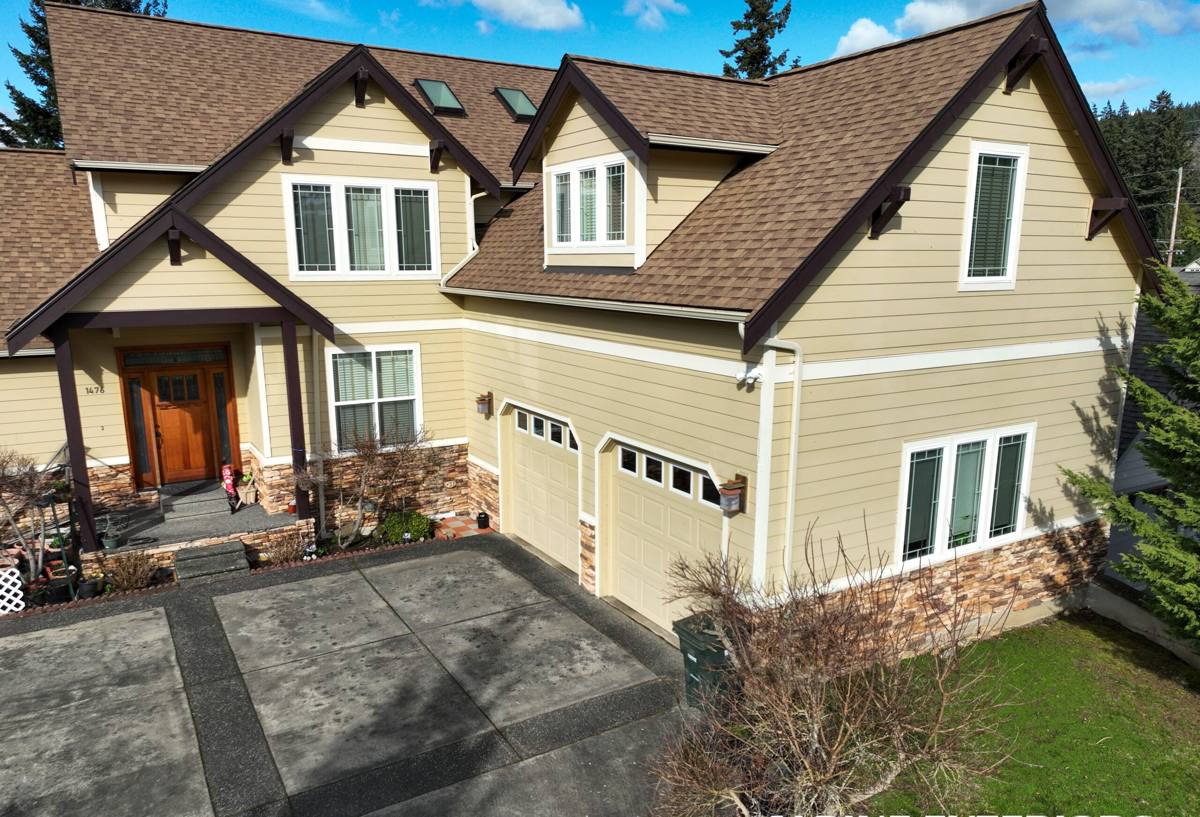
What a Correct Window Installation Actually Involves
Window replacement gets sold like it's a simple swap: remove the old unit, set the new one, caulk the edges. In a coastal environment, that shortcut is where the future leaks come from. A correct installation in a place like Sandy Point involves several layers working together, not just the window itself.
- Removing the old unit and inspecting the rough opening for hidden rot or water staining before anything new goes in
- Repairing or rebuilding any damaged framing so the new window has a sound surface to attach to
- Installing water-resistive barrier and flashing tape in the correct shingled order so water is directed out, not trapped in
- Setting the window level, plumb, and square, then mechanically fastening it per the manufacturer's specification
- Insulating the gap between the frame and the rough opening without overpacking it, which can bow the frame
- Sealing the exterior with a compatible, marine-grade or high-performance sealant rated for sustained UV and salt exposure
- Finishing interior and exterior trim so water sheds away from the unit rather than pooling against it
Skip the flashing detail or use a cheap sealant that breaks down under salt exposure and UV, and the window can look fine for a year or two while water is already working its way into the wall behind it.
Choosing the Right Window Materials for a Waterfront Property
Material choice matters more in Sandy Point than it does for a home set back from the water. Some materials handle salt air, moisture cycling, and UV exposure better than others, and the trade-offs are worth understanding before you pick a product.
| Material | How It Handles Salt Air & Moisture | Trade-offs to Know |
|---|---|---|
| Vinyl | Won't rust or rot; performs well against salt exposure when quality-grade | Lower-end vinyl can discolor or become brittle under constant UV and wind; frame color choices are more limited |
| Fiberglass | Very stable in temperature swings and moisture; excellent resistance to corrosion | Higher upfront cost than vinyl; fewer installers in the region stock and install it correctly |
| Wood-clad | Good insulating properties; clad exterior protects the wood from direct weather | Any breach in the cladding or seal exposes wood to rot risk; requires more diligent installation and maintenance near the water |
| Aluminum | Strong and rigid, but conducts heat and cold readily | Prone to corrosion and pitting in salt air unless it's a marine-rated finish; can feel cold to the touch and contribute to condensation |
For most Sandy Point homes, we steer people toward quality vinyl or fiberglass with a sealed, insulated glass unit and a low-E coating. It's less about brand loyalty and more about matching the material's real-world behavior to a shoreline environment, rather than to how it performs in a showroom.
Common Problems We Find in Sandy Point Homes
A fair number of homes in Sandy Point started as seasonal cabins and have since been converted to full-time residences. That history shows up in the windows. Original single-pane or early dual-pane units, aluminum-framed windows from decades past, and trim that was never detailed for year-round coastal exposure are all common. On these homes we typically see:
- Fogged or failed dual-pane glass where the seal between panes has broken down, letting moisture in between the glass
- Soft or discolored trim around the window from long-term water intrusion at the perimeter seal
- Frames that no longer close tightly, letting in drafts and noise from wind off the water
- Hardware that's corroded to the point of not latching securely
- Condensation on the interior glass or sill, a sign the window's insulating value has dropped off
None of these are cause for panic, but they are signs that the window's job — keeping weather out and conditioned air in — is no longer being done well, and that's usually cheaper to fix with a planned replacement than to keep patching.
Our Custom Window Replacement Process
"Custom" doesn't mean expensive or unusual — it means the window is built and installed to fit your home's actual openings and conditions, not a generic stock size. Here's how a typical Sandy Point project goes with us:
- On-site assessment. We look at each window's condition, the framing behind it, and how exposed that side of the house is to wind and salt spray.
- Measuring and material selection. Openings are measured precisely, and we talk through material, glass, and hardware options suited to the home's exposure.
- Ordering and lead time. Custom units are built to spec, so lead times vary — we give you a realistic timeline up front rather than guessing.
- Removal and opening inspection. Old windows come out and we check the rough opening for hidden moisture damage before anything new goes in.
- Installation with proper flashing and sealing. This is the step that determines whether the window performs for one winter or twenty.
- Trim and finish work. Interior and exterior trim is finished to shed water correctly and match the home.
- Final walkthrough. We check operation, seals, and finish with you before calling the job done.
What Affects the Cost of Custom Windows in Sandy Point
Every home's window project is a little different, so we won't quote a number without seeing the house. But the main variables that move the price are consistent, and it's worth understanding them before you start comparing bids.
| Cost Factor | Why It Matters |
|---|---|
| Window material and glass package | Vinyl, fiberglass, and wood-clad carry different unit costs, and upgraded low-E or impact-resistant glass adds to the price |
| Number and size of openings | Larger units and more openings mean more material and labor |
| Condition of the existing framing | Hidden rot or water damage found during removal adds repair work before the new window can go in |
| Access and site conditions | Waterfront lots can have tighter access, elevation changes, or scaffolding needs that affect labor time |
| Flashing and sealing detail required | Doing this correctly for a high-exposure coastal wall takes more time than a standard installation, and it's not a place to cut corners |
| Trim and finish work | Matching existing trim profiles or upgrading trim material adds to scope |
Broadly, custom window replacement runs from a modest per-window cost for a straightforward vinyl unit up into a much higher range for larger, high-performance, or wood-clad units — the spread is wide enough that a walkthrough and written estimate is the only honest way to give you a real number.
A Maintenance Checklist to Protect Your Investment
Even a well-installed window in a salt-air environment benefits from a little seasonal attention. A short checklist goes a long way toward getting the full lifespan out of the investment:
- Rinse salt residue off frames and glass periodically, especially after storms with onshore wind
- Check exterior caulking and sealant once a year for cracking, shrinkage, or gaps
- Remove moss or algae buildup from sills and trim before it holds moisture against the surface
- Test that hardware — latches, locks, and balances — still operates smoothly, and address stiffness early
- Look for soft spots in exterior trim, which can signal water getting behind the finish
- Watch for condensation between panes, an early sign of seal failure in dual-pane glass
- Keep gutters and downspouts clear so roof runoff isn't running down over window heads
Why Local Experience in Sandy Point Matters
A contractor who mostly works inland jobs isn't necessarily going to detail a window installation the same way for a shoreline property. Knowing how exposed a given elevation is to prevailing wind and salt spray, which sealants actually hold up in this specific environment over years rather than months, and how the long Whatcom County moss season affects trim and drainage — that's knowledge you build by working these conditions repeatedly, not by reading a spec sheet. When we quote and install a window in Sandy Point, we're accounting for the same coastal exposure on every job in that area, not treating it like a standard Ferndale install with a nicer view.
If your windows in Sandy Point are drafty, fogged, hard to operate, or you're planning ahead for a full or partial replacement, we're happy to walk the property with you and give you a straightforward, no-pressure estimate. There's a form below — reach out and we'll get a look scheduled.