 Ferndale Siding
 Siding Repair Built for Kendall's Rural, Tree-Shaded Lots
Kendall sits inland from the coast but doesn't escape Whatcom County's defining weather pattern: long stretches of wet, gray months where moisture sits on a house far longer than most homeowners realize. Many Kendall properties are set back on wooded or partially forested lots, which means more shade, slower drying times, and more organic debris landing on siding, trim, and roof lines. That combination — persistent moisture plus tree cover — is exactly the recipe that breaks down siding from the outside in, whether it's old wood lap, aging vinyl, or a fiber cement product that wasn't installed to spec in the first place.
We do siding repair work throughout Ferndale and the surrounding Whatcom County communities, and Kendall calls for a slightly different read than a more open, in-town lot. Repair work here has to account for shaded siding that never fully dries between rain events, gutters and downspouts that clog faster under trees, and moss and algae growth that can take hold on siding, fascia, and trim well before a homeowner notices anything is wrong.
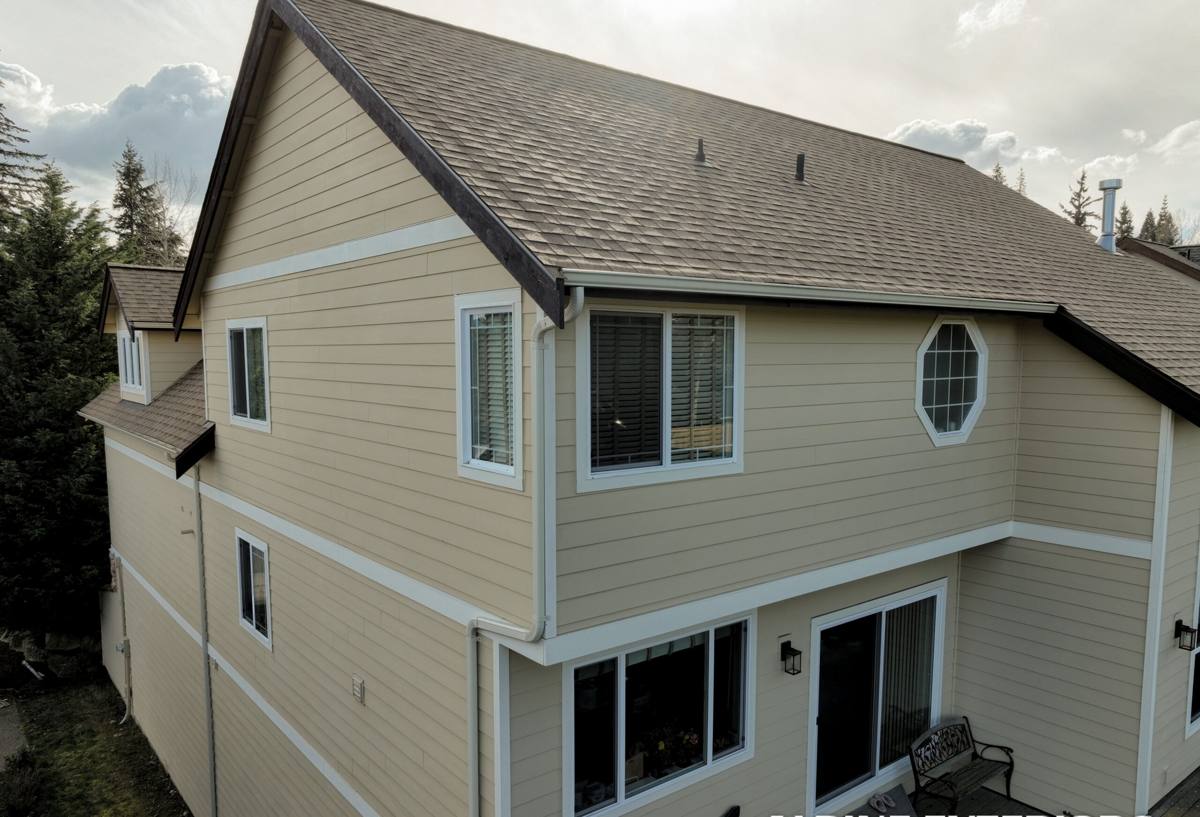
What's Actually Failing When Kendall Siding Needs Repair
Most of the repair calls we get in this part of the county trace back to a handful of root causes. Understanding which one you're dealing with matters, because a patch that doesn't address the underlying moisture source just buys a year or two before the same spot fails again.
Moss and Algae Staining and Surface Breakdown
Shaded, damp siding is a growth medium. On wood and lower-grade composite products, moss and algae don't just stain the surface — they hold moisture against the material, which accelerates rot and delamination underneath. On James Hardie fiber cement, the same growth is mostly a cosmetic problem because the material itself doesn't feed the organic growth or absorb water the way wood-based products do, but it still needs to be cleaned and addressed so it doesn't stain trim, caulk lines, or paint.
Moisture Intrusion at Seams, Corners, and Penetrations
Butt joints, inside and outside corners, and anywhere siding meets a window, door, hose bib, or vent are the highest-risk spots on any house. On tree-covered lots, these areas stay damp longer after a storm, so any gap in caulking, flashing, or house wrap gets more exposure time to do damage. We see this show up as soft spots, dark staining, or bubbling paint well before a hole is visible.
Impact and Storm Damage
Windstorms move branches and debris around wooded lots more than they do in open subdivisions. Cracked boards, dislodged trim, and dented or knocked-loose panels are a normal part of siding repair out here, and they need to be addressed quickly — a cracked board isn't just a cosmetic issue, it's an open door for water.
Failed Caulking and Sealant
Caulk has a service life, and it's shorter on a north-facing, shaded wall that rarely gets direct sun to help it cure and hold. Cracked or shrunken caulking at joints and trim is one of the most common — and most fixable — issues we find during an inspection.
Repair vs. Replace: How We Make the Call
Not every damaged section needs a full re-side, and we're not going to tell you it does. But there's a real point where patch-repairing a house becomes false economy. Here's the general framework we use when we walk a Kendall property.
| Situation | Usually Repair | Usually Replace |
|---|---|---|
| Damage location | Isolated to one or two wall sections | Spread across multiple walls or elevations |
| Underlying material | Sound, structurally intact siding nearby | Soft, delaminating, or rotted sheathing found underneath |
| Cause | Single storm event, isolated impact | Chronic moisture intrusion, long-term neglect |
| Product match | Discontinued but matchable color/profile available | Product line discontinued, no reasonable match |
| Age of siding | Well within expected service life | Near or past the end of its practical lifespan |
The honest answer usually comes down to what we find once trim and a section of siding come off. A house that looks fine from the driveway can have soft sheathing behind it, and a house with visible surface damage can have completely sound structure underneath. That's why we don't quote repair work sight-unseen from a photo — we look at the actual wall assembly before recommending a path.
What a Correct Repair Actually Involves
A siding repair that holds up in Kendall's climate isn't just swapping a bad board for a good one. Done right, it's a small-scale version of the same care we put into a full installation.
- Remove damaged material and inspect the house wrap or building paper underneath for tears or gaps
- Check sheathing for soft spots, staining, or rot and address any wood repair before new siding goes back on
- Confirm flashing at windows, doors, and penetrations is intact and properly lapped, not just caulked over
- Match the replacement material's profile, exposure, and color as closely as possible — with James Hardie ColorPlus finishes, this often means matching to the current product line rather than trying to blend an old batch
- Re-seal joints and penetrations with the correct exterior-grade sealant, not a quick caulk-gun patch
- Clean and treat any moss or algae staining on surrounding siding and trim so the repair doesn't stand out against dirty material
- Walk the full elevation, not just the damaged spot, to catch related issues before they become their own repair call
Skipping the inspection step underneath is the single most common shortcut that leads to a repair failing again within a year or two. If the sheathing or house wrap is compromised, putting new siding over it just hides the problem instead of fixing it.
Our Process for a Kendall Repair Job
1. On-Site Assessment
We walk the property, look at the damaged area and the surrounding siding, and check for the secondary signs of moisture — soft trim, staining, gutter overflow patterns — that tell us whether this is an isolated fix or a symptom of something bigger.
2. Straight Answer on Scope
We tell you what we found, what it will take to fix it correctly, and whether repair or a broader replacement makes more sense. If it's a simple, isolated repair, we say so — we're not looking to sell a full re-side on every call.
3. Material Matching
For homes already on James Hardie fiber cement, we match to the current HZ5 product line and closest available ColorPlus finish. For homes on other materials, we'll be upfront about what a like-for-like patch can and can't achieve, and what switching that wall — or eventually the whole house — to fiber cement would look like.
4. The Repair Itself
Removal, structural check, flashing and moisture barrier correction, and reinstallation to manufacturer spec — including proper fastening and clearances, which matter as much on a repair as they do on new construction.
5. Final Walkthrough
We check the repair against the surrounding siding for fit and finish before we consider the job done.
Why James Hardie Is What We Recommend for Repairs and Replacements Out Here
When a repair reveals that a wall section — or a whole elevation — needs more than a patch, we steer homeowners toward James Hardie fiber cement rather than reaching for whatever matches what's already up. That's not a sales position; it's a maintenance position. In a shaded, damp environment like Kendall's wooded lots, wood siding and lower-grade composite products stay wet longer and are more prone to rot, swelling, and repeat moss problems. Vinyl can warp and doesn't hold up to impact from falling branches the way a rigid fiber cement board does. Hardie's HZ5 product line is engineered for wet, humid climates, the ColorPlus factory finish resists the fading and touch-up mismatch that plagues field-painted siding, and it's non-combustible — a real consideration on wooded property. We don't install LP SmartSide, vinyl, Cemplank, Allura, primed spruce, or cedar, because we've made James Hardie our standard and want every repair and every full installation held to the same product and workmanship level.
Preventing the Next Repair Call
A few habits go a long way toward keeping siding sound between now and its next inspection, especially on a shaded, tree-covered lot.
- Trim back branches and brush that keep siding in constant shade and drop debris onto walls and gutters
- Clean gutters and downspouts at least twice a year so water isn't overflowing directly onto siding below
- Rinse visible moss and algae growth off siding before it spreads, using a gentle wash rather than a pressure washer that can force water behind seams
- Walk the exterior once or twice a year looking specifically at corners, trim joints, and anywhere siding meets a window or door
- Re-caulk joints as soon as cracking or shrinkage is visible — it's a cheap fix compared to the moisture damage it prevents
Why Hire a Crew That Already Works This Area
Siding repair in a rural, wooded part of Whatcom County isn't identical to repair work on an open in-town lot. Access can be tighter, shade and debris patterns change how moisture behaves, and matching an existing product line requires knowing what's actually still available versus discontinued. A crew that regularly works Ferndale and the surrounding communities, including Kendall, has already seen how local conditions affect siding and can spot the difference between a cosmetic issue and a structural one without guesswork. That local familiarity also means a more accurate first assessment — fewer surprises, fewer return trips, and a repair that's sized correctly the first time.
If you've got a section of damaged, stained, or aging siding on your Kendall property, we're happy to take a look and give you a straight assessment — repair or replace, no pressure either way. Reach out for a free estimate using the form below.