 Ferndale Siding
 Windows in Lynden Take a Different Kind of Beating
Lynden sits inland from Bellingham Bay, but it doesn't escape the marine weather that moves through Whatcom County. Storms coming off the water still bring driving, wind-pushed rain, and the open farmland around Lynden gives that wind nothing to break against before it hits a house. Add a long, damp shoulder season each spring and fall, and you get months where moisture sits against window frames and sills instead of drying off between rains. That combination is exactly what wears out window seals, rots wood sills, and lets moss and mildew creep into corners that don't see direct sun.
None of this means windows in Lynden need to be exotic or expensive. It means they need to be installed correctly the first time, with flashing and sealing details that account for wind-driven rain rather than just vertical rainfall. A window that would perform fine in a dry climate with a basic installation can fail here in a few years if water management wasn't part of the plan.
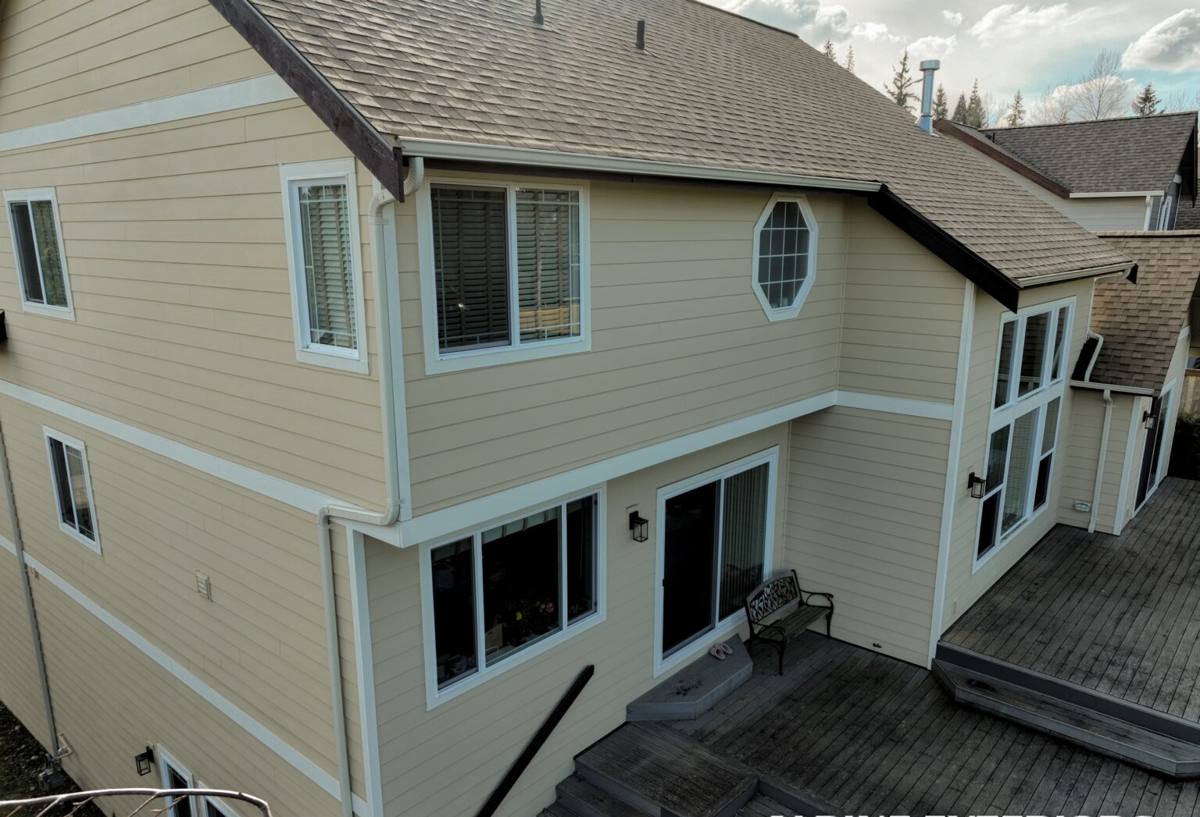
What Correct Installation Actually Involves
Most window problems we see in older Whatcom County homes aren't caused by bad windows — they're caused by installation shortcuts. The window unit itself is often the least important variable. What matters more is everything around it.
The details that actually keep water out
- Flashing sequence — sill pan flashing installed first, then side flashing, then head flashing lapped over the top, so water always sheds downward and outward, never into the wall cavity.
- Weather-resistive barrier integration — the window's flanges need to be properly integrated with the house wrap or building paper, not just caulked over it.
- Backer rod and sealant — gaps around the frame need proper backer rod before sealant is applied, so the sealant can flex instead of tearing when the frame expands and contracts.
- Sill pitch — the sill needs a slight outward slope so bulk water drains away from the house rather than pooling at the frame.
- Interior air sealing — foam or sealant on the interior side to control condensation and drafts, separate from the exterior weatherproofing.
Skip any one of these steps and the window can look fine for a year or two while water quietly works its way into the framing behind it. By the time staining shows up on interior drywall or trim, there's often already rot in the wall.
Signs Your Lynden Home's Windows Are Failing
Window failure is rarely sudden. It shows up gradually, and a lot of homeowners live with early warning signs for years before addressing them.
- Fogging or a milky haze between double-pane glass — the seal has failed and the gas fill is gone.
- Soft or spongy wood at the sill or bottom corners of the frame.
- Paint that bubbles or peels specifically around the window, not the rest of the wall.
- Moss or green staining building up on the sill or exterior trim.
- Drafts you can feel with a hand near the frame on a windy day.
- Windows that are hard to open, close, or lock — frames can swell or shift out of square as wood absorbs moisture.
Any one of these on its own isn't an emergency. Several together, especially on the same window, usually means the flashing or seal has already failed and it's a matter of time before it shows up as interior damage.
New Construction vs. Replacement Windows
One of the first decisions on any window project is which installation method fits the situation. They solve different problems, and picking the wrong one either costs more than necessary or leaves a weak point in the wall.
| Factor | New Construction (Nail Fin) | Insert / Replacement |
|---|---|---|
| When it's used | New builds, additions, or when siding is already coming off | Existing openings where siding and trim will stay in place |
| Flashing access | Full access to sheathing and house wrap for a complete flashing sequence | Limited to the existing opening; relies on the old frame's condition |
| Best for | Homes getting new siding or already opened up for other work | Sound existing frames with intact siding you want to keep |
| Labor involved | More — removes down to the rough opening | Less — works within the existing frame |
| Long-term risk | Lowest, when flashing is done correctly | Depends heavily on the condition of the original frame |
If your siding is due for replacement anyway, doing windows as new construction at the same time is usually the smarter long-term move — it's the only way to fully verify and rebuild the flashing behind the wall. If the siding is in good shape and the existing frame is solid and square, a quality insert installation is a legitimate, less invasive option.
Full-Frame vs. Insert: Signs You Need Full-Frame
An insert replacement only makes sense if the original frame is structurally sound. We recommend full-frame (new construction style) installation when we find rot in the framing, a frame that's badly out of square, or evidence that water has already gotten behind the old unit. Installing a new window into a compromised opening just repeats the same failure on a delay.
Our Window Installation Process
- On-site assessment. We look at existing window condition, siding type, framing access, and exposure — a window on the windward side of an open field gets treated differently than a sheltered one.
- Method recommendation. Full-frame or insert, based on what we actually find, not a default answer.
- Removal. Old units come out carefully to protect surrounding siding and trim, with the opening checked for hidden rot or moisture damage before anything new goes in.
- Flashing and prep. Sill pan, side, and head flashing installed in the correct order, integrated with the existing weather barrier.
- Window installation. Unit set level, plumb, and square, secured per manufacturer specs.
- Sealing and insulation. Exterior sealant with proper backer rod, interior gaps insulated and air-sealed.
- Trim and finish work. Interior and exterior trim reinstalled or replaced, caulked, and painted to match.
- Final walkthrough. Every window opens, closes, and locks properly before we consider the job done.
Window Types and Frame Materials
Frame material affects how a window handles Whatcom County's damp climate over the long run, and it's worth understanding the trade-offs before choosing.
| Frame Material | Moisture Behavior | Maintenance | General Cost |
|---|---|---|---|
| Vinyl | Doesn't rot or absorb water; won't warp from humidity | Low — occasional cleaning | Lower |
| Fiberglass | Very stable in wet/dry cycles; minimal expansion or contraction | Low | Mid to higher |
| Wood | Needs consistent exterior protection to avoid rot in a wet climate | High — repainting, caulk checks | Mid to higher |
| Wood-clad | Exterior shell protects the wood interior from weather | Moderate | Higher |
| Aluminum | Durable but conducts cold, more prone to interior condensation | Low | Varies |
We don't push one material as universally "best." Vinyl and fiberglass tend to be the lowest-maintenance choices for a climate with this much sustained moisture, since neither depends on paint or finish to stay watertight. Wood windows can absolutely last if the exterior finish is kept up — that's the trade-off homeowners should go in understanding, not something we sugarcoat.
Why Hire a Crew That Already Works in Lynden
Window installation isn't just about the product — it's about understanding how a specific house sits in a specific piece of weather. A crew that regularly works Whatcom County knows to check sill pitch on west- and south-facing exposures where wind-driven rain hits hardest, knows which older Lynden-area homes tend to have original wood-frame windows that have outlived their seals, and doesn't need to relearn local flashing practices on your job.
Familiarity with the area also means faster, more accurate estimates. We're not guessing at how a house this age, in this kind of exposure, typically holds up — we've already seen the pattern on similar homes nearby.
Questions worth asking any window contractor before you hire
- Do you install sill pan flashing on every job, or only when asked?
- Will you tell me if you find rot or damage before closing the wall back up?
- What's your plan if the existing frame turns out to be out of square?
- Who's actually on the crew doing the work — is it subcontracted?
- What does the warranty cover — the window unit, the labor, or both?
- Can I see the manufacturer's installation instructions you're following?
A contractor who answers these directly, without hedging, is a good sign. Vague answers about flashing or warranty coverage are a reason to keep looking.
Maintaining New Windows Through the Whatcom County Seasons
Even a correctly installed window benefits from basic seasonal attention in this climate.
- Clear debris and moss buildup from sills and tracks before it holds moisture against the frame.
- Check exterior caulking each fall for cracking or gaps before winter storms arrive.
- Wipe down interior sills during cold snaps if condensation appears — it's usually a humidity issue inside the home, not a window defect.
- Make sure gutters and downspouts near windows are directing water away from the wall, not dumping it onto the sill below.
- Operate locks and hardware periodically so they don't seize up over a wet winter.
None of this is complicated, but skipping it for years is how a well-installed window still ends up with avoidable problems.
Get a Straightforward Estimate
If your windows in Lynden are drafty, fogged, hard to operate, or just original to a house that's due for an upgrade, we're happy to take a look and give you an honest read on what's actually needed — full-frame, insert, or just better sealing around what you already have. The estimate is free, there's no pressure, and the form below is the fastest way to get started.