 Ferndale Siding
 Birch Bay Roofs Work Harder Than Most
Birch Bay sits right on the water in Whatcom County, and that location shapes everything about how a roof out here ages. Homes close to the Salish Sea take on a steady dose of salt-laden air, wind that drives rain sideways instead of straight down, and heavy tree cover in many neighborhoods that keeps roof surfaces shaded and damp for long stretches of the year. Add in the Pacific Northwest's long, wet moss season, and you have a set of conditions that will find every weak point in a roofing system — loose flashing, thin underlayment, poor ventilation — faster than they'd show up on a drier, more sheltered inland property.
A new roof installation here isn't just about picking a shingle color. It's about building an assembly that can shed wind-driven rain, resist moss colonization, and stand up to corrosion around every metal component, year after year, without babysitting.
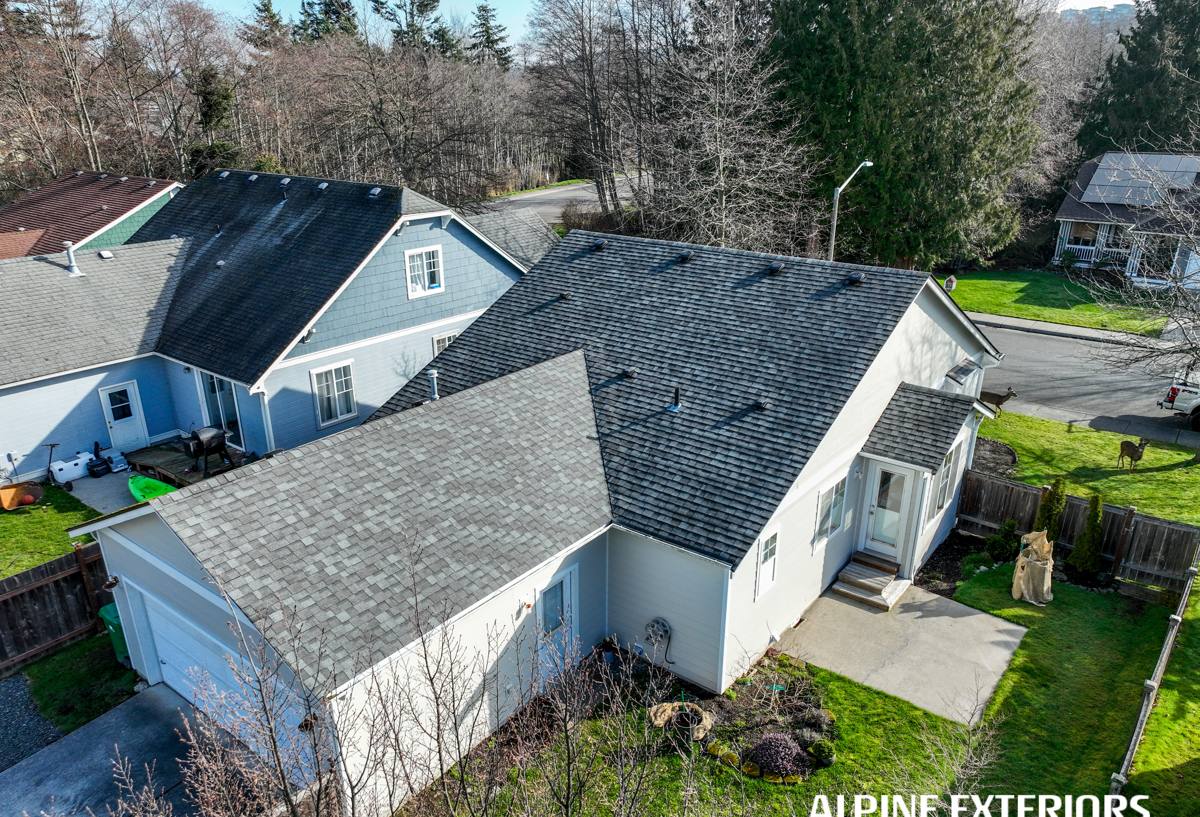
Signs a Repair Won't Cut It Anymore
Roof repairs make sense when the damage is isolated — a cracked pipe boot, a few lifted shingles after a windstorm. But once a roof is failing broadly, patching it becomes a losing game of chasing leaks. These are the signals we look for when deciding whether a Birch Bay home needs a full new roof instead of another repair:
- Granule loss heavy enough that you're finding grit in the gutters every season
- Shingles that are cupping, curling, or cracking across multiple slopes, not just one spot
- Thick moss mats that have lifted shingle edges or trapped standing moisture underneath
- Soft or spongy decking felt underfoot, or daylight visible through the roof deck from inside the attic
- A roof that's 20-25+ years old, especially one with a history of repeated leak calls
- Rust staining or corrosion around flashing, vent stacks, or valleys
- Interior signs — ceiling stains, musty attic smell, or insulation that's damp or matted
If two or three of these apply, it's usually cheaper over time to replace the roof correctly once than to keep sending a crew back out for spot repairs on a system that's already past its useful life.
What a Correct New Roof Installation Actually Involves
A roof that's going to hold up on the Whatcom County coastline needs more attention paid to the parts you don't see than the shingle color you do. Here's what we consider non-negotiable.
Full Tear-Off and Deck Inspection
We don't install new roofing over old. A full tear-off lets us actually see the decking — plywood or plank sheathing that's been sitting under a failing roof in a wet climate is exactly where rot hides. Any soft or delaminated sections get replaced before anything else goes down. Skipping this step is how a new roof ends up with problems in year three instead of year twenty.
Underlayment and Water Barrier
Standard felt underlayment is a minimum, not a solution, for a property exposed to wind-driven rain. We use synthetic underlayment rated for high wind and moisture exposure, and we add self-adhering ice-and-water barrier at eaves, valleys, and around every roof penetration — the places where wind-blown rain is most likely to work its way backward under standard shingle laps.
Ventilation, Balanced Intake and Exhaust
Moss and rot both thrive on trapped moisture, and a poorly ventilated attic manufactures that moisture from the inside. A correct installation balances intake at the soffits with exhaust at or near the ridge, sized to the attic's actual square footage. We check this on every job — not just when a homeowner asks — because it's the difference between a roof that dries out between rains and one that stays damp underneath year-round.
Flashing and Valleys
Flashing around chimneys, skylights, sidewalls, and valleys is where most roof leaks actually start, not out in the open field of shingles. We use corrosion-resistant metal flashing, formed and step-flashed correctly at every wall and roof transition, sealed rather than caulked-and-hoped.
Roofing Material Options for a Birch Bay Home
There's no single "right" material for every home here — it depends on your roof's slope, your home's style, and how much long-term maintenance you want to take on. Here's how the common options compare for a coastal Whatcom County property, based on our own installation standards.
| Material | Salt Air / Wind-Driven Rain | Moss Resistance | Maintenance Load |
|---|---|---|---|
| Architectural Asphalt Shingle | Good, with proper fasteners and flashing | Moderate; benefits from algae-resistant granules | Low to moderate |
| Standing Seam Metal | Excellent when fasteners and flashing are corrosion-rated | High — sheds moisture quickly, little surface for moss to grip | Low |
| Cedar Shake | Fair; needs vigilant sealing and airflow underneath | Low without regular treatment and cleaning | High |
We're upfront that we steer most Birch Bay homeowners away from untreated cedar shake as a primary roofing choice. It's not that cedar can't look good — it's that in a shaded, damp, salt-air environment it demands a maintenance schedule (cleaning, treating, monitoring for moisture retention) that most homeowners don't want to keep up with for the life of the roof. Architectural asphalt with algae-resistant granules or standing seam metal give you a much longer stretch of "install it and don't think about it."
What Drives the Cost of a New Roof Here
Every estimate is specific to the house, but these are the factors that consistently move the number up or down on Birch Bay properties.
| Cost Factor | Why It Matters |
|---|---|
| Roof pitch and complexity | Steep slopes, multiple valleys, and dormers take more labor and safety setup than a simple gable |
| Number of existing layers | Tear-off and disposal cost more when there are two layers of old shingles to remove |
| Decking condition | Rotted or soft sheathing found during tear-off has to be replaced before installation continues |
| Material choice | Asphalt, metal, and cedar carry different material and labor costs, as shown above |
| Ventilation upgrades | Adding proper intake/exhaust venting where none existed is common on older Birch Bay homes |
| Site access | Waterfront lots, limited driveway access, or steep yards affect staging, dumpster placement, and crew logistics |
We'd rather walk your roof and give you real numbers than quote a broad range that doesn't mean much for your specific house — but as a starting point, most full asphalt shingle replacements on this coastline land in the mid-to-upper five figures, with metal roofing typically running higher and simpler asphalt jobs sometimes lower. Your written estimate will break out labor, materials, and any decking repair separately.
Our Installation Process
Homeowners want to know what's actually going to happen once they sign off on a new roof. Here's the sequence we follow on a Birch Bay job:
- On-site inspection of the current roof, attic, and ventilation, followed by a written estimate
- Material selection, walking through the trade-offs above so you pick what fits your home and budget
- Permitting and scheduling, timed around Whatcom County weather windows when possible
- Full tear-off and deck inspection, with any needed sheathing repair done before anything is installed
- Ice-and-water barrier at eaves, valleys, and penetrations, then synthetic underlayment across the full deck
- Flashing, ventilation components, and drip edge installed correctly at every transition
- New roofing material installed to manufacturer spec, including proper nailing pattern and exposure
- Full site cleanup, including a magnetic sweep for stray nails, and a final walk-through with you
Moss, Ventilation, and the Long Game
Birch Bay's moss season is long, and it's a symptom, not just a cosmetic nuisance. Moss holds moisture against the roof surface, and over years that moisture works its way into fastener holes and shingle laps. A new roof installed with algae-resistant shingles, proper attic ventilation, and clean roof-to-tree clearance will fight moss far better than a bare-minimum install — but no roof is moss-proof if the trees around it aren't kept back and the gutters aren't kept clear. We'll tell you honestly, after installation, what upkeep will actually extend your roof's life: keeping overhanging branches trimmed back, clearing debris from valleys before the fall rains, and having gutters checked so water isn't backing up under the eaves.
Why a Crew That Already Works Birch Bay Matters
Roofing crews that mostly work drier, inland areas don't always think in terms of salt-air corrosion or wind-driven rain — because they don't have to. Working this stretch of Whatcom County regularly means we default to corrosion-resistant fasteners and flashing without being asked, we know how local wind exposure off the water affects shingle selection and installation technique, and we've dealt with the access challenges of waterfront and near-waterfront lots enough times that staging a job here doesn't slow us down. We're also familiar with the county's permitting process for this area, which keeps your project moving instead of stalled on paperwork.
None of that shows up in a glossy brochure, but it shows up in whether your roof is still doing its job cleanly in fifteen years.
If you're weighing a repair against a full replacement, or just want an honest read on what your roof actually needs, we're happy to come take a look. The estimate is free, there's no pressure, and you'll get a straight answer either way — use the form below to get started.