 Ferndale Siding
 Why Cordata Homes Wear Out Siding Faster Than the Brochure Says
Cordata sits inside the same marine air mass that shapes the whole Whatcom County coastline, and that air is not neutral toward the outside of a house. Salt-laden moisture drifts in off the Strait of Georgia and Bellingham Bay, driving rain comes sideways during winter storms, and a long, wet moss season settles in from fall through spring and doesn't let go. None of that is dramatic on any single day. It's the accumulation that does the damage — years of cycling between saturated and dry, freeze and thaw, sun and shade, that most siding products were never engineered to handle without a maintenance schedule most homeowners don't keep up.
What that means in practice for a Cordata home: siding that looks fine from the street can be failing quietly at the seams, at the bottom edges near grade, and anywhere moisture collects and stays. By the time paint is visibly peeling or boards are visibly cupping, there's often already moisture intrusion happening behind the cladding. That's the core reason a siding replacement here isn't just a cosmetic upgrade — it's a chance to correct the moisture path the original installation may have gotten wrong.
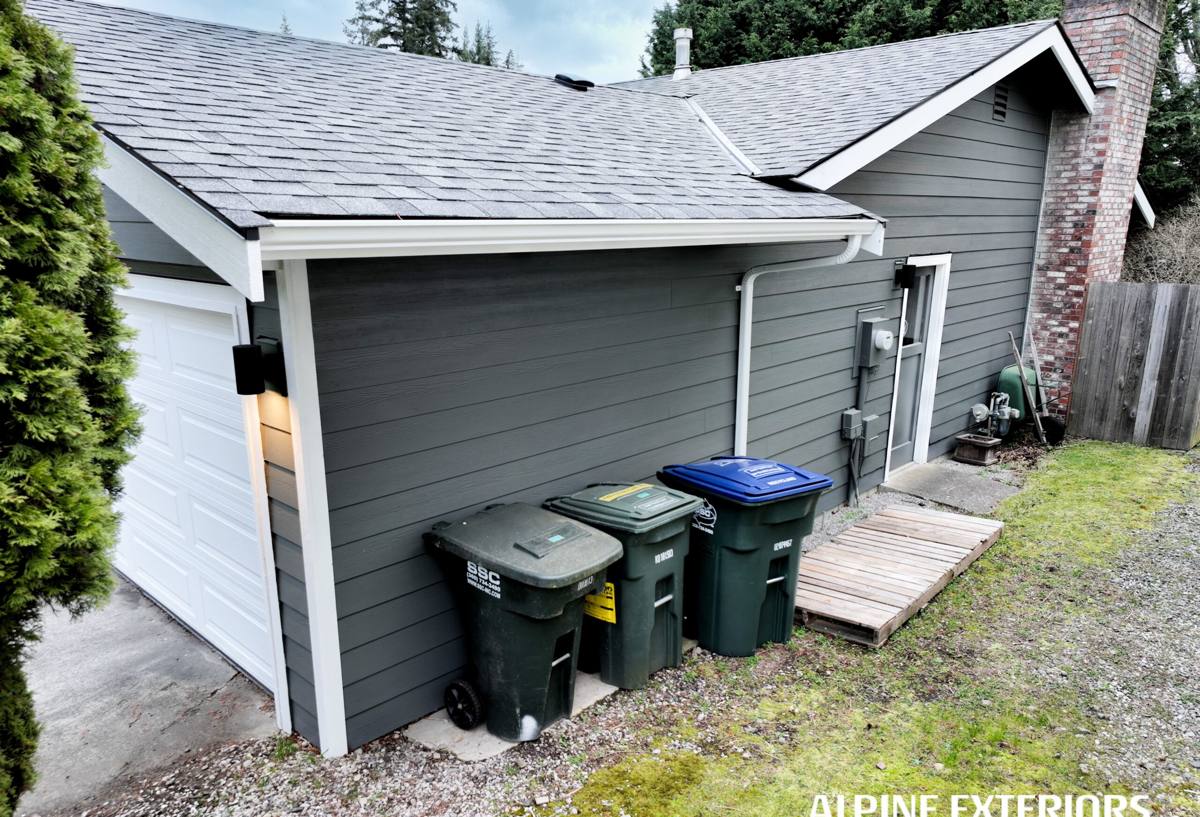
What "Correct" Actually Means on a Siding Replacement
A siding replacement is not just pulling old boards off and nailing new ones on. Done right, it's a full envelope correction, and in a climate like this the details matter more than the product label. A correct job includes:
- Full tear-off and inspection of the sheathing underneath — soft spots, rot, or old moisture staining get addressed before anything new goes on, not covered up.
- A continuous water-resistive barrier (WRB) installed shingle-style so water always sheds downward and outward, never into a seam.
- Correct flashing at every window, door, and roofline intersection — the single most common failure point on older installations in this region.
- Proper fastening schedule and clearances — siding held off grade and hardscaping by the manufacturer's minimum, so splashback and standing moisture don't sit against the bottom course.
- Factory-finished material where possible, so the paint layer isn't relying on a field crew's spray gun and weather window to hold up for a decade.
Skip any one of these and the new siding will look good for a season or two, then start showing the same problems as what it replaced — just with a fresh coat of paint hiding it a little longer.
Why We Install Only James Hardie Fiber Cement
We made a deliberate decision to install one product system, and only one: James Hardie fiber cement, in the HZ5 line engineered for this climate zone. That's not a marketing position — it's a response to what we've seen happen to other materials in exactly this kind of weather.
Vinyl siding is inexpensive and low-maintenance in mild climates, but it isn't rigid, and Cordata's driving rain and wind gusts find the gaps at seams and corners over time; it also softens and can warp when exposed to prolonged direct heat, which limits where it can safely go on a house. LP SmartSide and other engineered wood products perform reasonably well when installation is flawless and maintenance is consistent, but they're wood-based, and wood-based siding in a region with a long moss and mildew season needs vigilant upkeep to keep moisture from working into cut edges and fastener holes. Cedar is a beautiful, traditional choice for this region, but it's a natural material that needs refinishing on a real schedule, and skipping even one cycle in this climate accelerates checking, cupping, and rot.
Fiber cement solves the problem those materials share: it's dimensionally stable across wet and dry cycles, it doesn't feed moss and mildew the way wood-based products can, and it's non-combustible. James Hardie's ColorPlus factory finish is baked on and warranted separately from the substrate, which means the paint isn't the weak link the way field-applied finishes can be. It's the product we're willing to put our name behind on a Cordata home.
Comparing Siding Options for This Climate
| Factor | Vinyl | Engineered Wood (LP) | Cedar | James Hardie Fiber Cement |
|---|---|---|---|---|
| Moisture resistance | Fair — seams are vulnerable | Moderate — depends on sealed edges | Moderate — needs refinishing | Strong when installed to spec |
| Moss/mildew resistance | Good surface, poor at seams | Moderate | Needs regular treatment | Strong, non-organic substrate |
| Maintenance cycle | Low, but seam failures are hard to spot | Regular caulk/paint checks | Refinish every few years | Factory finish, periodic wash |
| Fire resistance | Combustible | Combustible | Combustible | Non-combustible |
| Typical lifespan with upkeep | 20–30 years | 20–30 years | 20–30 years with refinishing | 30+ years |
No single factor makes the decision for a homeowner, but stacked together against Whatcom County's specific conditions, the pattern is why we standardized on one product rather than offering all of them.
Signs a Cordata Home May Be Due for Replacement
Siding failure in this climate is usually gradual, and homeowners often notice the wrong symptom first — paint color instead of the moisture damage underneath it. Walk the exterior and look for these signs before deciding whether repair or full replacement makes sense:
- Persistent moss or dark streaking that returns within weeks of cleaning
- Soft or spongy spots when you press on siding near the bottom courses or below windows
- Visible cupping, warping, or gaps opening between boards
- Paint that's failing in patches rather than evenly across a wall
- Interior signs like musty smells, peeling interior paint, or stains near exterior walls
- Caulking that's cracked or missing at trim, window, and corner joints
One or two of these might mean a repair is enough. Several together, especially combined with the age of the original siding, usually points toward replacement being the more cost-effective long-term move — patching a failing system just delays the same decision at a higher cost later.
How the Moss Season Changes the Calculus
Whatcom County's moss season isn't a cosmetic nuisance — it's a moisture-holding blanket that sits on north-facing and shaded walls for months at a time, which describes a lot of the tree-lined lots common around Cordata. Moss and algae hold water against the siding surface long after the rain has stopped, extending the amount of time any given wall section stays wet. On a wood-based product, that extended wet time is exactly what accelerates rot at seams and fastener penetrations. On fiber cement, the substrate itself doesn't feed the organic growth, and the factory finish resists staining better over time, but that doesn't mean it's maintenance-free — periodic washing to keep moss from building up thick still matters for appearance and to keep water from pooling behind buildup at trim lines.
Our Process, Start to Finish
We approach every Cordata siding replacement the same structured way, because skipping steps is where climate-driven failures start:
- On-site assessment — we walk the full exterior, check problem areas homeowners flagged, and look at trim, flashing, and grading, not just the siding itself.
- Written scope and estimate — a clear breakdown of tear-off, sheathing repair allowance, WRB and flashing work, material, and finish, so there's no ambiguity about what's included.
- Tear-off and sheathing inspection — old siding comes off, sheathing gets inspected and repaired as needed before anything new is installed.
- Weather barrier and flashing installation — the part of the job that determines how the house performs in year eight, not just year one.
- Hardie installation to manufacturer spec — correct fastening, clearances, and joint treatment, following James Hardie's published installation requirements for this climate zone.
- Final walkthrough — we go over the finished work with the homeowner before calling the job done.
Warranty and Long-Term Value
James Hardie backs its fiber cement products with a non-prorated limited warranty on the substrate, and ColorPlus factory finishes carry their own separate finish warranty — a structure that reflects the fact that the paint and the board are engineered and tested as one system, not applied separately in the field. Warranties are transferable to a subsequent homeowner in most cases, which matters for resale in a market where buyers are increasingly asking what the siding is and when it was last replaced. That long-term structure is part of why we frame a Hardie replacement as an investment in the house rather than a maintenance expense — it's meant to be the last siding decision a homeowner has to make for a long time.
Why Hiring a Crew That Already Works in This Area Matters
Installation quality is the difference between a siding system that performs for thirty years and one that fails in five, and installation quality depends heavily on a crew understanding the specific conditions they're building against. A crew that regularly works Ferndale and the surrounding Whatcom County neighborhoods already knows how much clearance to leave at grade for this rainfall pattern, how aggressive the moss growth gets on shaded walls, and where driving rain typically finds gaps in flashing that were installed without this climate in mind. That familiarity shows up in the small decisions made on-site — the ones that don't appear on an estimate but determine whether the job holds up.
If your Cordata home's siding is showing any of the signs above, or you're simply planning ahead, we're happy to take a look and walk you through what we find — no pressure, no obligation. A free estimate is a good first step to understand exactly where your home stands and what a correct replacement would involve.