 Ferndale Siding
 Custer Homes Face a Different Kind of Weather Test
Custer sits in the open, rural stretch of Whatcom County between Ferndale and the Canadian border, close enough to the Salish Sea that salt-laden air, wind, and driving rain reach these properties with little to slow them down. Add in a wet season that runs for months and a moss-friendly climate that keeps siding, sills, and roof edges damp long after a storm has passed, and you have conditions that are genuinely harder on windows than what a home twenty miles inland deals with. A window that performs fine in a sheltered subdivision can fail years early out here simply because it's taking on more wind-driven moisture and more corrosive salt air.
We install windows throughout Ferndale and the surrounding Whatcom County area, and Custer's mix of older farmhouses, manufactured homes, and newer construction on larger, more exposed lots has taught us a lot about what actually holds up in this specific setting versus what looks fine in a showroom and fails at the flashing within a few years.
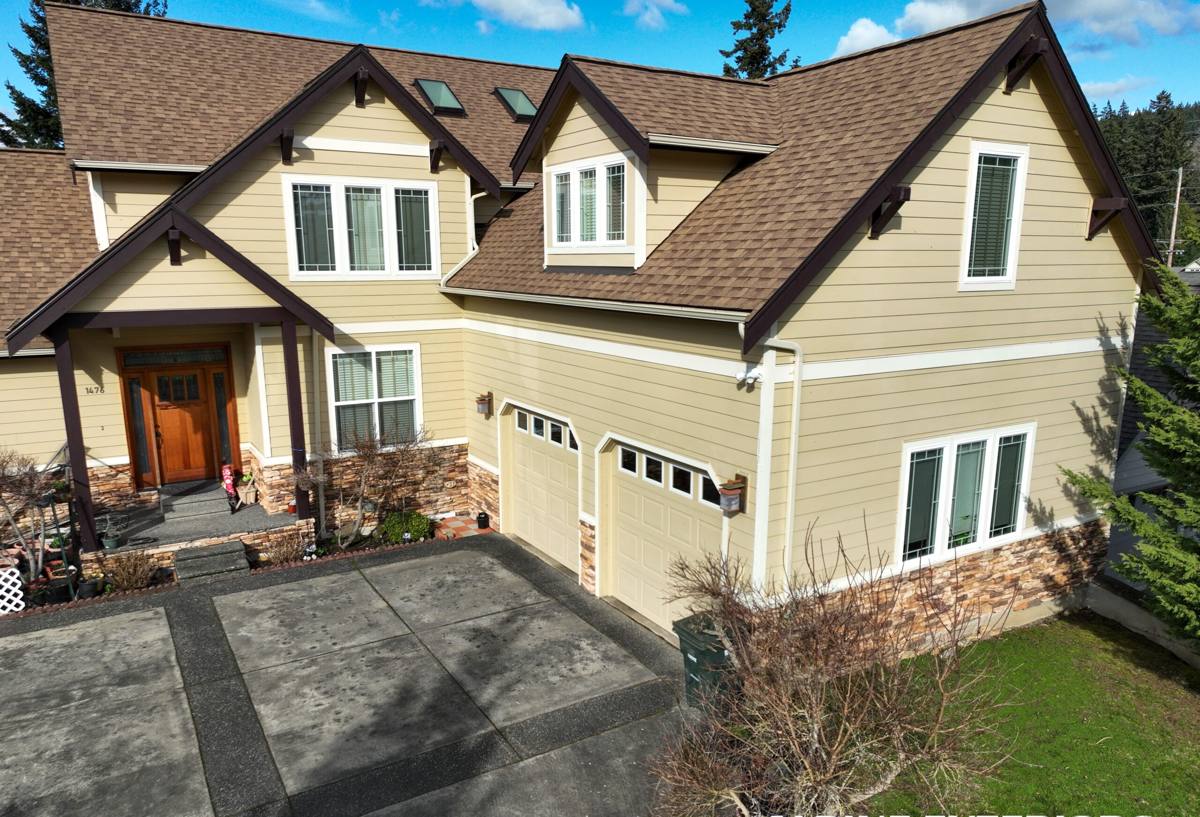
What Salt Air, Driving Rain, and Moss Season Actually Do to a Window
Salt Air and Hardware Corrosion
You don't need to be right on the water to feel the effects of salt air. Wind carries fine salt particles well inland, and Custer's open exposure means that air reaches window hardware, screen frames, and fasteners more than it would in a denser, tree-sheltered neighborhood. Over years, that accelerates corrosion on lower-quality hinges, cranks, and locking hardware, and it can pit unprotected aluminum trim and frames.
Driving Rain and Wind-Driven Water
Rain that falls straight down is easy for almost any window to shed. Rain that's pushed sideways by wind — common on Custer's open, unobstructed lots — tests a window and its flashing in a different way. Wind-driven rain gets forced up and under trim, into nail fins, and behind siding if the flashing details weren't done correctly the first time. Most of the "leaking window" calls we get aren't caused by a defective window at all — they're caused by flashing or sealant that was never properly tied into the wall's water management system.
Moss Season and Trapped Moisture
Whatcom County's long wet season keeps north-facing walls, sills, and anything shaded by trees or eaves damp for extended stretches. That moisture supports moss and mildew growth on sills and trim, and if it gets trapped behind an improperly sealed window instead of shedding off, it will rot wood-framed sills and trim over time, and it will corrode the internal hardware of vinyl and aluminum units that weren't built for sustained moisture exposure.
Signs Your Custer Home's Windows Are Due for Replacement
Not every issue means a full replacement, but a homeowner who knows what to look for can catch a problem before it spreads to the framing around the window. Walk your exterior on a wet day if you can — that's when problems show themselves most clearly.
- Visible fogging or a permanent haze between the panes of a double-pane window, which means the seal has failed
- Soft, discolored, or spongy wood on the sill, jamb, or exterior trim
- Drafts you can feel near the frame even when the window is fully latched and locked
- A window that's difficult to open, close, or lock, often a sign the frame has swollen or shifted
- Visible moss, black staining, or standing moisture on the sill or in the lower corners
- Condensation forming on the interior glass regularly, even without unusual indoor humidity
- Heating bills that run noticeably higher than a similar-sized home nearby
- Paint or caulking that keeps failing in the same spot no matter how often it's redone
One item on that list can often be repaired. Several showing up on the same window, especially combined with soft wood at the sill, usually means the unit and the flashing around it are past the point where patching makes sense.
What a Correct Window Installation Actually Involves
Flashing and Water Management Come First
The window itself is rarely the weak point in a coastal, wind-exposed setting like Custer — the flashing around it is. A correct install builds a layered drainage path: a sill pan that captures any water that gets past the window and directs it back outside, house wrap integrated over the flanges in the right shingle-lap order, and flashing tape at every seam so water always has somewhere to go other than into your wall cavity. Skipping or shortcutting this step is the single biggest reason windows leak within a few years, regardless of how good the window itself is.
Air Sealing and Insulation
A gap between the window frame and the rough opening is a straight path for drafts, moisture, and eventually pests. That gap needs to be filled with a low-expansion foam or backer rod and sealant rated for window applications — not just packed with fiberglass, which does little to stop air movement and can hold moisture against the frame.
Fastening, Shimming, and Structural Fit
A window has to be shimmed level, plumb, and square before it's fastened, or it will bind, leak, and wear out its hardware early. Fasteners go where the manufacturer specifies, at the spacing specified, into solid framing — not just wherever is convenient. This is also where the exterior trim and caulking get tied back into your siding so the whole assembly sheds water the way it's supposed to.
Choosing a Window Built for This Climate
Frame material matters more here than in a sheltered inland location, because Custer's combination of salt air, wind, and standing moisture punishes the wrong choice faster. Here's how the common options actually compare for this specific setting.
| Frame Material | Upfront Cost | Moisture & Salt Air Performance | Maintenance | Best Fit for Custer |
|---|---|---|---|---|
| Vinyl | Lowest | Good — won't rot or corrode; weld quality at the corners determines long-term water resistance | Low, occasional cleaning | Most homes on a standard budget |
| Fiberglass | Higher | Very good — dimensionally stable and handles temperature swings without warping or gapping | Low | Homes with heavier wind and rain exposure, or larger openings |
| Wood-clad | Highest | Fair — the cladding protects the wood, but any break in that cladding lets moisture reach bare wood underneath | Moderate to high, cladding seams need periodic inspection | Homeowners who want a wood interior look and accept the added upkeep |
| Aluminum (uninsulated) | Moderate | Poor in this climate — conducts cold, condenses heavily, and is prone to pitting from salt air | Moderate | Rarely our first recommendation for this exposure |
We don't install every product on the market, and that's intentional. For Custer's exposure, our standard is vinyl and fiberglass units with fully welded — not just caulked — corner seams and factory weatherstripping rated for coastal conditions. That combination holds up to years of wind-driven rain and salt air without the ongoing maintenance burden that wood-clad frames or bare aluminum carry out here.
How the Installation Works, Start to Finish
- On-site assessment of your existing windows, framing condition, and any moisture or rot already present
- Precise measurement of each opening — no two older homes have perfectly uniform rough openings
- Careful removal of the old unit, checking the sheathing and framing underneath for hidden damage
- Repair of any soft or rotted framing before the new window goes in — installing a new window over damaged framing just hides the problem
- Installation with a sill pan, properly lapped house wrap, and sealed flashing at every seam
- Shimming, leveling, and fastening per manufacturer specification, followed by low-expansion foam air sealing
- Exterior trim, caulking, and touch-up work tied back cleanly into your existing siding
- Interior finish work and a final walkthrough where we test operation, locks, and check for drafts before we call the job done
Why Hiring a Crew That Already Works in Custer Matters
Window installation is one of those jobs that can look identical on the surface — same product, same basic steps — while the actual outcome depends entirely on details a homeowner can't easily inspect once the trim is back on. A crew that already works in Custer has seen how the wind sits on these open lots, how far wind-driven rain gets pushed up under trim on the exposed sides of a house, and where moss and moisture tend to collect first on homes in this area. That's not something you get from a general contractor who occasionally passes through the area; it's something you build by doing the work here repeatedly and dealing with the callbacks when a shortcut doesn't hold up.
It also means we're not guessing at what's under your siding. Whatcom County has a mix of home ages and construction styles, and knowing what's typical for a Custer-area build going in helps us plan the job correctly the first time instead of discovering surprises mid-install.
Cost Factors Worth Understanding Before You Get Quotes
Window installation pricing varies enough between homes that a single number is rarely honest. The main factors that move the price are the number of windows being replaced, the size and style of each opening (a large picture window costs more to handle than a standard double-hung), whether the frame material is vinyl, fiberglass, or wood-clad, how accessible the openings are, and whether we find rot or damaged framing once the old window comes out that needs to be repaired before the new one goes in. A straightforward, full-frame replacement with sound framing underneath is a very different job — and price — than one where the sill has been slowly rotting for years.
Getting a written, itemized quote that separates the window product cost from labor, flashing, and any framing repair lets you compare bids honestly instead of comparing numbers that don't reflect the same scope of work.
If your Custer home has drafty, foggy, or hard-to-operate windows, or you'd just like an honest read on whether repair or replacement makes more sense before winter's driving rain sets in, we'd be glad to take a look. Use the form below to request a free, no-pressure estimate.