 Ferndale Siding
 Building Decks for Lummi Nation's Marine Climate
Lummi Nation sits right up against the water, wedged between Bellingham Bay and Hale Passage, which means homes here deal with a version of Whatcom County weather that's harder on outdoor structures than what you'd find a few miles inland. Salt-laden air moves off the water year-round, driving rain comes in sideways off winter storms, and the shade and moisture combination through fall and winter turns almost any north-facing or tree-covered deck into a moss farm by spring. A deck built without those three things in mind — salt, rain, and moss — will look fine for a year or two and then start showing problems fast: rusted fasteners, soft spots in the decking, slick green boards, and framing that never really dries out between storms.
We build custom decks for homes in and around Lummi Nation with that climate as the starting assumption, not an afterthought. That changes material choices, hardware, drainage details, and even how we schedule the work.
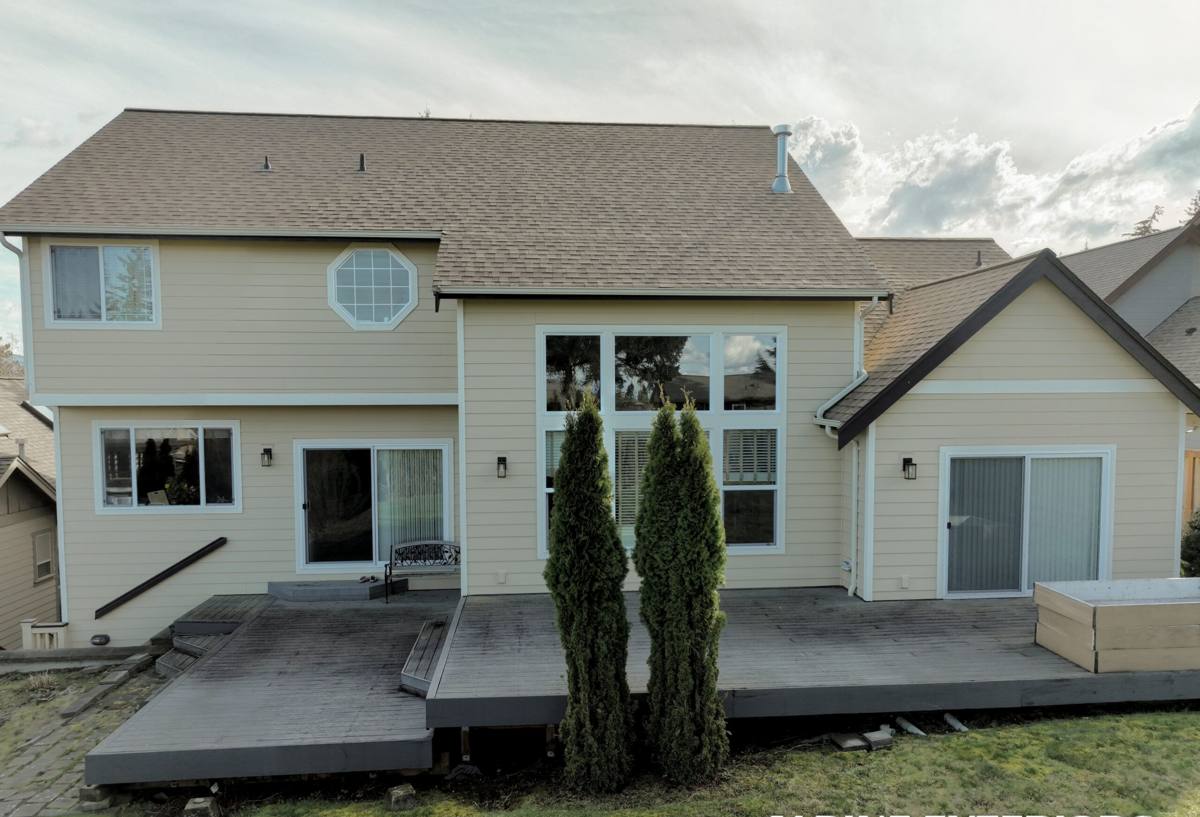
What Salt Air, Rain, and Moss Actually Do to a Deck
Salt Air and Corrosion
Airborne salt doesn't just affect decks that are literally on the beach. It travels on wind and settles on any exposed metal — nail heads, screw threads, joist hangers, railing brackets — and speeds up corrosion compared to a deck built the same way ten miles inland. Once a fastener starts rusting, it weakens, stains the wood or composite around it, and eventually needs to be replaced, which usually means partially disassembling whatever it's holding.
Driving Rain and Trapped Moisture
Ferndale and the surrounding shoreline get plenty of rain that doesn't fall straight down — wind-driven storms push water up under railings, behind ledger boards, and into any gap that isn't properly flashed or sealed. A deck that sheds rain fine in a light drizzle can still let water track back into the house framing or pool under the decking during a real coastal storm if the details weren't built for that kind of weather.
Moss, Algae, and Slippery Boards
Shade, moisture, and mild temperatures are exactly what moss and algae need to establish themselves, and a lot of Lummi Nation properties have some combination of tree cover and damp ground that keeps a deck from fully drying out for days at a stretch in the off-season. Beyond looking bad, a mossy deck surface gets genuinely slick, and moss holds moisture against the board surface, which shortens the life of wood decking in particular.
Choosing a Decking Material That Fits This Climate
There's no single "best" decking material — it depends on budget, how much upkeep you want to do, and how close to the water your lot sits. Here's how the common options actually perform in a salt-air, high-moisture setting like this one.
| Material | Moisture & Salt Tolerance | Moss/Algae Resistance | Maintenance |
|---|---|---|---|
| Pressure-treated wood | Good if detailed correctly; end cuts and fastener points are the weak spots | Low — needs regular cleaning and sealing | Annual cleaning, re-sealing every 1-2 years |
| Cedar | Naturally rot-resistant but still needs sealing near salt air | Low to moderate | Regular cleaning, periodic oiling/sealing |
| Composite decking | Very good — doesn't absorb moisture like wood | Moderate — surface texture matters | Occasional washing, no sealing needed |
| PVC/capped decking | Excellent — fully moisture-sealed board | Good, especially lighter colors that show less staining | Lowest — mostly rinsing |
For a lot of Lummi Nation homeowners, especially anyone close to the water or under significant tree cover, composite or capped PVC decking earns its higher upfront cost back in avoided maintenance. That said, plenty of homeowners are happy with wood as long as they know what the upkeep actually looks like — we'll walk through that honestly rather than push whatever has the best margin.
Framing and Hardware: The Part Homeowners Don't See
The decking surface is what you notice, but the framing and fasteners underneath are what actually determine how long a deck lasts in this environment. In coastal Whatcom County conditions, we treat hardware selection as a structural decision, not a cosmetic one.
- Stainless steel fasteners (not standard galvanized) at any connection exposed to salt air, especially railing posts and ledger attachments
- Corrosion-resistant structural connectors and joist hangers rated for the fastener type used
- Joist tape over framing lumber to keep standing water off the top of joists and beams
- Properly flashed ledger board where the deck meets the house, so wind-driven rain can't track behind it
- Ground-contact rated posts and footings sized for actual Whatcom County frost depth, not a shortcut minimum
Standard galvanized hardware is built for general-purpose framing, and in a lot of the country it holds up fine for decades. In a marine climate like Lummi Nation's, it corrodes noticeably faster, and by the time it fails it's usually hidden under decking where you won't see it coming.
Footings, Drainage, and Grading
A deck that traps water underneath it stays damp longer, which feeds moss and speeds up rot in both wood framing and the underside of composite boards. Before we set a single post, we look at how water actually moves across the lot — grading, downspout locations, and whether the ground under the deck will drain or pool. Footings get set below frost depth per Whatcom County requirements, and where drainage is a known issue, we'll grade or add drainage under the deck rather than just building on top of a wet spot and hoping.
Spacing between deck boards also matters more here than it would somewhere drier — tight spacing looks clean on install day but slows drying and gives moss a head start. We set gapping based on the material and the site's actual sun and airflow, not a one-size default.
Permitting: Lummi Nation vs. the Rest of Whatcom County
One thing that catches homeowners off guard: a lot of Lummi Nation is tribal trust land, which can mean a deck project here falls under different permitting and jurisdiction than a similar project a few miles away in unincorporated Whatcom County or the City of Ferndale. The right process depends on where your specific property sits and how it's held, and it's worth confirming before any work starts rather than assuming county rules apply by default. We're used to sorting through that on the front end so it doesn't turn into a delay once the project is underway.
Our Process for a Custom Deck Build
Every deck we build here follows the same basic sequence, adjusted for the specific lot, sun exposure, and material choice:
- On-site walkthrough to assess sun/shade patterns, drainage, tree cover, and proximity to salt water
- Design and material conversation, including honest tradeoffs between wood, composite, and PVC for your specific spot
- Confirming the correct permitting path for your property before scheduling work
- Footings and framing built to Whatcom County structural requirements with coastal-grade hardware
- Decking installation with spacing and fastening appropriate to the material and site conditions
- Final walkthrough covering how to maintain the specific material you chose through moss season
Keeping a Deck Ahead of Moss Season
No decking material is entirely maintenance-free in this climate, but the right build makes upkeep manageable instead of constant. A few habits go a long way regardless of material:
- Sweep debris and standing leaves off the deck regularly through fall — trapped organic matter is what moss actually feeds on
- Clean with a deck-safe cleaner before moss gets established rather than after, since removal is harder than prevention
- Check railing posts and ledger connections annually for early rust staining, which shows up before a fastener actually fails
- Keep gutters and downspouts clear so runoff isn't dumping extra water onto or under the deck
A well-built deck in a spot with decent sun exposure will need far less of this than one tucked under trees on the north side of a house — that's part of why the sun/shade assessment matters during design, not just after the moss shows up.
Why Hire a Crew That Already Works Lummi Nation
A deck built to a generic spec sheet can pass inspection and still underperform here within a few seasons — the failures that show up in salt-air, high-moisture environments are specific enough that experience with this exact stretch of coastline matters. We already know which hardware holds up, how the local permitting process actually works for properties on Lummi Nation, and what drainage and material choices hold up through a real Whatcom County winter rather than a mild one somewhere else. That's the difference between a deck that needs real work again in five years and one that just needs the normal cleaning and occasional re-sealing.
If you're planning a new deck or replacing one that hasn't held up to the salt air and moss, we're happy to take a look and talk through what makes sense for your specific property. Reach out for a free, no-pressure estimate using the form below.