 Ferndale Siding
 Birch Bay Sits Right at the Edge of the Weather
Birch Bay is a waterfront community on the Salish Sea, and that shoreline setting changes what a home's exterior has to deal with compared to a lot a few miles inland. Homes here take on salt-laden air coming off the water, wind-driven rain that hits siding sideways rather than falling straight down, and — on the wooded and shaded lots set back from the water — a moss and algae season that runs longer than in drier parts of Whatcom County. Our crew works Birch Bay regularly alongside jobs in Ferndale proper, and the approach we bring to a siding job here is built around that specific combination, not a generic Pacific Northwest playbook.
We install James Hardie fiber cement siding exclusively — no vinyl, no LP SmartSide, no primed wood, no other fiber cement brand. For a shoreline property in Whatcom County that sees this much combined salt exposure and moisture, it's the one system we're willing to put our name behind.
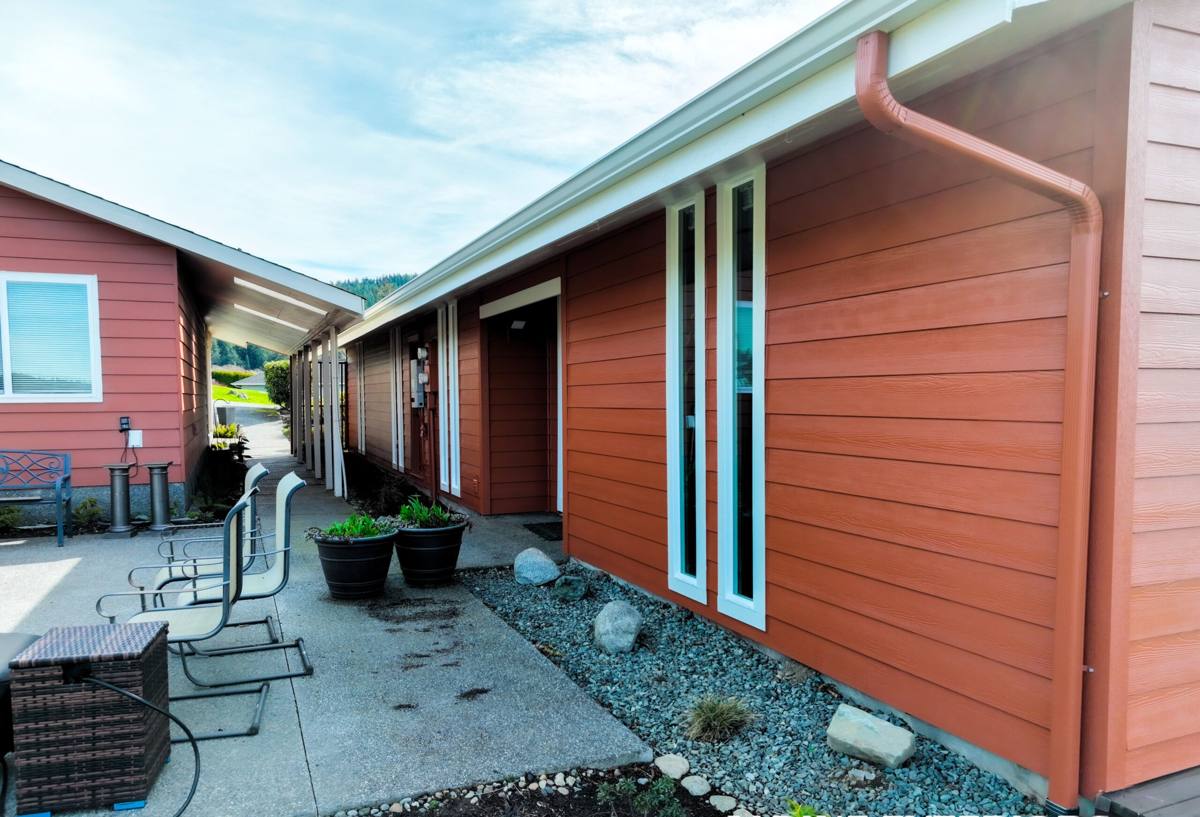
What Salt Air, Driving Rain, and Moss Actually Do to a Wall
Salt Air and Metal Fasteners
Airborne salt from the water doesn't just sit on the surface of a house — it works into any exposed or under-protected metal over time, accelerating corrosion in fasteners, flashing, and trim connectors far faster than the same materials would wear a few miles inland. A siding system that isn't detailed with corrosion-resistant fasteners and properly lapped flashing will show that wear first at the fastener heads and cut edges, long before the siding panel itself is the problem.
Wind-Driven Rain
Storms coming off open water push rain into a wall horizontally instead of letting it run straight down and off. That matters because siding systems are designed to shed rain that runs down the face of the wall — wind-driven rain finds its way into laps, butt joints, and penetrations that aren't sealed and flashed correctly. On an exposed waterfront lot, that detailing has to be tighter than it would on a sheltered inland property.
Moss, Algae, and Trapped Moisture
Whatcom County's damp, mild climate already supports a long moss season, and shaded or tree-lined Birch Bay lots hold onto that moisture even longer. Moss and algae growth on siding isn't just a cosmetic problem — organic growth holds water against the surface of the wall for extended periods, and on a material that isn't dimensionally stable or properly finished, that sustained moisture contact is what eventually leads to swelling, softening, or coating failure underneath the growth.
Why We Standardized on James Hardie for This Kind of Exposure
We made the decision years ago to install one fiber cement system rather than offer a menu of siding products at different price points. James Hardie is non-combustible, factory-finished with its ColorPlus coating rather than field-painted, and backed by a transferable warranty that holds up when the installation itself is done to spec. For a waterfront property, the factory finish matters in a specific way: a coating applied and cured under controlled conditions adheres and weathers more consistently than a coating applied on-site, which is a real advantage against salt air and sustained UV exposure over the life of the siding.
We're not going to tell you every other siding material is unusable — vinyl and engineered wood products have their place and their price point. What we will say is that we've made a professional decision not to install them, because the maintenance burden and moisture behavior we've seen in this kind of climate don't match what we're willing to warranty our labor against.
The HZ5 Product Line: Built for This Side of the State
James Hardie doesn't manufacture one formulation for the whole country — it engineers different fiber cement mixes for different climate zones, and the HZ5 line is the formulation specified for regions like ours that see sustained moisture and freeze-thaw cycling rather than dry heat. Specifying the correct HZ line for a Birch Bay property isn't a cosmetic detail; it's the difference between a product engineered for this climate and one that's simply available at the supply house. We specify HZ5 as the baseline for every job in this area and adjust up from there based on a given property's actual exposure.
What a Correct Installation Looks Like Here
Fiber cement siding fails less often because of the material itself and more often because of installation shortcuts — and on an exposed waterfront lot, those shortcuts show up faster. A correct job includes:
- A continuous water-resistive barrier installed and lapped correctly behind the siding, not just tacked up as an afterthought
- Proper gapping at every butt joint and around penetrations, sealed with a sealant rated for the exposure rather than left to rely on caulk alone
- Corrosion-resistant fasteners driven to Hardie's specified pattern and depth — not overdriven, which crushes the board's edge and opens a path for water
- Flashing integrated at every window, door, and roofline intersection so water is directed out and down, never trapped behind the cladding
- Correct clearance at the bottom of the siding above grade, decks, and roof lines, so splashback and standing moisture don't sit against the board
- Factory-cut and factory-primed edges used wherever possible, with any field cuts sealed per manufacturer spec
Any one of these done wrong won't necessarily show up in year one. On a Birch Bay property, sustained salt exposure and moisture tend to expose the weak point within the first few years rather than the first few decades.
Our Process for a Birch Bay Home
Assessment
We start by walking the exterior and checking the condition of the sheathing underneath the existing siding wherever it's accessible — on a waterfront property, we're specifically looking for signs of moisture that's already gotten past the old cladding, since that changes the scope of the job before a single new panel goes up.
Removal and Sheathing Check
Old siding comes off in sections so we can inspect sheathing as we go rather than all at once, catching any soft or water-damaged areas early enough to address them before they're covered back up.
Weather Barrier and Flashing
We install the water-resistive barrier and flashing system first, and this is the step that matters most for long-term performance — it's also the step a homeowner can't see once the siding is on, which is exactly why we don't rush it.
Hardie Installation
Panels go up to Hardie's published fastening and gapping specifications for our HZ5 climate zone, with attention to every joint, corner, and penetration along the way.
Trim, Caulking, and Final Walkthrough
Trim and accessories are installed and sealed, and we walk the finished job with the homeowner before calling it done.
Comparing Siding Materials for a Salt Air, High-Moss Climate
| Factor | James Hardie Fiber Cement (HZ5) | Vinyl | Untreated or Primed Wood |
|---|---|---|---|
| Salt air / corrosion resistance | Strong when fasteners and flashing are correctly specified | Panel itself resists corrosion but can become brittle over time | Vulnerable without diligent, ongoing maintenance |
| Moss / algae resistance | Factory ColorPlus finish resists staining and organic growth better than field-applied paint | Prone to surface algae and mildew staining in shaded, damp settings | Highly vulnerable; organic growth can penetrate the wood surface |
| Wind-driven rain performance | Excellent when gapped, flashed, and fastened to spec | Can flex and allow water intrusion at laps in high wind | Dependent on coating condition; degrades as paint ages |
| Fire resistance | Non-combustible | Combustible, can melt or deform under heat | Combustible |
| Typical maintenance | Periodic wash, repaint on a much longer cycle if ever needed | Low structural maintenance but limited repair options once damaged | Regular repainting and moisture monitoring required |
Maintenance Checklist for Birch Bay Homeowners
- Rinse siding periodically to clear accumulated salt residue, especially on wall faces most exposed to prevailing wind off the water
- Trim back vegetation and overhanging branches to reduce shade and airflow blockage that extends the moss season on a given wall
- Walk the exterior after major storms and check caulked joints, trim seams, and flashing for any visible gaps or separation
- Keep gutters and downspouts clear so overflow doesn't run down the face of the siding repeatedly during heavy rain
- Address any soft spots, staining, or bubbling in paint or coating promptly rather than waiting for the next scheduled maintenance
Why Hiring a Crew That Already Works Birch Bay Matters
Exterior work on a waterfront lot in Whatcom County isn't identical to a job a few miles inland, and a crew that only occasionally works this stretch of coastline is more likely to default to generic detailing rather than adjusting for actual site exposure. We've worked enough Birch Bay properties to know that fastener corrosion resistance, flashing details, and moss-prone shaded elevations all need more attention here than on a typical in-town Ferndale lot — and we build that into the estimate and the installation, not as an upcharge but as the baseline for doing the job correctly the first time.
If you're weighing a siding project for a Birch Bay home, we're glad to walk the exterior with you and give you a straightforward, no-pressure estimate — just fill out the form below and we'll follow up.