 Ferndale Siding
 Building a Deck That Actually Holds Up in Marietta
Marietta sits close to the water on Whatcom County's coastline, and that location shapes everything about how a deck should be built here. Salt-laden air moves in off the bay, rain comes in sideways more often than most homeowners expect, and the shaded, damp stretches of the year give moss and algae plenty of time to take hold on any surface that doesn't shed water well. A deck built to a generic spec sheet from a drier climate will show its age fast in this environment — soft spots, corroding hardware, slick green boards, and rot creeping in where nobody's looking. A deck built for Marietta's actual conditions can go the other direction and stay solid, safe, and good-looking for decades.
This page is about deck building specifically for homes in and around Marietta — not a generic overview of decks in general. The framing choices, fastener grades, drainage details, and material picks that make sense here are different from what you'd spec for an inland, drier part of the state, and that difference is where a lot of decks fail early.
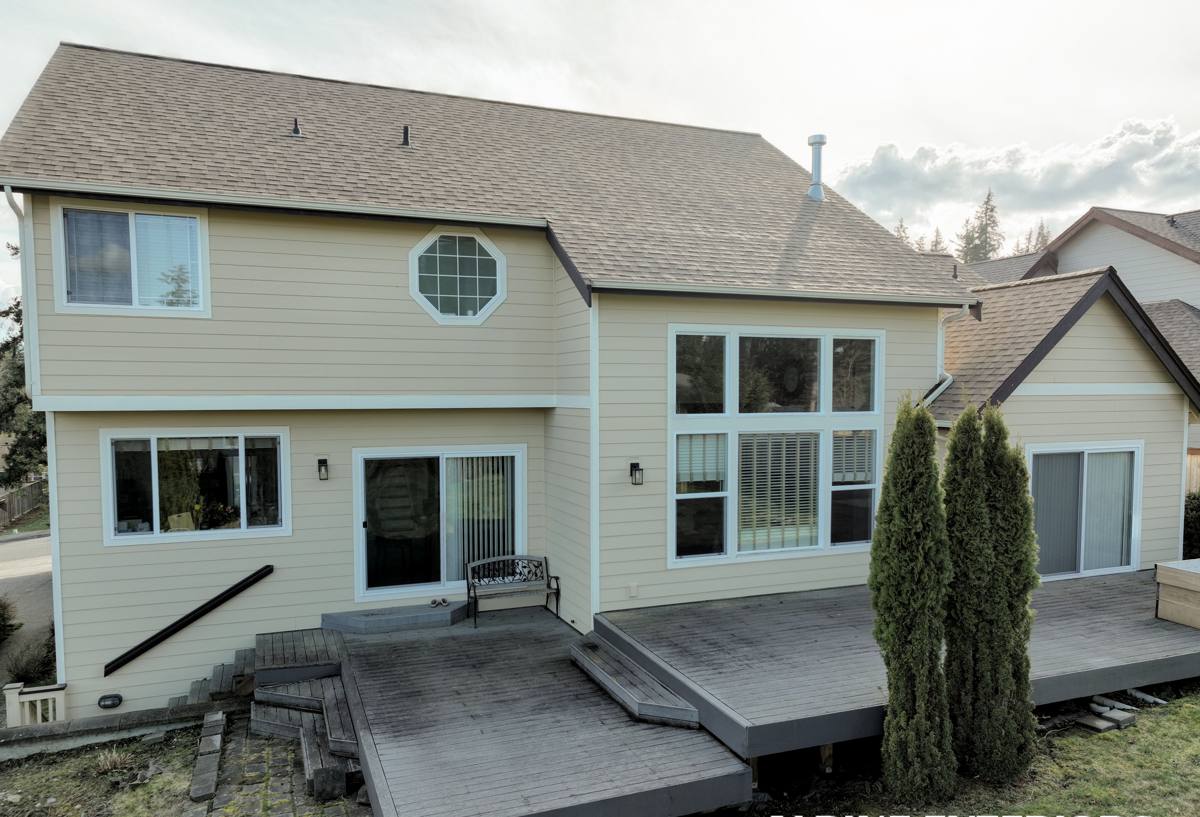
What Marietta's Conditions Demand From a Deck
Three environmental factors drive almost every decision on a coastal Whatcom County deck build:
- Salt air: accelerates corrosion on fasteners, brackets, and any exposed metal hardware — untreated or under-rated hardware can start rusting within a season or two.
- Driving rain: wind-blown rain gets up under railings, into ledger connections, and behind fascia boards, not just straight down onto the deck surface. Flashing and gap details matter more here than in calmer inland climates.
- Extended moss season: long stretches of overcast, damp weather each year give moss, algae, and mildew a long runway to establish on any deck surface or structural member that stays wet too long.
None of these are exotic problems, and none require exotic solutions. They require a builder who treats them as design inputs from the start — material selection, board spacing, ventilation, and hardware grade all get decided with these three factors in mind, not added as an afterthought.
What a Correctly Built Deck Involves
Footings and Framing
Everything above ground depends on what's below it. Footings need to be sized and set to local frost depth and soil conditions, and posts need to be properly isolated from ground contact with post bases rather than buried directly, which traps moisture against the wood. Joists should be sized for the actual span and load, not the minimum that happens to look fine — undersized framing is one of the more common shortcuts we see on older decks in this area, and it shows up as bounce and eventual sag long before the decking itself wears out.
Ledger Board and Flashing
Where a deck attaches to the house, the ledger board connection is the single most failure-prone detail on the entire structure if it's done wrong. Proper flashing — installed in the right order relative to the house's siding and water-resistive barrier — keeps rain from tracking behind the ledger and into the rim joist or wall framing. In a climate with as much wind-driven rain as this one, a poorly flashed ledger is a slow leak that can go unnoticed for years while it does real damage.
Choosing Decking Material for This Climate
There's no single "best" decking material — the right choice depends on how much maintenance a homeowner wants to take on, budget, and how the deck will be used. Here's how the common options actually perform under salt air, rain, and moss exposure:
| Material | Moisture & Moss Resistance | Maintenance | Typical Lifespan Here |
|---|---|---|---|
| Cedar | Naturally moisture- and insect-resistant, but surface still needs care | Regular cleaning and re-staining/sealing every 1-2 years | 15-20 years with upkeep |
| Pressure-Treated Fir/Pine | Treated for rot resistance, but end cuts and fastener holes are vulnerable | Sealing every 1-2 years, moss cleaning | 15-20 years with upkeep |
| Composite Decking | Very good — resists moss growth better than wood, doesn't absorb water into the board | Periodic washing, no staining/sealing | 25-30+ years |
| PVC/Capped Polymer | Best moisture and moss resistance of the common options | Occasional washing only | 25-30+ years |
We'll walk through these trade-offs honestly during an estimate rather than push whatever happens to be easiest to install. A homeowner who genuinely enjoys the look and feel of real wood and is willing to stay on top of maintenance can get a great result from cedar. A homeowner who wants to spend weekends doing something other than re-sealing a deck is usually happier with composite or capped polymer, even at a higher upfront cost, because the long-term maintenance burden in this damp climate is so much lower.
Railings, Fasteners, and Hardware
Salt air is hardest on the parts of a deck people don't think about — the screws, joist hangers, post bases, and structural bolts holding everything together. Standard zinc-coated hardware can start showing surface rust within a couple of years this close to the water. We spec stainless steel or high-grade coated fasteners rated for coastal and treated-lumber exposure, and we make sure hardware is compatible with whatever decking and framing material is used, since mismatched metals can accelerate corrosion through galvanic reaction. Railings get the same attention — a railing system is a safety component, and a corroding post base or loose baluster connection isn't something to discover after the fact.
Drainage, Airflow, and Keeping Moss Off
Moss doesn't grow because a deck is old — it grows because a surface stays damp longer than it should. A few design details make a real difference over the life of the deck:
- Consistent board spacing that lets water drain through rather than pool on the surface
- A slight slope away from the house so water sheds off the deck instead of toward it
- Open space or proper venting underneath the deck so the underside can dry out between rain events
- Keeping decking clear of overhanging vegetation where practical, since shade and leaf litter both extend how long a surface stays wet
- Choosing a decking surface texture that doesn't trap moisture in deep grain patterns
None of these eliminate the need for occasional cleaning — nothing does in a climate this damp — but they can be the difference between an annual wash-down and a deck that's visibly green by midwinter.
Our Deck Building Process
- On-site assessment: we look at the actual site — sun and wind exposure, slope, drainage patterns, and how the deck will connect to the house — before recommending materials or layout.
- Design and material selection: we walk through decking, railing, and structural options with honest trade-offs on cost, maintenance, and lifespan for this specific location.
- Permitting: we handle the permit application and coordinate any required inspections with the local jurisdiction.
- Framing and structural work: footings, posts, ledger flashing, and joists are built to span and load requirements, not shortcut minimums.
- Decking, railings, and finish work: surface installation, railing systems, stairs, and any trim or skirting.
- Final walkthrough: we go over the finished deck together, including basic maintenance guidance specific to the material installed.
Permits and Codes
Most deck construction in Ferndale and unincorporated Whatcom County requires a building permit, particularly for decks attached to the house or built above a certain height off the ground. Requirements can vary depending on the specific property and jurisdiction, and they cover things like guardrail height, stair geometry, footing depth, and ledger attachment. We handle this as part of the build rather than leaving it to the homeowner to sort out, and we won't cut a permit corner to save time — an unpermitted deck can turn into a real problem at resale or during a future remodel.
Why a Crew That Already Works in Marietta Matters
A contractor who builds decks across a wide range of climates has to relearn local conditions on every job. A crew that already works this stretch of Whatcom County coastline knows, without guessing, how far wind-driven rain travels up under a railing, which fastener grades actually hold up against salt air over time, and how much slope a deck surface needs to shed water before moss gets a foothold. That local familiarity shows up in fewer callbacks and a deck that performs the way it's supposed to in year five, not just on the day it's finished.
Before hiring anyone to build a deck in this area, it's worth asking a few direct questions:
- Do you pull permits and handle inspections, or is that left to me?
- What fastener and hardware grade do you use, and why?
- How do you flash the ledger board where the deck meets the house?
- What's your experience with decks specifically in this part of Whatcom County?
- Can you walk me through material trade-offs instead of just recommending one option?
A contractor who answers these clearly and specifically, without dodging the framing and flashing questions, is one worth trusting with the structural parts of the job that don't show once the decking is down.
If you're planning a new deck or replacing one that's showing its age in Marietta, we're glad to take a look and give you an honest, no-pressure estimate — including which materials and details make sense for your specific site. Use the form below to get started.