 Ferndale Siding
 Storm Damage in the Cordata Area: What Makes It Different
Homes in and around Cordata sit close enough to the water and open terrain that roofs here take a specific kind of beating year after year. It's rarely one dramatic event that does the damage. More often it's the combination of driving rain pushed sideways by wind, salt-laden air working on metal fasteners and flashing, and a moss season that runs longer here than it does in drier parts of the state. By the time a homeowner notices a stain on the ceiling, the roof has usually been dealing with some version of that combination for months.
That's the context we bring into every storm damage call in this area. We're not treating each roof as a generic repair — we're looking at it as a roof that lives in a marine climate, gets wind-driven rain from more than one direction depending on the storm track, and grows moss faster on shaded, north-facing slopes than a roof further inland would. Understanding that pattern changes how we inspect, what we look for first, and what we recommend fixing versus watching.
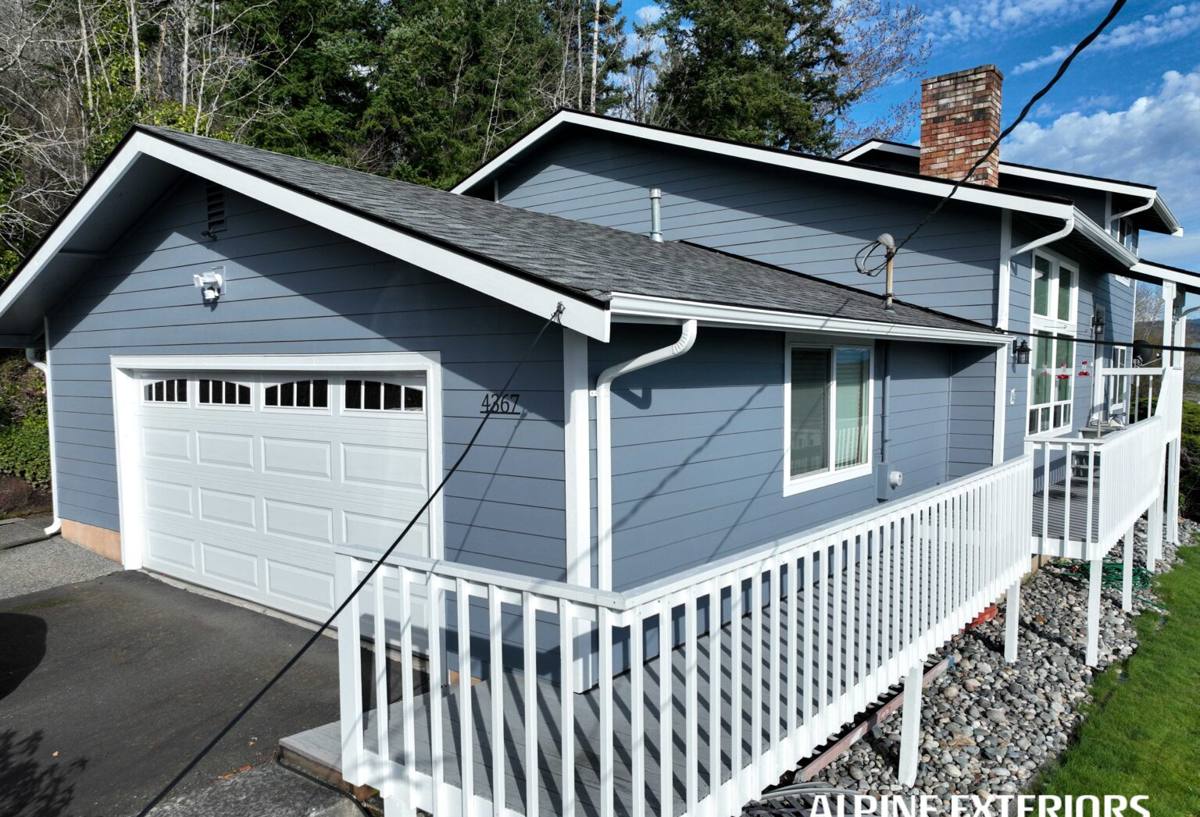
What Storm Damage Actually Looks Like on a Roof Here
Wind Damage
Strong wind doesn't have to rip shingles off to cause a problem. More often it lifts the tab edge just enough to break the seal strip underneath, and the shingle looks intact from the ground while it's actually no longer sealed down. Wind can also loosen ridge cap shingles, work nails loose at the shingle edges over repeated gusts, and crease shingles that get lifted and slapped back down without fully tearing.
Wind-Driven Rain Intrusion
This is the damage type we see most often in this area, and it's the hardest for a homeowner to spot without getting on the roof. Rain that's being pushed sideways by wind finds its way under lifted shingle edges, around flashing that's slightly out of sequence, and through any gap at a roof penetration — vent pipes, chimneys, skylights. It doesn't always show up as an active leak right away. Sometimes it shows up as a slow stain on an interior ceiling weeks later, once enough water has worked through the underlayment and sheathing.
Moss and Debris-Related Damage
Moss isn't storm damage in the classic sense, but it compounds storm damage significantly. A shaded slope with an established moss mat holds moisture against the shingle surface long after a storm has passed, which accelerates granule loss and can lift shingle edges from underneath. Storms also drop branches and debris that can gouge or crack shingles, and heavy, wet moss combined with wind can shift or dislodge material that was otherwise stable.
Flashing and Fastener Failure
Metal flashing and fasteners take steady corrosion pressure from salt-laden coastal air, and a storm is often what exposes a flashing joint or fastener that had already been quietly failing. Roof-to-wall flashing, valley flashing, and flashing around chimneys and skylights are the spots we check most carefully, because a small gap in any of these is a direct path for water into the structure.
Storm Damage vs. Everyday Wear: Why the Distinction Matters
Not everything that shows up after a storm was actually caused by that storm. This matters because it affects both the repair approach and, if you're filing a claim, how an insurance adjuster will assess the damage.
| Sign | More Likely Storm Damage | More Likely Gradual Wear |
|---|---|---|
| Missing shingles | Clean tear at the nail line, torn on one recent event | Curled, brittle edges consistent with age |
| Granule loss | Concentrated in one wind-exposed area | Even loss across the whole roof, especially older roofs |
| Leak location | New, tied to a specific recent storm date | Long-standing stain that's grown slowly over seasons |
| Flashing condition | Visibly bent, displaced, or torn loose | Corroded, thinned, or loosely sealed over time |
| Moss coverage | Present but not the primary damage source | Thick, established mat holding moisture long-term |
An honest inspection tells you which category you're actually dealing with, because the fix — and whether it's reasonable to pursue as a storm claim — depends on it.
How We Assess Storm Damage on a Cordata-Area Roof
We start on the ground with binoculars and a visual pass, then move to the roof itself when conditions allow it safely. A thorough assessment covers:
- Every roof slope, not just the side facing the prevailing wind — storms in this area don't always come from the same direction
- Shingle seal integrity, not just whether shingles are visibly missing or torn
- All flashing points: valleys, roof-to-wall transitions, chimneys, vents, and skylights
- The attic interior, where early water intrusion often shows up as staining on the underside of the sheathing before it ever reaches a ceiling
- Gutter and downspout condition, since a clogged or damaged gutter system can turn manageable rain into a roof-edge saturation problem
- Moss and debris load on shaded slopes, since that affects both the current repair and how soon the next inspection should happen
We document what we find with photos and a written summary before we recommend anything, so you have something concrete to reference whether you're deciding on a repair, getting a second opinion, or supporting an insurance claim.
Repair vs. Replacement: Making the Right Call
Storm damage repair isn't always a small job, and it isn't always a full re-roof either. The right call depends on how much of the roof is affected, how old the existing roofing is, and what condition the roof was in before the storm hit.
When a Targeted Repair Makes Sense
If the damage is limited to a section of the roof — a few courses of shingles, one flashing point, one section of ridge cap — and the rest of the roofing is in reasonably good condition for its age, a targeted repair is usually the right, cost-effective move. We match materials as closely as possible and make sure the repair is properly integrated into the surrounding roofing, not just patched over it.
When Replacement Makes More Sense
If the roof was already near the end of its service life, if storm damage is spread across multiple slopes, or if water intrusion has been ongoing long enough to affect underlayment or sheathing broadly, a repair can end up being a short-term fix on a roof that needs more than a patch. We'll tell you plainly when we think that's the case rather than selling a repair we don't think will hold.
Our Process, Start to Finish
- Initial contact and scheduling. We get basic details about the storm event and any visible symptoms — leaks, missing material, interior stains — and schedule an inspection promptly.
- On-site inspection. A full assessment of the roof, attic, and drainage system as described above, done safely and without cutting corners on slopes that are hard to see from the ground.
- Written findings and options. You get a clear explanation of what we found, photos, and honest options — repair, replacement, or in some cases, monitor and revisit.
- Insurance coordination, if applicable. If you're filing a claim, we can provide documentation and, if needed, meet an adjuster on-site to walk the damage together.
- Repair work. Materials matched to your existing roofing where possible, flashing and fastener work done to hold up in this climate specifically, and cleanup when the work is complete.
- Final walkthrough. We show you what was done and answer any questions before we consider the job finished.
What to Do in the First 48 Hours After a Storm
- Do a ground-level visual check with binoculars — don't get on the roof yourself if it's wet, windy, or you're not equipped for it
- Check the attic for fresh staining, damp insulation, or daylight where there shouldn't be any
- Photograph any visible exterior damage — missing shingles, displaced flashing, debris on the roof — from the ground
- Clear debris away from downspouts and gutters if it's safe to do so, so drainage isn't blocked during follow-up rain
- Note the date and rough timeline of the storm event, which matters if you end up filing an insurance claim
- Call for an inspection promptly rather than waiting — a small intrusion point gets worse with every additional rain event, not better
A Note on Insurance Claims
Most homeowner's policies cover sudden storm damage — wind, wind-driven rain, falling debris — but the burden is on you to show the damage is tied to a specific event and wasn't simply deferred maintenance. That's part of why a documented inspection matters even if you're not sure yet whether you'll file a claim. We're not a public adjuster and we don't handle the claim itself, but we can provide the kind of clear, dated documentation that supports a fair assessment, and we're glad to meet an adjuster on-site if that's useful to you.
Why a Crew That Already Works This Area Matters
Roofing crews that work Whatcom County and the Ferndale area regularly develop a feel for which flashing details tend to fail first in this climate, which slope orientations grow moss fastest, and how wind-driven rain actually behaves on the roof shapes common to this area — knowledge that comes from repeated exposure to the same conditions, not from a general roofing checklist. That local pattern recognition speeds up diagnosis and helps make sure a repair addresses the actual cause of intrusion, not just the visible symptom.
It also means faster response after a storm. When a weather event hits the region, demand for roofing inspections spikes across every crew at once. Working this area consistently, rather than driving in from further out only when called, means we're already positioned to respond quickly rather than adding significant travel time on top of an already busy stretch.
Get an Honest Look at Your Roof
If a recent storm has you wondering whether your roof came through it clean, we're happy to take a look and give you a straight answer — no pressure, no upsell if the roof is fine. Reach out below for a free storm damage assessment and estimate.