 Ferndale Siding
 Window Replacement for Sandy Point Homes
Sandy Point sits out on its own peninsula on the Whatcom County coastline, northwest of Ferndale, with homes built directly along the beach and the community's canals off the Strait of Georgia. There's little in the way of natural windbreak out here — no ridge line, no stand of timber, no neighboring town to soften what comes off the water. That open exposure is part of what makes Sandy Point a desirable place to live, and it's also exactly why windows take more of a beating here than they do on a typical inland Ferndale lot just a few miles away.
We handle siding, roofing, windows, and decks for homes throughout this part of Whatcom County, and window replacement in Sandy Point specifically gets treated as its own category of work. Salt-laden air, wind-driven rain with nothing to slow it down, and a moss season that runs long even by regional standards all put more stress on a window system — the frame, the glazing, the hardware, and especially the flashing — than manufacturer installation guidance written for a moderate climate ever accounts for.
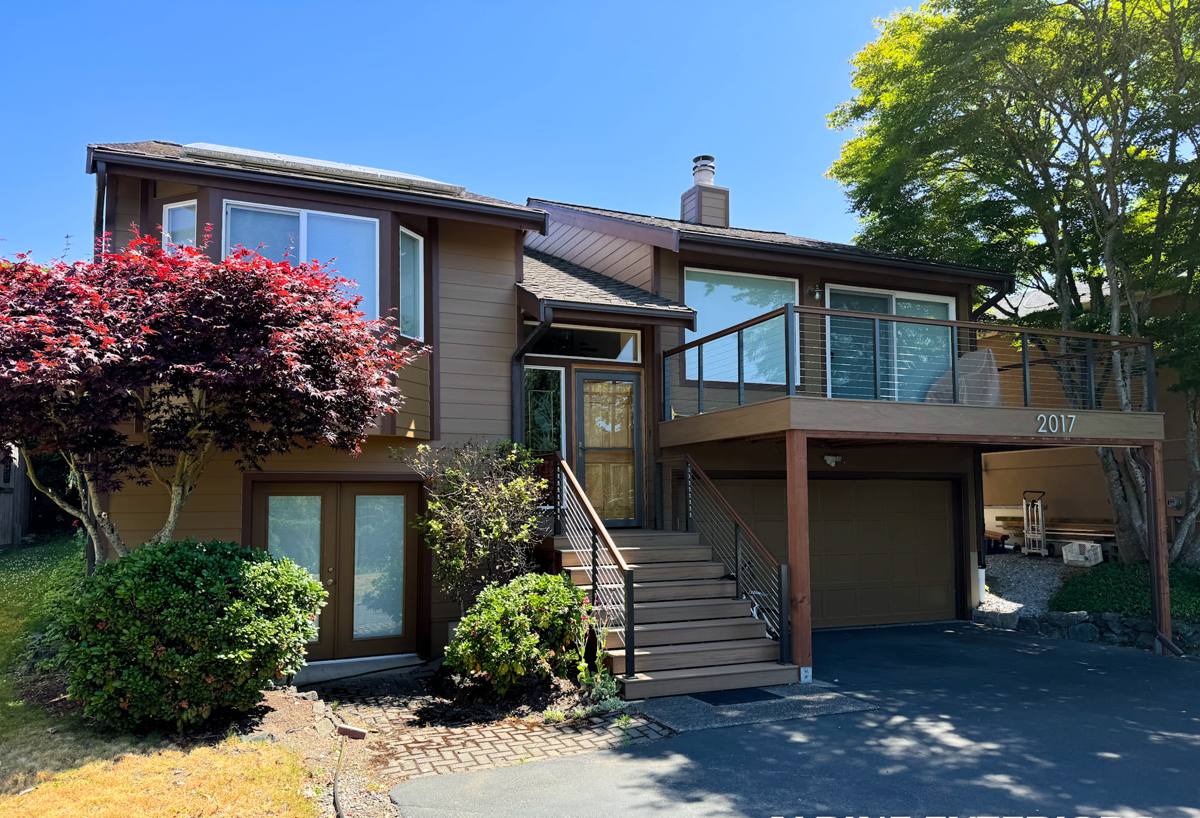
What Sandy Point's Exposure Does to Windows
Salt Air and Corrosion
Homes fronting directly onto open water or the canals take salt-laden marine air daily, not just during storms. That air works on window hardware, fasteners, and lower-grade frame components in ways a drier or more sheltered site never sees — hinges that stiffen early, screws and fasteners that pit and corrode, and finishes that chalk or fail years ahead of schedule. Components rated for general Pacific Northwest use can still underperform on a true waterfront lot like this one, which is why hardware grade matters more here than it does a few miles inland.
Wind-Driven Rain Off Open Water
With no windbreak between a Sandy Point home and the water, storms push rain sideways into window openings rather than letting it run down the wall the way it would on a calmer, more sheltered site. That kind of wind-driven rain finds gaps in flashing and seals that would never get tested on a typical inland property. It's also harder on window units themselves — sustained wind load against a large or older window stresses seals and frame connections over years of exposure, not just during the worst storms.
A Long Moss and Mildew Season
Persistent regional dampness and mild temperatures already give Whatcom County a long moss and mildew season, and a waterfront property like Sandy Point tends to run at the long end of that range. Window sills, trim, and the wood framing around older units are common places it takes hold first, especially on shaded or north-facing elevations where standing moisture doesn't dry out between rain events. Left alone, sustained growth holds moisture directly against the frame and sill, which is exactly the condition that leads to hidden rot.
Sun, Salt Film, and Frame Wear
Open water exposure cuts both ways — the same lack of windbreak that lets rain and wind hit harder also means more direct sun on south- and west-facing glass and frames than a shaded inland lot gets. Combined with a fine film of salt residue that settles on glass and hardware between rains, that exposure accelerates finish wear, seal degradation, and hardware fatigue on windows that face the water most directly.
Signs a Sandy Point Home Needs Window Replacement
- Fogging or visible moisture trapped between panes of a double-pane window
- Hardware that's stiff, pitted, or corroded from sustained salt air exposure
- Drafts near the frame even when the window is fully latched and closed
- Soft, discolored, or visibly rotted wood at the sill or surrounding trim
- Visible gaps, cracked caulk, or failed sealant where the frame meets the siding
- Paint or finish that's peeling or chalking noticeably faster than the rest of the exterior
- Windows that have never been touched since the home was built, particularly on the water-facing side
Repair vs. Full Replacement: How We Make the Call
Not every window on a Sandy Point property needs to come out. A unit with a failed seal but a sound frame and working hardware is often a fair repair or reglaze candidate, and we'll say so rather than pushing a bigger job than the property actually needs. But once framing has softened, hardware has corroded past reliable function, or a unit has been struggling for years against direct water exposure, patching it usually just delays a larger job while moisture keeps working on the wall behind it.
| Condition | Repair Often Makes Sense | Replacement Usually Makes Sense |
|---|---|---|
| Fogged glass, sound frame and hardware | Yes — reglaze or seal replacement | Only if the frame is also compromised |
| Corroded or stiff hardware, frame otherwise sound | Yes — hardware replacement | Not usually on its own |
| Soft, rotted, or delaminating sill or frame | Rarely a lasting fix | Yes |
| Persistent drafts despite resealing | Sometimes, if flashing is the actual cause | Yes, if the unit itself is the source |
| Original single-pane or early double-pane units facing the water | Short-term fix at best | Yes, for real comfort and durability gains |
What Correct Window Replacement Involves Here
Removal and Opening Inspection
Once the old window comes out, the rough opening tells us most of what we need to know. On a waterfront property this is where we typically find whatever the old window's flashing missed — softened sheathing, staining that shows a long-running leak path, or trim that looks fine from outside but is failing underneath. Any of that gets addressed before a new unit goes in, not covered over.
Flashing and Weatherproofing
This is the step that decides whether a window replacement holds up on a lot this exposed. Flashing has to lap correctly into the surrounding weather-resistive barrier and siding, direct water out and away from the opening rather than trapping it behind the frame, and use sealants rated for sustained salt and moisture exposure rather than standard caulk. On a direct waterfront lot, we treat this as non-negotiable on every window, not an upgrade a homeowner has to ask for separately.
Frame Setting and Sealing
The new unit gets shimmed level and square, fastened per the manufacturer's spec, and sealed at every seam with attention to the water-facing side of the home specifically. Corners and sill pans get extra scrutiny here, since those are the spots most likely to be shortcut on a rushed installation and the first place wind-driven rain finds a way in.
Choosing Frame Materials and Glazing for This Exposure
We install vinyl and fiberglass window systems suited to the Pacific Northwest's wet, mild climate, and on a property like this one we lean toward the option that holds up with the least ongoing upkeep against salt air and sustained moisture. Neither is the automatic right answer for every home — it depends on the opening, the budget, and how much maintenance a homeowner wants to take on.
| Frame Material | How It Handles This Exposure | Trade-Off |
|---|---|---|
| Vinyl | Resists rot and corrosion well; performs reliably in wet, mild coastal climates | Limited color range; can flex slightly on very large units |
| Fiberglass | More dimensionally stable across temperature swings; holds paint if a custom color is wanted | Higher upfront cost than comparable vinyl |
| Wood-clad (exterior-protected) | Can work when properly clad and maintained, with a warmer interior look | More maintenance-sensitive on a direct waterfront lot; cladding integrity matters more here |
On glazing, a double or triple-pane unit with a low-E coating helps on two fronts that matter here: it cuts down on the condensation that shows up on cold window glass during damp Whatcom County winters, and it reduces the fading and heat gain from direct afternoon sun on water-facing glass. Hardware grade matters just as much as either of those choices — corrosion-resistant hardware is worth specifying on every window here, not just the ones facing the water directly.
How Windows Fit Into the Rest of the Home's Exterior
Window problems on a Sandy Point home rarely start and end with the window itself. A section of siding that's lost its seal, roof flashing that's let water travel down behind the wall, or a deck ledger trapping moisture near a lower window can all show up first as a drafty or water-stained window, well before anyone traces the source. Because we handle siding, roofing, windows, and decks as one connected scope, the person flashing a window on this job understands how it ties into the siding and roof details around it, instead of treating the window as an isolated swap.
Cost Factors for Window Replacement in Sandy Point
| Factor | What It Affects | Why It Matters Here |
|---|---|---|
| Frame material and glazing package | Unit cost and long-term upkeep | Salt air rewards frame and hardware upgrades that a sheltered inland home could skip |
| Existing opening condition | Repair work needed before the new unit goes in | Long-running leaks behind older windows can mean sheathing or framing repair |
| Flashing and sealant scope | Labor time per opening | Wind-driven rain off open water requires a more thorough flashing sequence than a calmer site |
| Number and size of openings | Total project scope | Larger, view-oriented windows are common on this stretch of coast and take more time to flash correctly |
| Water-facing vs. sheltered elevation | Hardware and sealant grade recommended | Openings facing the water directly take more sustained exposure than a side or rear wall |
Exact pricing depends on the specific home and how many openings are involved, which is why we walk the property in person and look at each window individually rather than quoting off a flat per-window rate.
Why a Local Crew That Works Sandy Point Matters
A contractor who works this stretch of Whatcom County coastline regularly already knows what a fully exposed waterfront lot does to a window installation that would hold up fine a mile or two inland. That shows up in decisions that don't come up in a sales pitch — how much extra lap a flashing detail gets on the water-facing side, which hardware grade actually holds up out here, and when a sealant needs to be rated for sustained salt exposure rather than general-purpose use. Sandy Point's exposure is real and specific, and a crew with hands-on experience on this peninsula treats it as such instead of applying a generic installation approach built for a sheltered lot.
Our Process
- On-site assessment — we check frame condition, hardware function, seal integrity, and how the existing flashing ties into the siding around each window
- Honest recommendation — a clear read on which windows are reasonable repair candidates and which make more sense to replace, explained plainly
- Written scope and lead time — a straightforward estimate before any work begins, with realistic timing since window orders can take several weeks
- Removal and opening prep — the old unit comes out carefully, with any hidden rot or flashing issues addressed before the new window goes in
- Installation and flashing — the new unit is set, shimmed, and flashed to a sequence built for this level of exposure, not a generic template
- Final check — hardware operation, seal quality, and trim integration confirmed before we call the job done
If your Sandy Point home has windows that fog, stick, or feel drafty on the water-facing side — or you're just not sure whether repair or replacement is the right call — we're glad to take a look. Reach out using the form below to schedule a free, no-pressure estimate.