 Ferndale Siding
 Why Decks Age Faster in the Bellingham Area
Bellingham sits close enough to the water and inside enough of Whatcom County's wet weather pattern that outdoor structures take a beating most homeowners underestimate. It isn't one dramatic storm that wrecks a deck here — it's the slow, repeated cycle of moisture, salt-tinged air, and shade-grown moss working into every joint, fastener, and board edge over years. A deck built with the wrong materials or the wrong details for this climate can look fine for a season or two and then fail in ways that are expensive to fix piecemeal.
Driving rain doesn't just fall straight down here — wind pushes it sideways into ledger connections, under railing posts, and into end grain that was never sealed. Add in the mild, damp winters that keep wood surfaces wet for weeks at a stretch, and you get ideal conditions for rot to start exactly where you can't see it: at the ledger board, around post bases, and underneath surface-mounted hardware.
Salt Air and Metal Fatigue
Homes closer to the water deal with airborne salt that accelerates corrosion on anything less than the right grade of fastener or connector. Once a nail, screw, or joist hanger starts corroding, it loses holding strength long before it looks obviously bad from the surface. That's a structural problem hiding behind a cosmetic one.
Moss and Trapped Moisture
Whatcom County's long, mild moss season means north-facing and shaded decks stay damp far longer than decks in drier climates. Moss holds water against the wood surface, keeps boards from drying out between rains, and if left to spread, works into board gaps and fastener heads where it accelerates decay from the top down instead of just the underside.
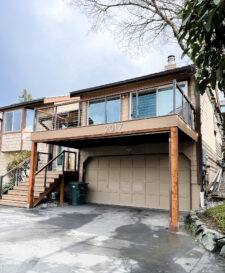
Signs a Bellingham Deck Needs Replacement, Not Just Repair
Not every tired-looking deck needs to be torn out. But there's a point where patching individual boards is throwing money at a structure that's already compromised underneath. Some signs point clearly toward replacement rather than repair:
- Soft, spongy, or spring-loaded spots when you walk across the decking — usually rot in the joists below, not just the board
- Visible gaps, cracking, or splintering at board ends, where water sits longest
- Rust streaks or corrosion around fasteners, joist hangers, or ledger bolts
- A ledger board separating from the house, or flashing that's missing, cracked, or was never installed
- Post bases sitting in standing water or buried in soil/mulch instead of sitting clear of grade
- Railings that flex or wiggle under normal hand pressure
- Moss or algae that keeps returning within weeks of cleaning, especially on shaded sections
- A structure that's 20+ years old and was built before current ledger-flashing and hardware standards were common practice
If you're only seeing one or two of these on a small, accessible section, repair may still make sense. When several show up together, or when the framing itself is affected, replacement is usually the more honest recommendation — and the more cost-effective one over a five- or ten-year horizon.
What a Correct Deck Replacement Actually Involves
A deck replacement done right is not just pulling up old boards and screwing down new ones. The parts you don't see — the ledger connection, the framing, the flashing — determine whether the new deck lasts fifteen years or five.
Ledger Board and Flashing
The ledger board, where the deck attaches to the house, is the single most common failure point in this climate. It needs proper flashing that directs water away from the house sheathing, correct fastener spacing and type, and a gap or drainage path so water doesn't pool between the ledger and the siding. This is also where a lot of older or budget builds cut corners, because it's hidden work that doesn't show up in a walkthrough.
Framing and Footings
Joist size and spacing need to match the actual span and expected load, not just match what was there before. Post footings need to sit below frost depth and be sized for the soil conditions on the lot — Whatcom County's clay-heavy soils in some areas hold moisture differently than sandy or well-drained lots, and footings that worked on one property don't automatically work on the next.
Fasteners and Hardware
Given the salt air and moisture exposure, hardware matters more here than in drier inland climates. Stainless steel or high-grade coated fasteners and connectors cost more up front but avoid the corrosion-driven failures that show up in cheaper hardware within just a handful of wet seasons.
Decking Surface and Drainage
Board spacing, ventilation underneath the deck, and slope away from the house all affect how fast water leaves the structure instead of sitting in it. A deck that traps water — because it was built flush to grade, or without gaps for airflow — will grow moss and rot regardless of how good the decking material is.
Choosing a Decking Material for This Climate
There's no single "best" decking material — the right choice depends on your budget, how much maintenance you're willing to do, and how much shade and moisture exposure the specific deck location gets.
| Material | Moisture/Moss Resistance | Maintenance | Typical Lifespan |
|---|---|---|---|
| Pressure-treated wood | Good if sealed regularly; vulnerable if maintenance lapses | Annual cleaning and periodic sealing/staining | 10–20 years with upkeep |
| Cedar | Naturally decay-resistant but still needs sealing in this climate | Regular sealing to maintain resistance | 15–20 years with upkeep |
| Capped composite | Strong — shrugs off moisture and resists moss buildup on the surface | Periodic washing, no staining/sealing | 25–30+ years |
| Uncapped composite | Moderate — can absorb moisture at cut edges over time | Occasional cleaning | 15–25 years |
We generally steer clients toward capped composite for decks that stay shaded or get heavy weather exposure, simply because the maintenance burden is so much lower here than in a drier climate. Wood isn't wrong — it's a legitimate, often less expensive choice — but it only performs well if someone actually keeps up with sealing on schedule, and that's a real commitment given how much of the year this region stays damp.
Our Deck Replacement Process
1. On-Site Assessment
We walk the existing deck, check the ledger connection, probe framing for soft spots, and look at drainage and grading around the structure. This tells us whether replacement is actually necessary and what the new build needs to account for on your specific lot.
2. Plan and Material Selection
We go over material options, layout, and any structural changes honestly — including trade-offs on cost, maintenance, and longevity — so you're picking based on real information, not a sales pitch.
3. Permitting
Deck replacements in Bellingham and the surrounding county often require a permit, particularly when the deck is elevated, attached to the house, or involves structural changes. We handle that process rather than leaving it on you.
4. Demolition and Disposal
The old deck comes out, including footings or framing that's being replaced rather than reused, and debris is hauled off the site.
5. Framing and Structural Work
New footings, framing, ledger flashing, and hardware go in to current standards, sized for your specific span and load — not just replicated from the old build.
6. Decking, Railing, and Finish
Decking, railings, stairs, and any trim go on last, with attention to drainage, ventilation, and fastener placement so the finished deck is set up to shed water instead of holding it.
Permits and Code Considerations Locally
Most attached, elevated decks in Bellingham and unincorporated Whatcom County require a building permit, and inspections typically check footing depth, ledger attachment, and railing height/spacing. Skipping permits on a deck replacement can create real problems later — at resale, with insurance, or if something fails and it turns out the work wasn't inspected. We build to pass inspection the first time, not to cut corners that surface as someone else's problem down the road.
Why Hiring a Crew That Already Works in Bellingham Matters
A contractor who works this area regularly already knows which details matter here: how to flash a ledger against wind-driven rain, which fastener grade actually holds up against salt air over a decade instead of just looking fine at handoff, and how local soil and drainage patterns affect footing placement. That's the kind of judgment that doesn't come from a generic build — it comes from having replaced decks on homes with the same weather exposure yours has.
It also means faster, more honest assessments. We're not guessing at how a design will perform in this climate; we've already seen what holds up and what doesn't after a few Whatcom County winters.
What Affects the Cost of a Deck Replacement
Every deck is different, so we don't quote a number until we've actually seen the site, but the main cost drivers are consistent:
- Deck size and footprint
- Decking material chosen (wood vs. composite, and grade within each)
- Height and whether stairs, multiple levels, or a covered section are involved
- Condition of the existing framing and footings, and how much needs full replacement
- Railing style and any custom features
- Site access — tight lots or difficult grade can add labor time
We'd rather walk you through these factors on your specific deck than throw out a broad range that doesn't mean much until we've seen the structure.
If your deck is showing its age or you're just planning ahead, we're happy to take a look and give you a straightforward, no-pressure estimate — no upsell, just an honest read on what your deck needs. Use the form below to get started.