 Ferndale Siding
 Why Custer Roofs Wear Differently Than Roofs Inland
Custer sits close enough to the water and the Canadian border that its weather behaves a little differently than roofs even ten or fifteen miles inland. Homes here deal with a steady mix of salt-laden air off the Strait of Georgia and Birch Bay, long stretches of driving rain that comes in sideways more often than straight down, and a moss season that can stretch from fall through spring. None of these factors alone is unusual for Western Washington. Together, on a roof that wasn't detailed for them, they add up to shortened shingle life, hidden moisture problems, and moss that comes back faster than a homeowner expects.
Asphalt shingle roofing is still the right call for most Custer homes — it's cost-effective, proven, and easy to repair in sections. But "asphalt shingles" isn't a single product or a single installation method. What holds up on a dry, inland roof in Eastern Washington is not automatically what holds up two miles from saltwater in Whatcom County. This page is about what actually matters for a shingle roof in Custer specifically, not shingle roofing in general.
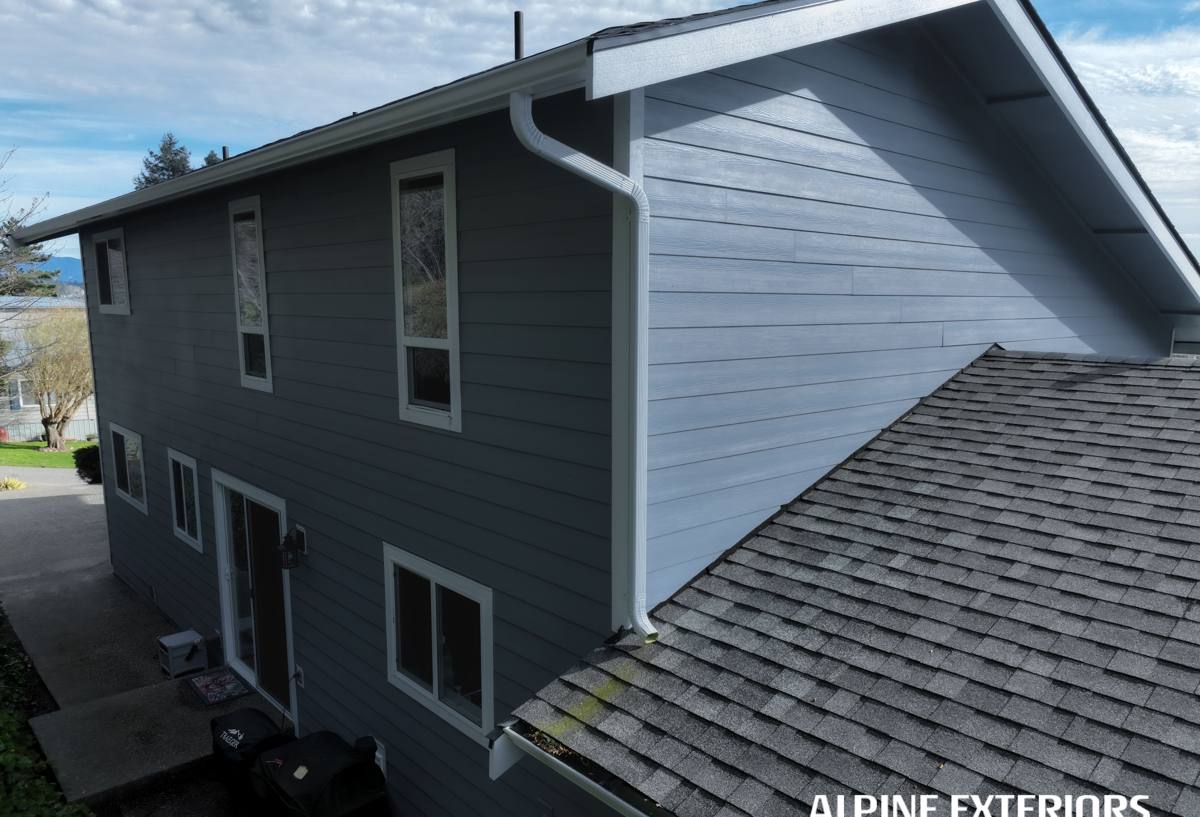
What Salt Air Actually Does to a Shingle Roof
Salt air doesn't dissolve asphalt shingles, but it does accelerate the breakdown of the metal components tied into the roof system — flashing, fasteners, vent stacks, and gutter hardware. Once those start to corrode, water finds paths into the roof deck that the shingles alone can't stop. We pay close attention to fastener and flashing material selection on homes this close to the water, because a roof is only as good as its weakest metal component.
Salt-carried moisture in the air also settles into shingle granules and roof valleys, creating a slightly damp surface that never fully dries between rain events during the wetter months. That constant low-level moisture is exactly what moss, lichen, and algae need to establish themselves — which brings us to the next issue.
Moss Season Isn't Just a Fall Chore
In Custer, moss isn't a once-a-year gutter-cleaning problem. The combination of shade from mature trees, persistent moisture, and mild temperatures means moss spores can take hold almost any time the roof stays damp for more than a day or two. Left alone, moss holds water against the shingle surface, lifts shingle edges as it grows, and works its way under tabs — which is how a moss problem turns into a leak problem. A correctly installed roof in this area accounts for moss resistance from day one rather than treating it as an annual maintenance afterthought.
What a Correct Asphalt Shingle Job Looks Like Here
A roof that's built for Custer's conditions isn't just "shingles nailed to plywood." The parts underneath and around the shingles matter as much as the shingles themselves, especially in a climate with this much driving rain.
- Ice and water shield at vulnerable points — eaves, valleys, and roof-to-wall transitions get a self-adhering waterproof membrane, not just felt, because these are where wind-driven rain gets pushed uphill under the shingle line.
- Synthetic underlayment across the field — more tear-resistant and more consistently waterproof than old-style felt, and it holds up better through a multi-day install if weather rolls in.
- Balanced intake and exhaust ventilation — proper soffit intake paired with ridge or box venting keeps moist attic air moving out instead of condensing on the underside of the deck.
- Corrosion-appropriate metal — flashing, drip edge, and fasteners chosen with the salt-air exposure in mind, not just whatever is standard stock.
- Algae-resistant shingles — granules treated to resist the blue-green algae that causes the dark streaking common on shaded, moisture-prone roofs in this region.
- Sealed, tight valley and penetration details — every pipe boot, chimney flashing, and valley is a place water concentrates; these get extra attention, not just standard nailing patterns.
Skip any one of these and the roof might look fine for a season or two. The problems that show up from skipping them tend to appear two, five, or ten years later — as soft decking, granule loss, or moss regrowth right after a cleaning — which is exactly the kind of failure that's expensive to trace back to an installation shortcut.
Signs a Custer Roof Needs a Closer Look
Because moisture and moss issues here build gradually, most homeowners don't notice a problem until it's visible from the ground. Some early indicators worth acting on:
- Dark streaking or green-black staining, especially on north-facing or shaded slopes
- Moss visible at the ridge, in valleys, or along the lower edge of the roof
- Granules collecting in gutters or at downspout outlets
- Shingle tabs that look curled, cupped, or lifted at the edges
- Soft spots or sagging noticeable when walking near the roofline (viewed from a ladder, not by walking the roof)
- Daylight or water staining visible in the attic near vents, chimneys, or valleys
Any one of these on its own isn't necessarily an emergency, but in combination, or if it's been more than a few years since the roof was last inspected, it's worth having someone look before the next round of fall rain.
Choosing the Right Shingle for This Climate
Not every asphalt shingle product is built the same way, and the differences matter more in a wet, salt-air, moss-prone area than they would somewhere dry. We generally steer Custer homeowners toward architectural (dimensional) shingles over basic three-tab for a few honest reasons: they're heavier, they shed wind-driven rain more effectively because of their layered profile, and most manufacturers back them with stronger algae-resistance treatments and longer warranty terms. Three-tab shingles are lighter-weight and less expensive up front, but they have less material to resist the repeated wet-dry cycling this climate puts them through, and their flatter profile gives wind-driven rain a more direct path at the seams.
| Factor | 3-Tab Shingles | Architectural Shingles |
|---|---|---|
| Typical lifespan in this climate | Shorter — more exposure to wet-dry cycling | Longer — heavier mat resists moisture cycling better |
| Wind-driven rain performance | Flat profile, more seam exposure | Layered profile sheds water more effectively |
| Algae/moss resistance options | Available, but thinner granule bed | Typically stronger treatments, more granule depth |
| Upfront cost | Lower | Moderate premium |
| Warranty terms (varies by manufacturer) | Generally shorter | Generally longer |
The right choice still depends on the home's roof pitch, tree coverage, sun exposure, and the homeowner's budget and timeline — we walk through those specifics on-site rather than recommending the same product for every house.
How We Approach a Custer Roofing Job
Every roof gets assessed for its specific exposure before we talk products. A shaded, tree-covered lot near Custer's wooded areas has different moss and moisture needs than an open lot closer to Birch Bay's salt air. Our process generally runs:
- On-site inspection — deck condition, ventilation, existing moss or algae growth, flashing condition, and roof age.
- Honest scope and options — repair versus full replacement, shingle options suited to the home's exposure, and a clear written estimate.
- Tear-off and deck check — old material removed and the decking inspected for soft or water-damaged sections before anything new goes down.
- Underlayment and flashing detail work — ice and water shield, synthetic underlayment, corrosion-appropriate flashing and fasteners.
- Ventilation correction — intake and exhaust balanced to reduce attic condensation, a common contributor to premature shingle failure in this climate.
- Shingle installation — installed to manufacturer nailing and exposure specs, not shortcuts, since warranty coverage depends on it.
- Final walk-through — cleanup, gutter check, and a review of what was done and why.
What Affects the Cost of a Custer Roofing Project
| Cost Factor | Why It Matters Here |
|---|---|
| Roof pitch and access | Steeper or hard-to-access roofs take longer and require more safety setup |
| Deck condition | Rot or soft decking found during tear-off adds repair scope |
| Shingle grade | Architectural vs. 3-tab, plus algae-resistance level |
| Ventilation upgrades | Adding or correcting intake/exhaust venting if the existing system is inadequate |
| Tree coverage and moss removal | Heavily shaded lots often need moss treatment as part of the scope |
| Number of valleys and penetrations | More flashing detail work means more labor time |
We give a written, itemized estimate before any work starts so there aren't surprises once the tear-off begins — though a certain amount of deck condition can only be confirmed once the old roofing is off.
Maintenance That Actually Matters in This Climate
A well-installed asphalt shingle roof in Custer still needs periodic attention — the climate doesn't let any roof coast on installation quality alone. A simple, realistic maintenance routine:
- Have gutters and downspouts cleared at least twice a year, more often under heavy tree coverage
- Get a visual roof check after major fall storms, before the wettest months settle in
- Address small moss patches early rather than waiting for full coverage
- Keep overhanging branches trimmed back to reduce shade and debris buildup
- Have flashing and sealant points checked every few years, since these fail before the shingles usually do
- Avoid pressure washing shingles — it strips protective granules and shortens shingle life
Why Local Experience in Custer Actually Matters
A roofing crew that regularly works in and around Custer and Ferndale has already seen how this specific stretch of Whatcom County behaves — which slopes tend to hold moss longest, how far wind-driven rain travels up under an eave in a coastal storm, and which flashing details fail first when they're cut corners. That's not something a crew unfamiliar with the area gets right by following a generic checklist. It shows up in the details: where ice and water shield actually gets extended to, how ventilation gets balanced for a specific attic, and which shingle products hold their algae resistance longest in salt air rather than just on paper.
If you're dealing with visible moss, staining, aging shingles, or you're just due for an honest inspection, we're happy to take a look and give you a straightforward assessment — no pressure, no upsell. Reach out using the form below to schedule a free estimate for your Custer home.