 Ferndale Siding
 Building Decks That Hold Up in Custer's Coastal Climate
Custer sits close enough to the water and open farmland that decks here take a different kind of beating than a deck built twenty miles inland. Salt-laden air off the Strait works into fasteners and metal connectors faster than most homeowners expect, driving rain finds its way into any gap in flashing or decking seams, and the long stretch of gray, damp months from fall through spring keeps wood surfaces wet far longer than the sunny months ever dry them out. Add in the shade from mature trees common on larger Custer lots, and you get ideal conditions for moss and algae to take hold on anything that isn't detailed correctly.
None of that means a deck can't last for decades out here. It means the build has to account for moisture from day one — not as an afterthought, but in the framing, the fasteners, the flashing, and the decking material itself. A deck designed for a dry inland town and simply dropped onto a Custer lot will show problems within a few seasons: soft spots, streaking, loose railings, and moss creeping across boards that never get a full day of sun.
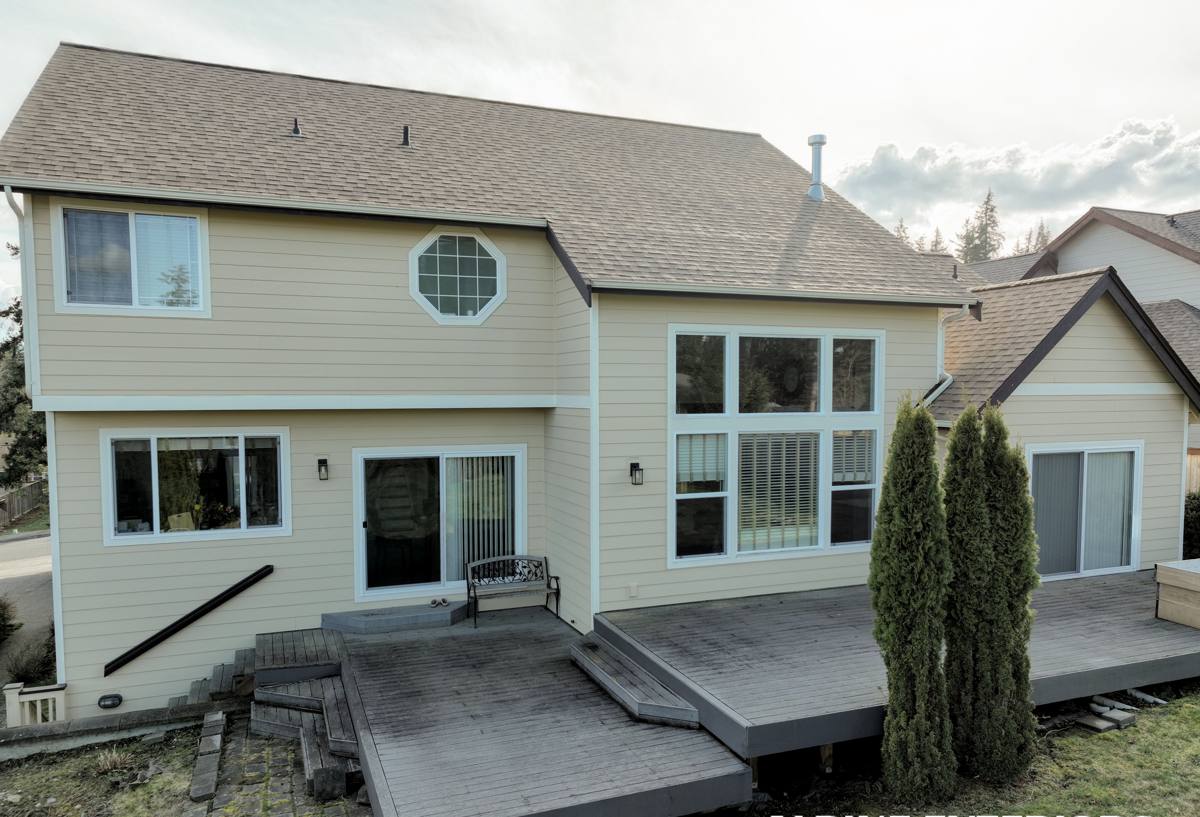
What a Correct Deck Build Involves in This Area
Footings and Framing
Whatcom County's frost depth and soil conditions mean footings need to be sized and set correctly, not guessed at. On many Custer properties the ground holds moisture longer into the season, which affects how footings are poured and how quickly a crew can safely work after a wet stretch. Framing lumber should be rated for ground contact or exterior use wherever it's within splash range of soil or standing water, and every ledger board attachment to the house needs proper flashing — this is the single most common failure point we see on older decks in this region, where water worked behind an unflashed ledger and rotted the rim joist behind it.
Fasteners and Hardware
Salt air corrodes standard fasteners faster than inland conditions do. Hot-dip galvanized or stainless hardware, and coated structural screws rated for the decking material being used, are not optional upgrades — they're the baseline for a deck that's going to be exposed to coastal moisture year-round. Mixing incompatible metals (aluminum flashing against the wrong fastener, for example) causes galvanic corrosion that can weaken connections from the inside where you can't see it.
Drainage and Airflow
A deck that can't shed water and breathe underneath will grow moss and mildew no matter what decking material sits on top. Proper joist spacing, gapping between boards, and grading away from the house all matter more here than in drier climates, because the margin for error shrinks when a structure stays damp for months at a stretch.
Choosing the Right Decking Material for Custer
There's no single "best" decking material — there's the right material for how a homeowner wants to use the deck and how much upkeep they're willing to do. In a climate with this much rain and moss pressure, the trade-offs are worth understanding up front.
| Material | Moisture & Moss Resistance | Maintenance | Typical Lifespan |
|---|---|---|---|
| Pressure-treated wood | Good if sealed and maintained; moss can gain a foothold in shaded, damp spots | Annual cleaning and periodic sealing | 15-20 years with upkeep |
| Cedar | Naturally moisture-resistant but still needs sealing against driving rain | Regular cleaning, re-oiling or staining every 1-2 years | 20-25 years with upkeep |
| Composite decking | Very good; resists rot, but surface moss/algae can still grow in shaded areas and needs washing | Occasional washing, no sealing or staining | 25-30+ years |
| PVC/capped polymer | Excellent; fully sealed surface sheds water and resists staining | Low; periodic washing | 25-30+ years |
We don't push one product on every homeowner. A wood deck under a covered porch on a well-drained Custer lot can perform beautifully for decades. A composite or PVC deck in a shaded, damp corner of the yard often makes more sense simply because it removes the annual sealing and staining cycle that wood demands in this climate. Where we do steer people away from a product, it's almost always about honest maintenance burden or moisture behavior in shade — not because a material is inherently bad, but because it may not fit that specific yard's sun and drainage.
Railings and Fasteners in Salt Air
Metal railing systems and cable railing look great but require materials rated for coastal exposure — standard mild-steel components will show rust streaks within a season or two out here. Aluminum, coated steel, or stainless hardware are the right call for anything permanent and load-bearing.
Our Deck-Building Process
- On-site assessment: we walk the lot, check drainage patterns, sun/shade exposure, soil conditions, and how the deck will tie into the house.
- Design and material selection: we talk through wood versus composite versus PVC based on the specific spot on the property, budget, and how much upkeep the homeowner wants to take on.
- Permitting: most deck projects in Whatcom County require a building permit, especially anything attached to the house or more than 30 inches off grade. We handle the paperwork and inspections as part of the job.
- Footings and framing: footings poured to proper depth, ledger flashed correctly, framing set with corrosion-resistant hardware.
- Decking and railing installation: boards and railing installed to the manufacturer's spec for gapping, fastening, and expansion — critical for composite and PVC products, which expand and contract with temperature.
- Final walkthrough: we go over the finished deck with the homeowner, including what maintenance (if any) the chosen material needs going forward.
Permits, Setbacks, and Local Code Considerations
Deck projects in and around Custer typically fall under Whatcom County building code rather than city code, since Custer is an unincorporated community. That means permit requirements, setback rules, and guardrail/height regulations follow the county's process rather than Ferndale's. Guardrails are generally required once a deck surface is a certain height above grade, and stair and railing spacing has to meet code for safety — these aren't areas where cutting corners is worth the risk, both for liability and for resale down the road. We pull permits and schedule inspections as a standard part of any deck build rather than treating it as optional.
Maintenance That Actually Matters Out Here
The single biggest factor in how long a Custer deck lasts isn't the brand of decking — it's whether moisture and moss get managed early and consistently. A few habits make a real difference:
- Sweep leaves and debris off the deck surface regularly, especially in fall — trapped organic matter holds moisture and feeds moss growth
- Rinse or wash the deck surface at least once or twice a year to remove algae and moss before it gets established
- Check ledger flashing and any spot where the deck meets the house every year or two for signs of water intrusion
- For wood decks, reseal or restain on the schedule the product calls for — don't wait until boards look gray and dry
- Keep gutters and downspouts near the deck clear so runoff isn't dumping directly onto or under the structure
- Trim back overhanging branches where possible to reduce shade and speed drying after rain
What Drives Cost on a Custer Deck Project
| Factor | Why It Matters |
|---|---|
| Decking material | Wood costs less upfront; composite and PVC cost more but reduce long-term maintenance spending |
| Size and shape | Multi-level decks, curves, and built-in features add framing and labor time |
| Height above grade | Taller decks need deeper footings, more bracing, and code-required guardrails |
| Site access and grading | Sloped or hard-to-access lots common around Custer can add site prep work |
| Railing system | Cable, glass, and metal railings cost more than standard wood or composite balusters |
| Permitting complexity | Setback issues or septic/well locations can affect design and add planning time |
We give straightforward, itemized estimates rather than a single lump number, so homeowners can see exactly where the budget is going and where there's room to adjust — swapping railing style or decking grade, for instance — without touching the structural work that keeps the deck safe and long-lasting.
Why a Locally Experienced Crew Matters Here
Building decks in a coastal, moss-prone corner of Whatcom County is genuinely different from building them in a drier inland region. A crew that already works Custer and the surrounding Ferndale area knows which fastener grades hold up against the salt air, how deep footings need to go in the local soil, which spots on a given property tend to stay shaded and damp longer, and what the county's permitting process actually requires — not in theory, but from doing it repeatedly on lots with the same drainage and exposure challenges. That familiarity shows up in fewer callbacks, fewer surprises during inspection, and a deck that's still solid and clean well past the point where a poorly detailed one would already be showing moss streaks and soft boards.
Signs an Existing Deck Needs Attention
If you're weighing a rebuild versus a repair on a Custer property, a few warning signs are worth checking before deciding:
- Soft or spongy spots underfoot, especially near the house or stair landings
- Visible gaps or dark staining where the deck ledger meets the siding
- Rust streaking from fasteners or metal hardware
- Persistent moss or algae that returns quickly after cleaning
- Loose or wobbly railings and posts
Any of these can usually be traced back to a moisture or fastener issue rather than the decking surface itself, which is why a proper assessment looks at the structure underneath, not just what's visible on top.
If you're planning a new deck or replacing one that hasn't held up to Custer's weather, we're happy to walk the property and put together a straightforward, no-pressure estimate — just fill out the form below to get started.