 Ferndale Siding
 Siding Installation in Custer: What the Climate Demands
Custer sits in the rural stretch of north Whatcom County between Ferndale and the Canadian border, close enough to the water that homes here deal with a mix of coastal and inland weather in the same season. Salt-tinged marine air moves in off the Strait of Georgia and Birch Bay, driving rain comes sideways during winter storms, and the tree cover that makes this area so pleasant to live in also means shaded north walls stay damp long after a storm has passed. That combination is hard on siding that isn't built or installed for it, and it's the reason we treat a Custer siding job differently than a job in a drier, more open part of the state.
Wood-based siding products — cedar, primed spruce, LP SmartSide — all rely on paint film and careful edge-sealing to keep moisture out. In a climate where wet weather can stretch across months without a real drying window, any gap in that paint film becomes an entry point. Vinyl siding doesn't rot, but it doesn't stop moss and mildew from taking hold in its overlaps and J-channels, and it doesn't handle the kind of driving wind gusts this area sees during winter fronts. We install James Hardie fiber cement siding exclusively because it's a non-combustible, dimensionally stable product engineered specifically for wet, marine-influenced climates like this one — and because getting a good 20, 30, or 40 years out of a siding job here depends as much on correct installation as it does on the product itself.
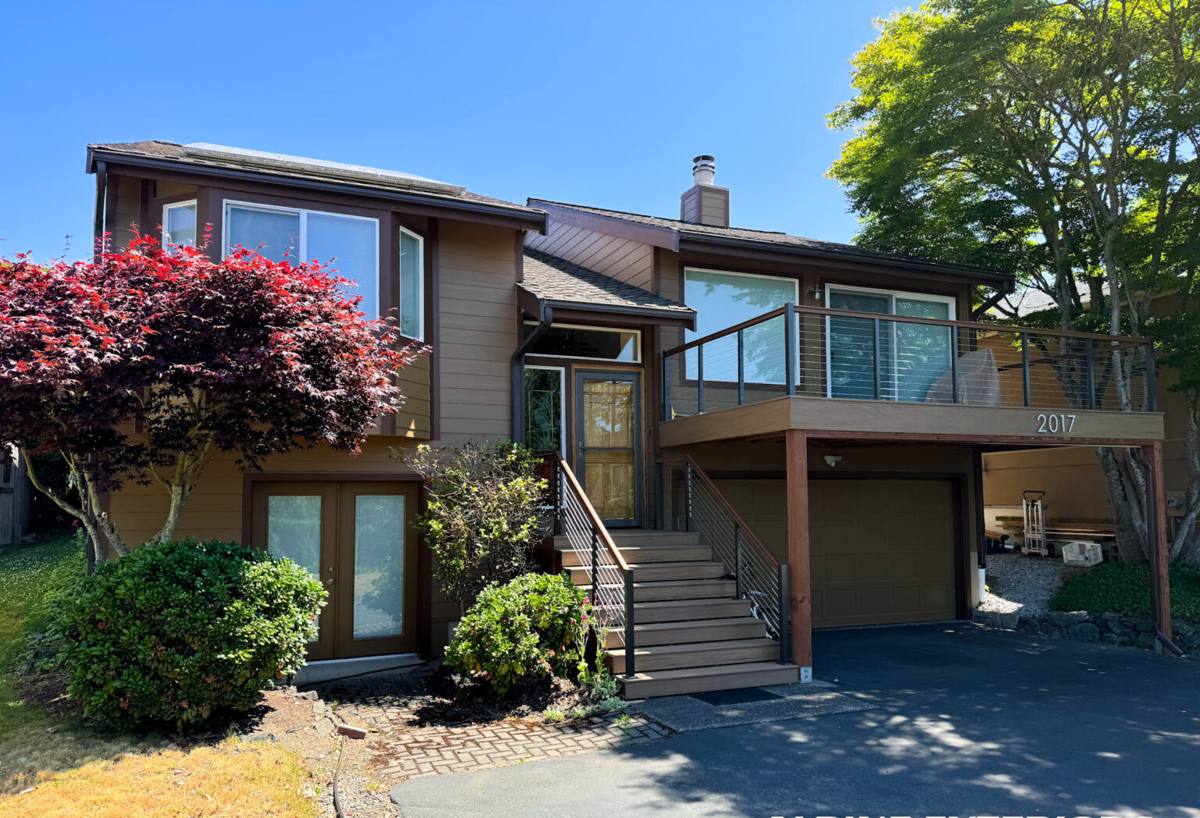
What "Correct" Installation Actually Means Here
Fiber cement siding is only as good as the water management system behind it. James Hardie board itself is rot-proof, but the wall assembly behind it — the weather-resistive barrier, the flashing, the gaps and clearances — is what determines whether moisture that reaches the wall gets out again or gets trapped. In a climate with Custer's rainfall and humidity, trapped moisture behind siding leads to sheathing rot and mold regardless of what's on the outside.
The details that matter most in this climate
- A continuous, properly lapped weather-resistive barrier (housewrap or building paper) installed shingle-style so water sheds outward, not into seams
- Rainscreen or furring strip installation where wall conditions call for it, creating a drainage gap and drying path behind the siding
- Correct flashing at every window, door, and roof-to-wall intersection — the single most common source of hidden leaks on any siding job
- Proper clearance between the bottom siding course and grade, decks, roof lines, and hardscape, so splashback and standing water don't wick into the board
- Factory-cut, factory-primed edges kept intact, with field cuts sealed per James Hardie's published installation instructions
- Fasteners set to the correct depth and pattern — overdriven nails crack the board's edge and create a moisture entry point that shows up as a stain years later
None of this is visible once the job is finished, which is exactly why it matters who's doing the work. A siding job can look identical from the curb and perform completely differently ten years later depending on whether these steps were followed.
Why Local Experience in Custer Specifically Matters
Custer isn't a dense subdivision — it's a mix of established homes on larger lots, many with mature tree cover and a fair number set back from the road with long, shaded exposures. Those conditions change how a siding installation should be approached. A wall that stays shaded and damp through the winter needs more attention to drainage and airflow behind the siding than a wall that gets full sun. A home near open fields or closer to the water deals with more direct wind-driven rain and benefits from tighter attention to flashing at every penetration. A crew that's worked houses throughout this immediate area has already seen how these microclimates play out on real walls — which sides of a house tend to grow moss first, where ice can form on north-facing eaves in a cold snap, and which older homes in the area were built with siding details that need extra correction during a re-side.
That local pattern recognition is different from general siding experience. It's the difference between a crew that follows a spec sheet and a crew that knows why the spec sheet says what it does for this part of Whatcom County.
Signs a Custer Home Needs New Siding
Siding failure in this climate is often gradual and easy to miss until it's advanced. Homeowners in and around Custer should watch for:
| Sign | What It Usually Means |
|---|---|
| Persistent moss or dark streaking on shaded walls | Surface is staying wet longer than it should — either a maintenance issue or a drainage/airflow problem behind the siding |
| Soft or spongy spots when pressed | Moisture has reached the substrate; likely rot in wood-based siding or sheathing |
| Paint that's peeling, bubbling, or failing faster than expected | Moisture is trying to escape through the paint film from behind — a sign of trapped water, not just weathering |
| Visible warping, cupping, or gaps at seams | Common with wood-based products as they absorb and release moisture repeatedly |
| Cracking at butt joints or panel edges | Often a sign of poor original installation — unsealed cuts or fasteners driven too close to the edge |
| Rising energy bills with no other explanation | Compromised siding and water-resistive barrier can affect wall insulation performance |
Catching these early matters. Once moisture gets past the siding and into the wall assembly, the repair scope grows quickly from "replace the siding" to "replace siding, sheathing, and possibly framing."
Our Installation Process
1. On-site assessment
We walk the exterior, check existing siding and trim condition, look at grading and drainage around the foundation, and note anything specific to the lot — tree cover, shaded exposures, proximity to standing water or low ground — that should influence the installation approach.
2. Tear-off and substrate inspection
Old siding comes off and we inspect the sheathing underneath. This is where hidden problems from a previous installation typically surface. Any soft, rotted, or compromised sheathing gets addressed before anything new goes up — covering damaged substrate with new siding just hides the problem for a few more years.
3. Weather-resistive barrier and drainage plane
A new, continuous water-resistive barrier goes on correctly lapped, with a rainscreen gap where the wall assembly calls for it. This is the layer that does the real work of keeping Custer's rain out of the wall long-term.
4. Flashing
Every window, door, and roof intersection gets flashed to shed water outward and down, never into the wall cavity.
5. James Hardie installation
Board, panel, or trim goes up to manufacturer spec — correct fastener spacing and depth, correct clearances at grade and roof lines, sealed field cuts, and factory-finished ColorPlus coating preserved wherever possible to avoid field painting.
6. Final walkthrough
We review the finished job with the homeowner, confirm caulking and trim details, and go over basic care.
James Hardie Product Lines Suited to This Area
James Hardie's HZ5 climate-engineered products are built for regions with significant moisture exposure like the Pacific Northwest, resisting moisture damage, cracking, and warping better than general-purpose siding lines. For Custer homes we typically discuss:
- HardiePlank lap siding — the most common choice, available in multiple textures and exposures, suited to nearly every home style in the area
- HardiePanel vertical siding — often used as an accent or on modern-style homes, or paired with lap siding for visual contrast
- HardieTrim — matching trim boards that hold paint and resist moisture as well as the field siding, avoiding the mismatch of durable siding paired with a trim product that fails first
- ColorPlus factory finish — a baked-on finish that holds color longer than field-applied paint and reduces how often repainting is needed, a real advantage in a climate that's hard on exterior paint
What This Costs, and What Drives the Range
Every home is different, and we don't quote a job without seeing it, but a few factors consistently move the price on Custer-area projects:
| Factor | Why It Matters |
|---|---|
| Tear-off scope | Full removal of old siding costs more than a straightforward re-side over sound sheathing |
| Sheathing/substrate repair | Rot found during tear-off adds material and labor before new siding can go up |
| Home size and wall complexity | Cut-up walls with lots of corners, gables, and dormers take longer per square foot than simple rectangular walls |
| Product selection | Lap vs. panel, standard vs. specialty textures, and trim detail all affect material cost |
| Access and site conditions | Long driveways, tree cover, and tight setbacks common on Custer lots can affect staging and labor time |
We'll walk through all of this on-site and put it in writing before any work starts — no surprise change orders for conditions we should have caught during the assessment.
Maintenance After Installation
James Hardie siding is low-maintenance, not no-maintenance. A short annual routine keeps it performing the way it's designed to in this climate:
- Rinse the exterior once or twice a year to clear pollen, road grime, and the early stages of moss or mildew before it takes hold
- Keep gutters clear so overflow doesn't run down the siding face
- Trim back vegetation that keeps a wall shaded and damp longer than it needs to be
- Recaulk joints and trim intersections if you notice gaps opening up over time
- Have flashing and caulking spot-checked every few years, especially around windows and roof intersections
None of this is heavy work, but skipping it in a climate like Whatcom County's is how a well-installed job ends up looking tired well before it should.
Ready to Talk About Your Custer Home
If your siding is showing its age, or you're planning ahead for a re-side, we're happy to take a look and walk you through exactly what your home needs — no pressure, no upsell to a product we don't stand behind. Reach out for a free estimate and we'll give you a straight answer about condition, scope, and cost.