 Ferndale Siding
 Point Roberts' Climate Is Harder on Siding Than Most of Whatcom County
Point Roberts sits on a small peninsula with water on three sides, which means homes here take a more concentrated version of the Pacific Northwest climate than you'll find a few miles inland in Ferndale or Bellingham. Salt-laden air off the water works into every seam, joint, and fastener on an exterior wall. Driving rain comes in at angles that inland homes rarely see, and it doesn't let up for months at a time. The same damp, shaded conditions that keep this part of Whatcom County green year-round also make it one of the better places on the West Coast for moss, algae, and mildew to take hold on anything porous enough to hold moisture.
Add that up over a decade or two and the pattern is predictable: siding installed without the local conditions in mind starts failing years before it should. You see swelling at butt joints, paint that chalks and peels, soft spots low on the wall where splashback and standing moisture collect, and moss creeping up from ground level toward the eaves. None of that is inevitable — it's a product and installation problem, and it's the specific problem we've built our process around solving.
Why James Hardie Fiber Cement Fits This Environment
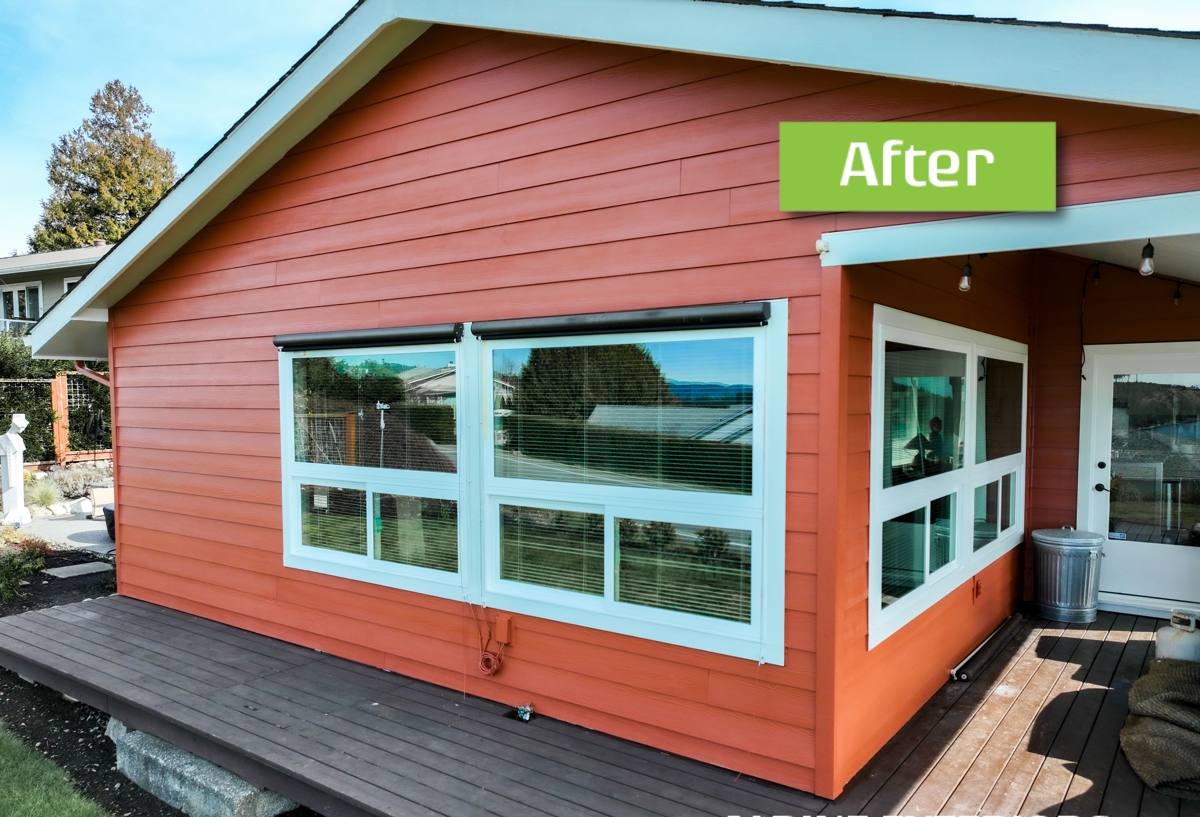
We install James Hardie fiber cement siding exclusively. Not because it's the only siding product sold in Whatcom County, but because after years working on homes exposed to this exact combination of salt air and constant moisture, it's the system that holds up without turning into an ongoing maintenance project.
Dimensionally Stable and Non-Combustible
Fiber cement doesn't swell and shrink with humidity the way wood-based siding does. That stability means fewer nail pops, less movement at the joints, and paint that stays adhered instead of cracking along stress lines. It's also non-combustible, which matters more every year as summer wildfire smoke and dry spells become part of the regional calendar, even out on the water.
Engineered for Marine Climates
James Hardie formulates its siding differently depending on climate zone, under its HZ5 and HZ10 designations. Whatcom County, including Point Roberts, falls into the zone James Hardie engineers for damp, marine-influenced weather — a real difference from a generic product sold the same way in a dry inland climate.
ColorPlus Factory Finish
Instead of relying on field-applied paint that has to cure properly in cold, damp conditions, James Hardie's ColorPlus finish is baked on at the factory under controlled heat and humidity. It resists fading and holds up to salt air longer than a job-site paint job, and it carries its own finish warranty separate from the substrate warranty.
What Correct Installation Looks Like on a Point Roberts Home
Fiber cement siding is only as good as the installation behind it. James Hardie's product warranty depends on the work following their published installation specifications, and in a high-moisture environment, the details that get skipped on a rushed job are exactly the details that cause the earliest failures.
Clearance and Drainage
Siding needs proper clearance from grade, roof lines, decks, and hardscaping — typically several inches minimum — so water has somewhere to go instead of wicking up into the bottom course. On a lot with heavy rain exposure and salt film buildup, skipping this clearance is one of the fastest ways to create a moisture problem behind siding that looks fine from the street.
Fastening and Flashing
Fasteners have to be placed at the correct location and depth — overdriven nails crack the board's edge and create an entry point for water. Flashing at windows, doors, and every horizontal joint needs to shed water outward, not trap it against the wall assembly. This is the step that separates siding that lasts thirty-plus years from siding that needs rework in five.
Caulking and Field Touch-Up
Joints, seams, and any cut edges need the right sealant, applied correctly, and any field-cut edges get sealed with touch-up paint matched to the ColorPlus finish. Left bare, a cut edge is a direct path for moisture into the board core — a small step that gets skipped far too often on jobs done in a hurry.
Choosing the Right Hardie Product Line
James Hardie makes several distinct product lines, and the right choice depends on the home's style and exposure, not just appearance preference.
| Product | Best Use | Notes for This Climate |
|---|---|---|
| HardiePlank Lap Siding | Traditional and craftsman-style homes | Most common choice; wide range of exposures and textures |
| HardieShingle | Accent gables, dormers, cottage-style homes | Gives a cedar-shake look without the moisture and maintenance issues of real shingle |
| HardiePanel | Modern or board-and-batten styles | Clean vertical lines; needs correct batten spacing for drainage |
| HardieTrim | Corners, window and door surrounds, fascia | Matched fiber cement trim avoids the rot common with wood trim in wet climates |
Our Installation Process, Start to Finish
The process is the same discipline on every home, adjusted for the specifics of the site:
- Assessment. We inspect the existing siding, sheathing, and any trouble spots — soft wood, past water intrusion, ventilation issues — before quoting anything.
- Tear-off and sheathing check. Old siding comes off and the sheathing underneath gets inspected and repaired as needed. This is often where hidden moisture damage from a prior installation shows up.
- Weather barrier. A code-compliant water-resistive barrier goes on correctly lapped and sealed, since this layer does as much work protecting the wall as the siding itself.
- Installation to spec. Siding, flashing, and fasteners go in following James Hardie's published requirements, not shortcuts.
- Caulking and finish work. Joints, trim, and cut edges are sealed and touched up to match the factory finish.
- Final walk-through. We review the completed work with the homeowner and register the product warranty.
Why a Crew That Already Works in Point Roberts Matters
Point Roberts is geographically separated from the rest of Whatcom County — reaching it by road means crossing into Canada and back, which affects how any contractor has to plan a job there. Materials, equipment, and crew scheduling all need to account for that in a way a straightforward Ferndale or Bellingham job doesn't require. A crew unfamiliar with that logistics reality tends to underbid the time it takes, then either rush the install or drag it out with delays.
There's also the exposure itself. A home a few blocks from the water on Point Roberts is dealing with a different level of salt and wind-driven rain than a home set back inland, even within the same general region. A crew that's worked multiple projects out there knows to plan installation days around weather windows, knows which details on a marine-exposed wall need extra attention, and isn't learning the local conditions on your project.
Maintenance in a Salt-Air, Moss-Prone Climate
Correctly installed James Hardie siding is low-maintenance, not no-maintenance. A little attention keeps it looking and performing the way it should for decades.
- Rinse siding periodically to remove salt film, especially on walls facing open water
- Keep gutters and downspouts clear so water doesn't overflow onto siding below
- Trim back vegetation and shrubs so walls get airflow and sun exposure, which discourages moss and mildew
- Check caulking at joints and trim annually, and re-seal any cracked or shrunken beads
- Address moss or algae at ground level early with a gentle wash rather than pressure-washing directly at siding joints
- Watch for any soft spots or discoloration low on the wall and have them checked before they spread
Cost Factors for a Point Roberts Siding Project
Every project is different, but a few factors consistently drive cost up or down:
| Factor | Why It Matters |
|---|---|
| Home size and number of stories | More surface area and taller walls mean more material and labor, plus added access requirements |
| Condition of existing siding and sheathing | Hidden rot or moisture damage found during tear-off adds repair scope before new siding goes on |
| Product line and trim detail | HardieShingle accents and custom trim work cost more than straightforward lap siding on a simple elevation |
| Site access and logistics | Point Roberts' location affects delivery scheduling and crew logistics compared to a mainland job |
| Color and finish selection | Standard ColorPlus colors are typically more economical than custom or premium finish options |
We walk through these factors with every homeowner during the estimate so there are no surprises once the work starts.
Get a Free, No-Pressure Estimate
If you're weighing a siding project on a Point Roberts home, we're glad to take a look, explain what we're seeing, and put together a straightforward estimate — no pressure, no obligation. Use the form below to get started.