 Ferndale Siding
 Why Decks Take a Beating in Lummi Nation's Marine Climate
A deck in Lummi Nation lives a harder life than a deck fifty miles inland. Sitting close to the water means salt-laden air settles on every exposed surface, working its way into fastener heads, joist hangers, and any metal hardware that wasn't rated for it. Add Whatcom County's pattern of driving rain — wind-blown moisture that gets pushed sideways under boards and into seams rather than falling straight down — and you have water reaching places it was never supposed to reach. Then there's the moss. Shaded decks, north-facing decks, and anything under tree cover here can grow a moss mat within a season or two, and that moss holds water against the wood far longer than open air ever would.
None of these factors alone destroys a deck quickly. Together, over years, they attack the same weak points: the ledger connection to the house, the tops of joists, fastener heads, and the underside of decking boards where nobody looks until something gives.
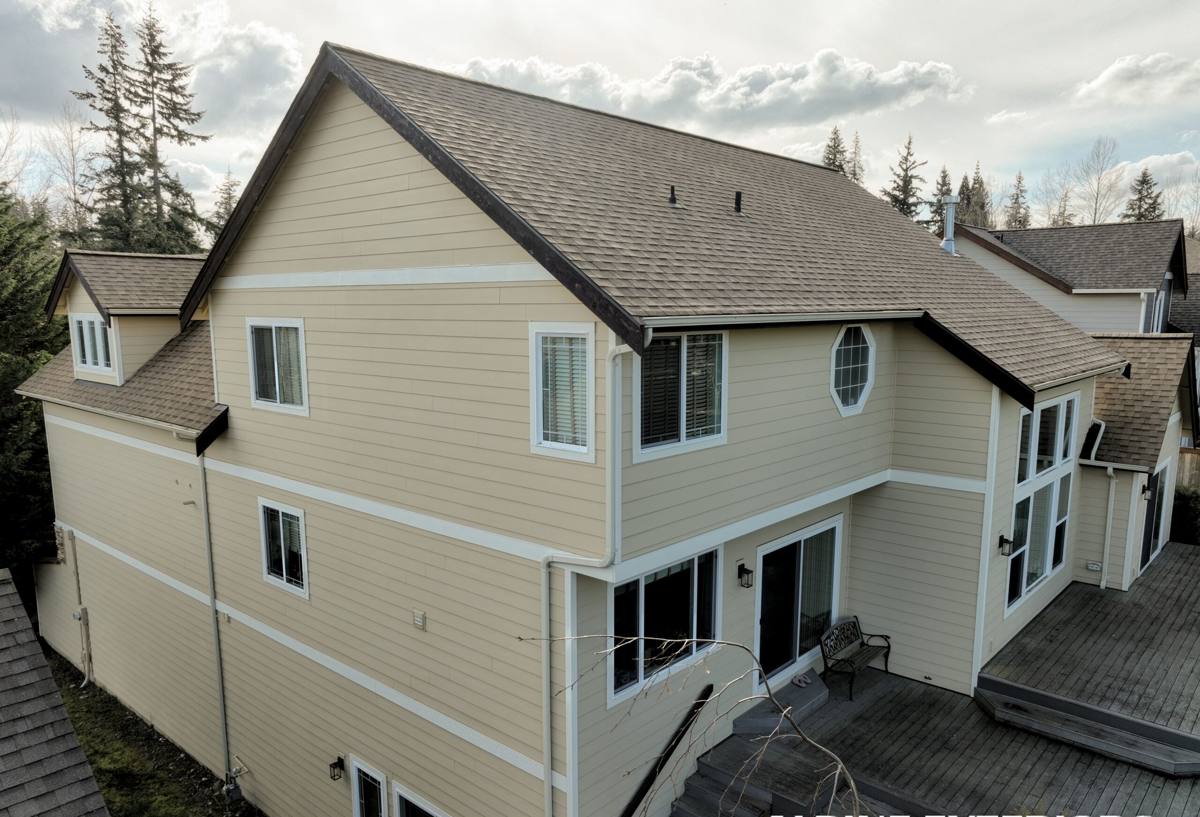
Signs Your Deck Needs Replacing, Not Just Repaired
Soft or spongy boards
If boards flex or feel spongy underfoot, especially near the house or in shaded corners, the wood underneath has already lost structural integrity. Surface staining won't fix that.
Rust streaks and popped fasteners
Rust bleeding out around screw or nail heads is a sign the fastener itself is corroding — common in coastal air when the original hardware wasn't rated for it. Once fasteners start backing out or shearing, the connections they were holding are no longer reliable.
The ledger board — the most common failure point
The ledger is the board that bolts the deck to the house, and it's the single most common place decks fail structurally. If it's been improperly flashed, rain gets trapped between the ledger and the house siding or rim joist for years without any visible sign from the yard. By the time you see staining or soft wood on the interior side, the damage is usually well established.
Moss that keeps coming back
If you've pressure-washed or scrubbed a deck and the moss returns within a few months, that's usually a drainage or airflow problem, not a cleaning problem — and it means moisture is sitting on that wood far more than it should.
What a Correct Deck Replacement Actually Involves
Ledger attachment and flashing
This is where we spend the most care. A correctly replaced deck gets a new ledger bolted (not just nailed) to solid framing, with proper flashing that sheds water away from the house rather than trapping it behind the board. This single detail is responsible for more deck failures — and more deck collapses nationally — than any other part of the structure.
Framing, joists, and footings
Joist sizing, spacing, and span all need to match current code for the loads a deck is expected to carry, not just match what was there before. Footings need to sit below frost depth and bear on undisturbed soil — something worth checking carefully given how variable soil conditions can be from lot to lot in this area.
Fasteners and hardware rated for coastal air
This is one place we won't cut corners. Standard hardware corrodes faster near the water. We use hot-dip galvanized or stainless connectors and fasteners rated for the environment, because replacing a deck only to have hardware fail again in a few years defeats the purpose of the job.
The decking surface itself
Whatever material goes on top needs airflow underneath it, consistent gapping for drainage, and fastening that won't work loose as the boards expand and contract with our wet winters and drier summers.
Choosing Decking Material for This Climate
There's no single "best" decking material — there's a best fit for your budget, your maintenance appetite, and how exposed your deck is to salt air and shade. Here's how the common options actually compare in a coastal Whatcom County setting:
| Material | Moss/Moisture Behavior | Maintenance | Typical Cost Tier |
|---|---|---|---|
| Pressure-treated wood | Absorbs moisture; needs sealing to resist moss and rot | Annual cleaning and re-sealing | $ |
| Cedar | Naturally rot-resistant but still needs upkeep in shaded, damp spots | Periodic oiling/sealing | $$ |
| Capped composite | Sheds moisture well; resists moss better than raw wood or older composites | Occasional rinsing | $$$ |
| PVC decking | Doesn't absorb moisture at all; best resistance to moss and salt staining | Low — rinse as needed | $$$ |
We're honest with clients about trade-offs rather than pushing one product. Composite and PVC cost more upfront but hold up better against the moss and moisture cycle this area produces. Wood costs less initially but asks for more of your time every year to stay ahead of the same conditions.
Permits and Building Within Lummi Nation
Depending on exactly where a property sits, deck replacement work in and around Lummi Nation can fall under Lummi Nation's own land-use and building authority rather than — or in addition to — Whatcom County's permitting process. This matters because it affects setback rules, inspection timing, and what documentation is required before and after the work. We don't guess on this: we confirm which jurisdiction and process applies to a specific property before pulling a permit or starting demolition, and we build to whichever code applies. If you're not sure which authority governs your property, that's something we sort out during the estimate, not something we leave for you to figure out later.
Our Deck Replacement Process
- On-site evaluation — we check the ledger connection, framing condition, footings, and any moss or moisture patterns specific to your lot's sun and wind exposure.
- Tear-off and structural assessment — once the old decking is off, we can see the framing and ledger connection directly, which sometimes reveals more (or less) damage than expected.
- Framing rebuild — joists, beams, and footings brought up to current code and sized for the deck's actual use (grilling area, hot tub, stairs, etc.).
- Ledger flashing detail — new ledger board, correctly bolted and flashed against the house.
- Decking install — your chosen material, fastened and gapped for proper drainage and airflow underneath.
- Railings and stairs — built or rebuilt to current code height and spacing requirements.
- Final walkthrough — we go over the finished deck with you, including what maintenance (if any) your chosen material needs going forward.
Railings, Stairs, and Guarding — Getting the Safety Details Right
Guardrail height, baluster spacing, and stair stringer support are code items, not style preferences, and they're the parts of a deck most likely to matter in an accident if they're wrong. Current code generally calls for guard height in the 36–42 inch range depending on use, baluster gaps that won't pass a 4-inch sphere, and stair stringers sized and supported to carry real foot traffic, not just look finished. On a replacement, this is the moment to fix any older deck that was built to a lighter, outdated standard — something we flag during the initial evaluation rather than after the fact.
Maintenance After Replacement
Whatever material you choose, a little seasonal attention goes a long way in this climate. After your new deck is in, we recommend:
- Rinsing salt residue off the surface and railings a few times a year, more often if the deck faces open water or prevailing wind
- Clearing leaves, needles, and debris from between boards before they trap moisture through fall and winter
- Checking shaded or low-airflow corners for early moss growth before it establishes
- Inspecting visible fasteners and hardware annually for early rust or loosening
- Keeping gutters and downspouts near the deck clear so runoff isn't draining straight onto or under it
Why Hire a Crew That Already Works in Lummi Nation
A deck built to a generic standard doesn't hold up the same way here as it would inland. Knowing which corners of a property catch the worst wind-driven rain, which fastener grades actually last near the water, and which jurisdiction's permitting process applies to a given lot isn't something you learn from a manual — it's something you learn from doing this work in this specific area, repeatedly. That local knowledge is what separates a deck that needs attention again in five years from one that's still solid in twenty.
If your deck is showing soft spots, recurring moss, or rust around the fasteners, we're happy to take a look and give you an honest read on whether it needs full replacement or just targeted repair. Reach out for a free, no-pressure estimate — the form below gets you started.