 Ferndale Siding
 Siding That Actually Fits Lynden's Climate
Lynden sits inland from the coast in the Nooksack Valley, which means it escapes some of the direct salt spray that hits homes closer to Bellingham Bay and the Ferndale shoreline. But inland doesn't mean dry. Whatcom County as a whole gets a long, wet fall-through-spring stretch, humid summers off the surrounding farmland, and enough shade and moisture around mature landscaping to keep north-facing walls damp for days after a storm. Add the seasonal moss and algae growth that shows up on siding, roofs, and fences across this part of the county, and you have a climate that is genuinely hard on exterior materials — even ones that look fine from the street.
Wood-based and foam-backed siding products are especially vulnerable here. They can look acceptable for a few years while moisture quietly works into seams, fastener holes, and butt joints. By the time paint is peeling or boards are soft to the touch, the damage is usually already into the sheathing. That's the core reason we standardized on James Hardie fiber cement for every home we side, including the ones we work on around Lynden.
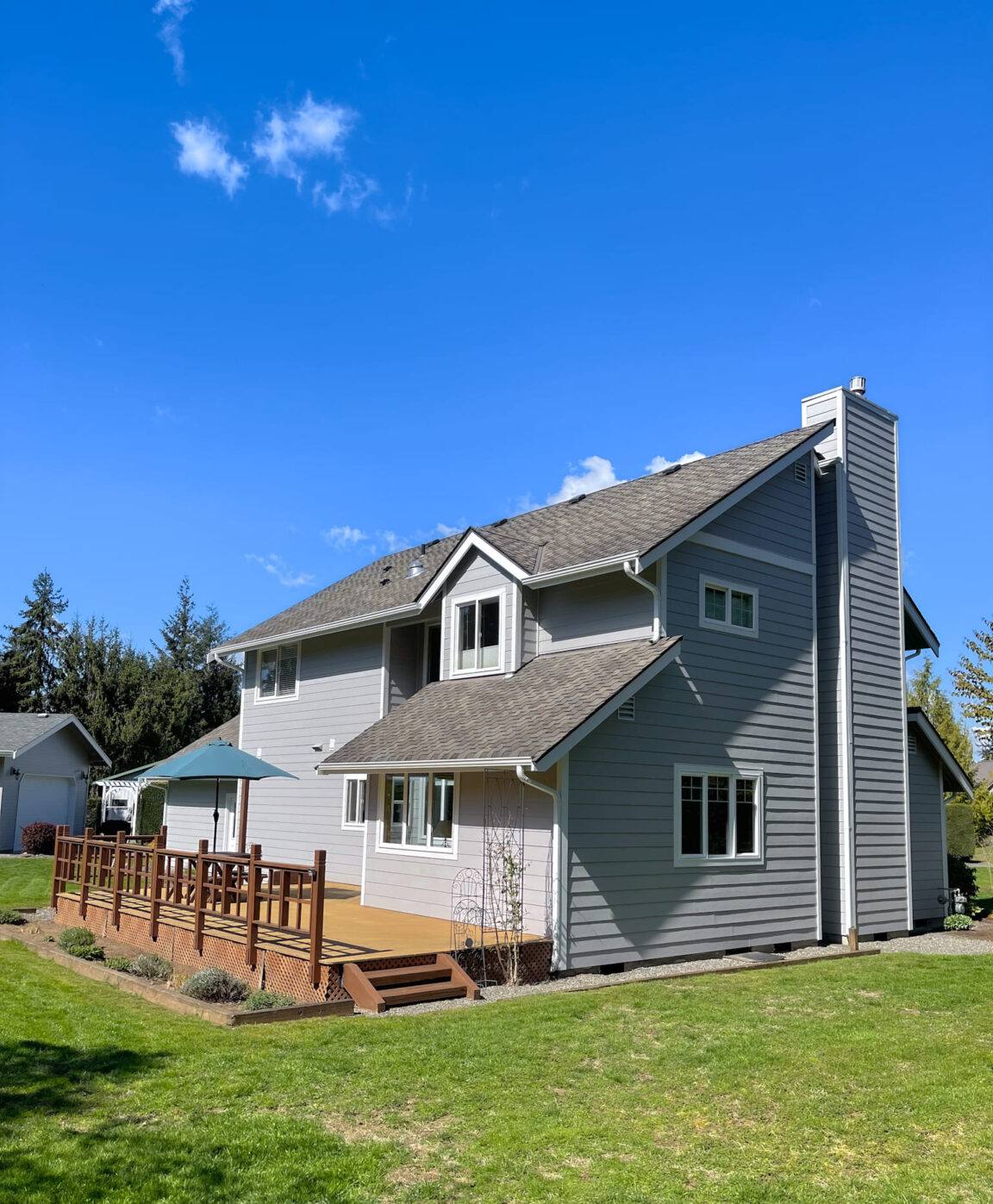
Why James Hardie Fiber Cement Holds Up Here
James Hardie siding is cement, sand, and cellulose fiber, cured into a rigid board. It doesn't absorb water the way wood or wood-composite products do, it won't rot, and it's non-combustible — which matters given how often this region sees dry-season wildfire smoke drift in from the interior even though local fire risk is lower than east of the Cascades. For a Lynden property, the practical benefits are simpler than the chemistry:
- It doesn't swell, cup, or delaminate when it takes on repeated rain cycles.
- It holds paint and factory finish far longer than wood siding exposed to the same moisture load.
- It resists pest damage — carpenter ants and moisture-loving insects that go after untreated wood siding aren't a concern with fiber cement.
- It's dimensionally stable through the region's temperature swings, so caulk joints and butt seams stay tight instead of opening up and letting water in.
James Hardie also builds its products in engineered lines matched to specific climate zones (HZ5 and HZ10 designations) rather than shipping one generic board everywhere. For Western Washington, that means a formulation designed around sustained moisture exposure and freeze-thaw cycling, not a board optimized for a dry climate and shipped here anyway.
ColorPlus Finish vs. Field-Painted Siding
Most Hardie boards installed in this region use the factory ColorPlus finish rather than site-applied paint. It's baked on in a controlled environment, which gives more even coverage and a stronger bond than paint rolled or sprayed on-site in variable weather. In a climate where a fresh paint job can face rain within days of being applied, that difference shows up in how the finish ages over the following decade — less fading, less need for early repainting, and touch-up product available that's color-matched instead of guessed.
What a Correct Installation Actually Involves
The board itself is only part of what makes siding perform. Most siding failures we're called out to inspect — on any brand — trace back to installation shortcuts, not the material. A correct James Hardie install on a Lynden home includes:
- Proper water-resistive barrier: a continuous weather barrier behind the siding, lapped correctly so water sheds outward, not into the wall assembly.
- Rainscreen or drainage gap where called for: a small air gap behind the siding lets any moisture that does get past the cladding drain and dry out instead of sitting against the sheathing.
- Correct fastener pattern and spacing: Hardie specifies exact nailing patterns, edge distances, and fastener types by product line — deviating from spec voids warranty coverage and creates weak points.
- Flashing at every penetration: windows, doors, hose bibs, light fixtures, and roof-to-wall intersections all need properly integrated flashing, not just a bead of caulk.
- Correct clearances: minimum gaps from grade, roofing, decks, and other transitions so the siding never sits in standing water or trapped debris — a common issue where landscaping has grown up against a wall over the years.
- Factory-cut and sealed edges: cut ends primed or sealed per Hardie's instructions so raw fiber cement isn't left exposed to weather.
Skip any one of these steps and you can end up with a wall that looks like a correct Hardie install from the curb but fails the same way a poorly installed wood or vinyl wall would — the material gets blamed for a workmanship problem.
Our Process, Start to Finish
We keep the process the same on every Lynden job, whether it's a full re-side or a targeted repair section:
- On-site assessment. We walk the exterior, check current siding and trim condition, look at moisture-prone areas (north walls, areas under overhangs, spots near sprinklers or dense landscaping), and note anything the existing wall assembly needs before new siding goes on.
- Detailed measurement and product selection. We measure for an accurate material takeoff and go over Hardie product lines, profiles, and ColorPlus color options that fit the home.
- Written estimate. Scope, product line, color, trim details, and price laid out clearly before any work is scheduled.
- Tear-off and substrate check. Old siding comes off, and we inspect the sheathing underneath for rot or hidden moisture damage before anything new goes up — this step is where problems from a prior installation usually surface.
- Weather barrier and flashing. House wrap, flashing at every window, door, and penetration, and drainage detailing installed to spec.
- Hardie board installation. Panels or lap siding installed with correct fastener spacing, clearances, and joint treatment.
- Trim, caulking, and touch-up. Color-matched caulking and touch-up paint at cut edges and seams.
- Final walkthrough. We go over the finished work with the homeowner before calling the job complete.
Choosing a Hardie Profile for a Lynden Home
James Hardie offers several board profiles, and the right one depends on the home's architecture and the homeowner's preference — not on climate performance, since all standard lines are built for this region. Common choices we install:
| Profile | Look | Typical Use |
|---|---|---|
| HardiePlank lap siding | Traditional horizontal board | Most common choice for farmhouse, craftsman, and traditional exteriors |
| HardiePanel vertical siding | Clean vertical panels, often with battens | Board-and-batten look, accent walls, gables |
| HardieShingle | Staggered or straight-edge shingle profile | Cottage or shingle-style homes, accent gables |
| HardieTrim | Fascia, corner boards, window and door trim | Paired with any of the above for a finished look |
Cost Factors Homeowners Should Understand
We don't quote prices without seeing the house, but the factors that move a Lynden siding estimate up or down are consistent from job to job:
| Factor | Why It Matters |
|---|---|
| Substrate condition | Rotted sheathing found at tear-off adds repair scope before new siding can go on |
| Home size and wall complexity | More corners, gables, and trim detail mean more labor and cut waste |
| Profile and trim choice | Shingle-style and heavy trim packages cost more in labor than plain lap siding |
| Color | Standard ColorPlus colors are typically more economical than custom or premium finishes |
| Access and site conditions | Fencing, landscaping, and multi-story sections affect staging and labor time |
Signs an Older Lynden Home Needs Attention
A lot of the calls we get in this area involve homes with wood or older composite siding that's showing its age. Common issues we find during inspections:
- Persistent moss or algae staining that keeps returning within a season of cleaning, usually a sign moisture is retained in the material itself.
- Soft or spongy spots when pressed, especially near the bottom courses and around window sills.
- Paint that's failing faster than expected, particularly on shaded or north-facing walls.
- Visible gaps at butt joints or corner boards where caulk has cracked and pulled away.
- Staining or discoloration below window and door trim, which often points to a flashing failure rather than a surface problem.
None of these are unique to Lynden, but the combination of persistent moisture and a long moss season makes them show up sooner here than in a drier climate.
A Homeowner's Checklist Before Hiring
Whether you call us or another crew, these are worth confirming before signing a siding contract:
- Is the installer specifically experienced with James Hardie's fastening and flashing requirements, not just "siding" in general?
- Does the written estimate specify the exact Hardie product line and profile, not just "fiber cement"?
- Will they inspect and address sheathing condition before installing new siding, not just cover it up?
- Is a drainage plane or rainscreen detail included where the home's exposure calls for it?
- Does the quote include proper flashing at all windows, doors, and penetrations as a line item, not an assumption?
- What does the manufacturer's warranty cover, and does it require a certified or approved installer to remain valid?
Why Local Installation Experience Matters
A crew that regularly works in Whatcom County knows to plan around this region's rain windows, knows which wall orientations on a given lot tend to hold moisture longest, and isn't guessing at flashing details for the first time. That experience shows up in the small decisions made on-site — where to add extra flashing, how tight to run a drainage gap, which corners need extra attention — that a generic install crew working from a different climate might skip entirely. It's also why we don't spread ourselves across five different siding products: sticking to one system, installed the same correct way every time, is how quality stays consistent from house to house.
If you're planning a siding project for a Lynden home and want a straight answer about what your walls need, we're glad to take a look. Reach out for a free, no-pressure estimate — we'll walk the exterior with you, explain what we find, and give you a clear, honest quote before any work begins.