 Ferndale Siding
 Why Fiber Cement Siding Makes Sense for Sumas Homes
Homes in and around Sumas sit in a part of Whatcom County where the weather doesn't let up for long. Winters bring weeks of steady rain, spring and fall carry heavy dew and fog off the lowland fields and river valleys, and the shaded, tree-lined lots common in this area stay damp long after a storm has passed. That combination is hard on siding that wasn't built to handle repeated wetting and drying cycles. Fiber cement holds up to that pattern in a way that wood, vinyl, and OSB-based composite products generally don't, which is why it's become the standard choice for homeowners in this part of the county who are replacing siding for the long term rather than patching it every few years.
This page is specifically about fiber cement siding installation for homes in the Sumas area near Ferndale. It's not a general overview of siding options — it's a look at what this climate does to exterior walls here, what a correct fiber cement job actually involves, and why the installation details matter as much as the product itself.
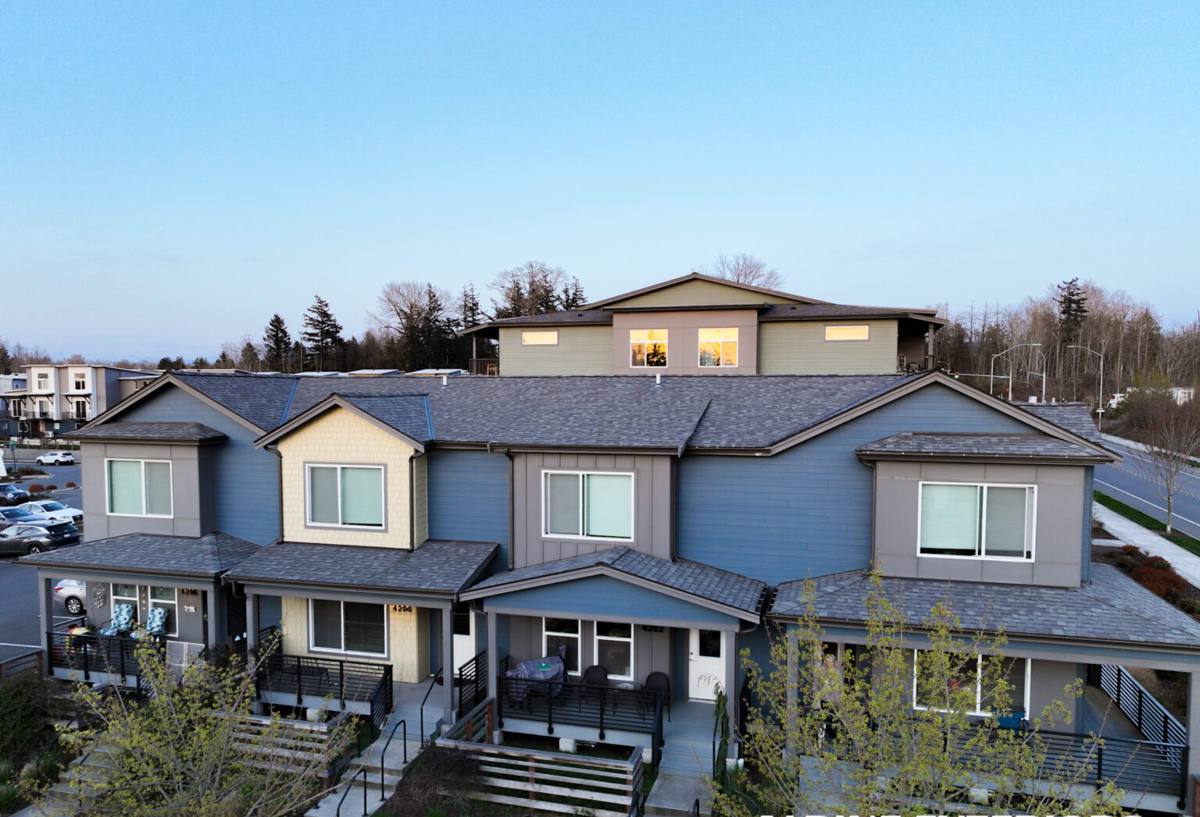
What Whatcom County Weather Does to Siding Over Time
Whatcom County sits under a marine-influenced weather pattern — moist air moves in off the Salish Sea and settles across the lowlands, carrying salt-laden humidity further inland than most homeowners expect. Add in driving rain that hits siding at an angle during winter storms, and you get two problems working together: constant moisture exposure and constant pressure to keep that moisture from finding a way behind the siding.
The other factor that's specific to this region is moss. Whatcom County's moss season runs long — often eight months or more where shade, tree cover, and consistent moisture overlap, which describes a lot of residential lots in and around Sumas. Moss and algae don't just grow on roofs. They colonize the horizontal ledges of lap siding, the tops of trim boards, and any spot where water sits instead of shedding. Over time that growth holds moisture against the siding surface far longer than open air ever would.
Why This Matters for Material Choice
Wood siding and OSB-based composite siding are both organic, wood-fiber products. When they stay wet for extended periods — which is exactly what happens under moss growth or behind poorly lapped boards — they're vulnerable to swelling, delamination, and rot. Vinyl doesn't rot, but it flexes and gaps with temperature swings and doesn't hold paint, so it fades and can't be refreshed later. Fiber cement is a cement-and-sand composite, not a wood product, so it doesn't feed rot the same way and it holds a factory finish far longer than field-applied paint on wood.
Why We Only Install James Hardie Fiber Cement
We install James Hardie fiber cement exclusively — no LP SmartSide, no vinyl, no primed cedar or spruce, and no off-brand fiber cement. That's a deliberate standard, not a sales pitch. Hardie's ColorPlus factory finish is baked on and warranted against peeling and cracking in a way field-applied paint can't match, which matters directly in a climate where repainting siding every few years isn't realistic for most homeowners. Hardie also engineers specific product lines for different climate zones (HZ5 for our region), which affects how the board is formulated to handle moisture cycling. We've seen enough of the alternatives fail early in this specific climate that we don't offer them — we'd rather do one product well than several products poorly.
What Correct Fiber Cement Installation Actually Involves
Fiber cement siding is only as good as the installation behind it. The board itself resists moisture and rot well, but a sloppy install can undercut all of that. In a climate like ours, these details aren't optional extras — they're the difference between siding that lasts decades and siding that fails at the seams in five to ten years.
- Correct water-resistive barrier (house wrap) installed and lapped properly before any siding goes up, with flashing integrated at every window, door, and penetration
- Minimum clearance gaps at the bottom of the siding and around all trim, so water has somewhere to drain instead of wicking into end grain
- Proper fastener placement and spacing per Hardie's installation specification — not just "close enough," since incorrect nailing is one of the most common causes of early failure
- Butt joints caulked or flashed correctly, and never face-nailed without backing
- Factory-cut and factory-primed edges kept intact wherever possible, with field-cut edges sealed per spec
- Rain screen or drainage plane detailing appropriate to wall assembly, especially on shaded or low-airflow elevations
This is also where moss resistance actually gets built into a job. Moss doesn't grow because of the siding material alone — it grows where water sits. Correct flashing, drainage gaps, and joint sealing keep water moving off the wall instead of pooling behind trim and horizontal laps, which is where moss and algae get their foothold in the first place.
Choosing the Right Product Line and Profile
James Hardie makes several siding profiles — lap siding in various exposures, shingle-style panels, and vertical board-and-batten — all available in the HZ5 formulation engineered for our climate zone. For most homes in the Sumas area, we look at:
- Exposure width and existing home style, so the new siding reads correctly on the house rather than looking generic
- Roof overhang depth and elevation exposure, since walls with minimal overhang or that face prevailing wind and rain need more attention to flashing detail regardless of product line
- ColorPlus finish selection — factory-applied color holds up to UV and moisture far better than field paint, and it comes with its own finish warranty
Cost Factors for a Sumas-Area Siding Project
Every home is different, so we don't quote firm numbers without seeing the property, but the factors that move a fiber cement project up or down in cost are consistent. This table covers what typically has the biggest impact.
| Factor | Why It Matters |
|---|---|
| Amount of existing damage or rot | Hidden sheathing damage found once old siding comes off adds repair scope before new siding can go on |
| Home size and wall complexity | More corners, gables, and trim detail mean more cutting, fitting, and labor time |
| Siding profile and exposure chosen | Wider exposures install faster; narrower traditional exposures take more boards and more labor |
| Trim and accessory scope | Full trim replacement, fascia work, and soffit repair add cost beyond field siding alone |
| Site access | Steep lots, limited driveway access, or heavy landscaping close to the house slow staging and setup |
| Story height | Two-story walls require additional scaffolding or lift equipment compared to single-story elevations |
The honest range for a full fiber cement re-side varies widely based on these factors, which is why we walk the property before giving a number rather than quoting off square footage alone.
Signs Your Current Siding May Be Failing
Homeowners in this area often call us after noticing a specific problem rather than planning ahead, so it helps to know what to look for before small issues become structural ones.
- Persistent moss or algae staining that comes back within weeks of cleaning
- Soft or spongy spots when pressed, especially near the bottom of walls or below windows
- Paint that's peeling, bubbling, or chalking heavily rather than just fading
- Visible gaps or warping at board joints and corners
- Water stains or discoloration on interior walls near exterior corners, which often points to siding-level moisture intrusion
- Siding that feels noticeably cold or damp to the touch compared to surrounding areas, suggesting trapped moisture
Any one of these on its own isn't necessarily an emergency, but they're worth having looked at before the next wet season, since damage behind siding tends to compound quietly.
Our Process, From Estimate to Finished Siding
We keep the process straightforward and communicate clearly at each stage, since re-siding a home is disruptive enough without added uncertainty.
- Free on-site walkthrough to assess current siding condition, wall assembly, and any visible moisture or rot issues
- Written estimate covering product line, profile, color, trim scope, and a clear cost breakdown
- Removal of existing siding with a check for hidden sheathing damage before new materials go up
- House wrap and flashing installed correctly at every window, door, and penetration before siding begins
- Hardie fiber cement installed to manufacturer spec, including fastener pattern, clearances, and joint treatment
- Final walkthrough with the homeowner to review the finished work before we consider the job complete
Why Hiring a Crew That Already Works in Sumas Matters
Siding installation looks similar on paper everywhere, but the details that keep a wall dry are regional. A crew that's used to installing in a drier climate may not think twice about clearance gaps or drainage detailing that matters far more here, where wet weeks stack up back to back and moss has months to establish itself on any surface that stays damp. Working regularly in the Sumas and greater Ferndale area means we're accounting for the local rain patterns, shaded lot conditions, and moss pressure as a matter of course, not as an afterthought. That familiarity shows up in details like flashing choices, gap spacing, and where we pay extra attention on north-facing or heavily shaded walls — the kind of judgment calls that don't show up on a spec sheet but make the difference between siding that looks good for a season and siding that holds up for decades.
If your Sumas-area home needs new siding — or you're not sure whether your current siding is holding up the way it should — we're happy to take a look and walk you through what we see, with no pressure to move forward. Fill out the form below to request a free estimate.